

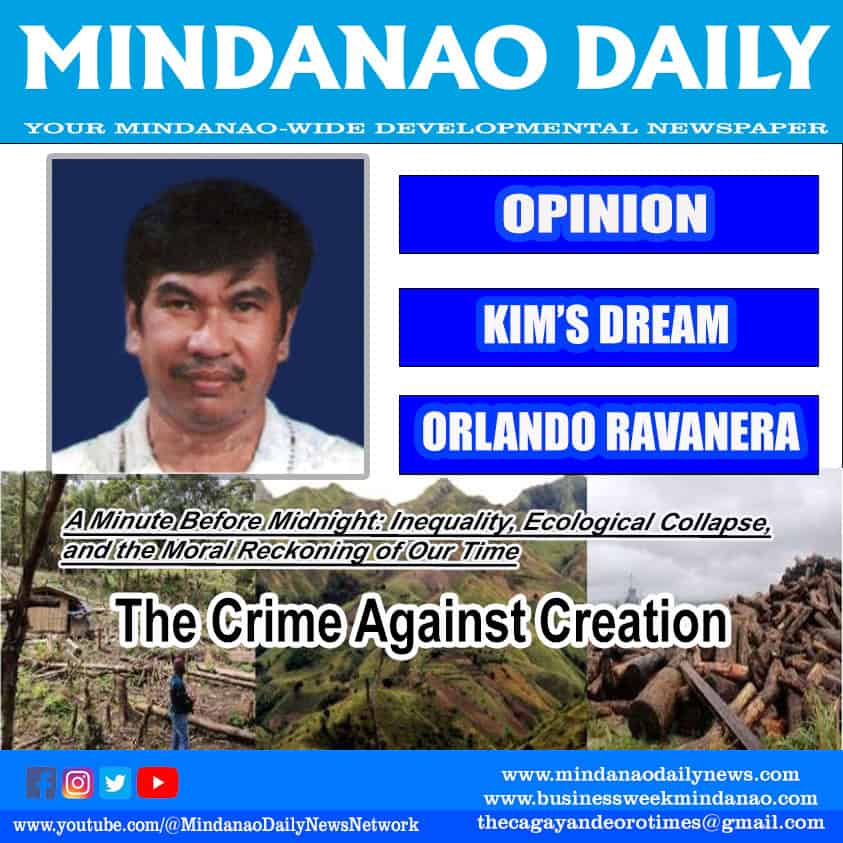
A Minute Before Midnight: Inequality, Ecological Collapse, and the Moral Reckoning of Our Time
Kim’s Dream Orlan Ravanera
We live in a profoundly complex and deeply unjust world. Unimaginable wealth exists side by side with unbearable poverty, extreme inequality, and widespread human suffering. Nowhere is this contradiction more glaring than in the United States, still the richest country on Earth. Yet in this land of abundance, the combined wealth of a handful of the richest individuals exceeds that of the bottom half of the population. Even more disturbing, the top one percent controls more wealth than the bottom ninety-nine percent combined. This is not a natural accident; it is the result of a system designed to concentrate power, resources, and privilege in the hands of the few.
Renowned intellectual Noam Chomsky has repeatedly described this reality with chilling clarity. Millions of Americans struggle with unemployment or precarious work. Tens of millions rely on food stamps just to survive. Every thirty minutes, an American takes own life, an alarming indicator of a society in deep moral and psychological crisis. Despite its wealth, the United States leads the world in incarceration and violent crime, not because of a lack of resources, but because of a social order hollowed out by greed, inequality, and moral decay.
Religious and spiritual leaders around the world have rightly condemned this grotesque imbalance as absolutely immoral. They point not to personal failure, but to what they call bad economics, a system rooted in exploitation and enforced globally through what many describe as modern-day American imperialism. This imperial system is sustained by corporate power, militarism, and political dominance. It controls a massive share of the world’s resources, including the richest oil reserves in the Middle East. Through a small number of oil corporations, it generates trillions of dollars annually, profits so vast that environmental destruction becomes merely collateral damage. With such wealth at stake, there is no real incentive for those in power to reduce greenhouse gas emissions or shift away from fossil fuels. The slow death of Mother Earth is treated as an acceptable cost of doing business.
As a result, humanity now finds itself in a full-blown climate emergency, an existential crisis that has thrown our species into survival mode. At the root of this crisis lies an economic system that worships endless growth, profit, and consumption, regardless of the consequences. This paradigm sacrifices both people and planet. It is like a staggering giant, unbalanced and frenzied, trampling forests, rivers, oceans, farmlands, and entire communities in its desperate attempt to remain upright. In its wake, it leaves devastation, displacement, and despair.
This harsh reality is painfully evident in our own country. Once blessed with extraordinary natural wealth, the Philippines has been systematically plundered. Our forests have been stripped, our rivers poisoned, our mountains carved open by mining, and our seas overfished. Our people remain poor not because we lack resources, but because those resources have been captured by powerful elites, often in collaboration with foreign interests. This is not accidental; it is deliberate exploitation, driven by a belief that war, extraction, and domination are necessary for economic health. History offers grim lessons. When U.S. President John F. Kennedy sought to de-escalate the Vietnam War, he was assassinated. Later investigations suggested that powerful interests linked to intelligence agencies and weapons manufacturers profiting enormously from war had much to lose from peace. War, after all, has long been described as the health of the nation for imperial economies.
Today, under leaders who deny climate science and openly govern for the ultra-rich, the same destructive playbook continues. Reckless nationalism, corporate greed, and political narcissism have pushed the world closer to environmental collapse and even nuclear catastrophe. The warnings of scientists, activists, and spiritual leaders grow louder by the day. We are told, time and again, that if we fail to act now, the damage may soon become irreversible. This crisis is not only political or economic; it is profoundly moral and spiritual. Humanity’s obsession with consumerism, despite its technological achievements, has brought us to the brink of ecological collapse. We have mistaken material progress for human flourishing, forgetting that no economy can survive on a dead planet. For us Filipinos, the question becomes urgent and unavoidable: Progress for whom? Growth for what?
In our country, so-called “development” has benefited only a privileged few powerful oligarchs who control land, energy, finance, and politics, while the majority are left behind. What we experience is not true peace, but what Dr. Martin Luther King Jr. once called negative peace: the absence of open conflict, but the presence of injustice. It is a peace that silences dissent while poverty deepens, ecosystems collapse, and communities suffer. This is especially evident in Mindanao, an island as wounded as it is beautiful. Here, Indigenous Peoples, farmers, and poor communities are pushed to the margins. Their ancestral lands are seized. Their voices are ignored. Power is concentrated in the hands of a few who manipulate laws and institutions for personal gain. Corruption thrives, inequality widens, and dignity is stripped from entire communities.
Negative peace is fragile. When injustice is ignored, it festers. When voices are silenced, anger grows. When greed reigns unchecked, conflict becomes inevitable. That is why restoring balance between economy and ecology is no longer optional; it is a matter of survival. Material progress alone cannot heal the collective stress, rage, and despair of a wounded society. World leaders often declare; it is our duty to save the Earth. Yet such statements ring hollow. Not all have benefited from the world’s resources only a few have, often through exploitation and violence. Millions of Filipinos are still waiting for justice, dignity, and a fair share of the Earth’s gifts. What we need is not empty rhetoric, but just, inclusive, and sustainable progress development that serves the people and heals the planet.
Environmentalists now warn that we are living “one minute before midnight.” Climate disasters intensify. Rainforests burn. Ice caps melt. Seas rise. Mass extinction accelerates. Hundreds of millions face displacement as climate refugees. The ecological threshold has been crossed, and the economic system driving this destruction remains largely unchanged. Even the late Pope Francis has called out these glaring and scandalous inequalities, urging humanity to break free from structures of oppression. Yet despite countless summits and promises, greenhouse gas emissions continue to rise. The planet burns while leaders talk.
It took a teenager, Greta Thunberg, to pierce the world’s conscience. Standing before global leaders, she spoke with moral clarity: our civilization is being sacrificed so a few can profit. Her words ignited a global movement, yet still, fossil fuel dependency continues, and coal plants rise even here in Mindanao. Why are six coal-fired power plants allowed to operate in a region already vulnerable to climate impacts? Why do politicians prioritize corporate interests over public health and ecological survival? The answer is disturbing but clear: many are backed by loggers, miners, and powerful business interests.
I witnessed this reality firsthand in the 1990s, when we formed human barricades against illegal logging and mining. One shipment of logs could generate hundreds of millions of pesos money shared among politicians, enforcers, and elites. When illegal miners were arrested, they were quickly freed. When Indigenous leaders resisted, some paid with their lives. The murder of Datu Fausto Orasan remains a painful symbol of a justice system that protects the powerful and abandons the vulnerable. This is not only a climate crisis. It is a crisis of justice, truth, and moral courage.
The time for denial is over. The time for silence is over. Filipino voters must awaken. We must demand clear, concrete, and courageous action from our leaders. We must resist systems that profit from destruction and choose a future rooted in compassion, equity, and respect for life. Let our outrage be so loud it cannot be ignored. Let our love for Mother Earth guide our resistance. This is the struggle of our time, and the clock is ticking. MAHALIN NATIN ANG ATING INANG KALIKASAN KUNG SAAN NAGMUMULA ANG BUHAY. All for God’s greater glory.
###