
The City’s Stewards: Mayors Who Shaped Cagayan de Oro
From the Sidelines
By: Ray G. Talimio Jr.
“Chronicling the leadership styles, achievements, and legacies of Cagayan de Oro’s mayors across decades, and how their governance shaped the city’s political, social, and economic transformation.”
The history of Cagayan de Oro is inseparable from the vision and resolve of its mayors. Each administration brought with it a new set of priorities and challenges, from rebuilding after war to modernizing infrastructure and steering economic growth. As the city celebrates its 75th Charter Anniversary, we reflect on the leadership legacies that helped shape its identity and progress.
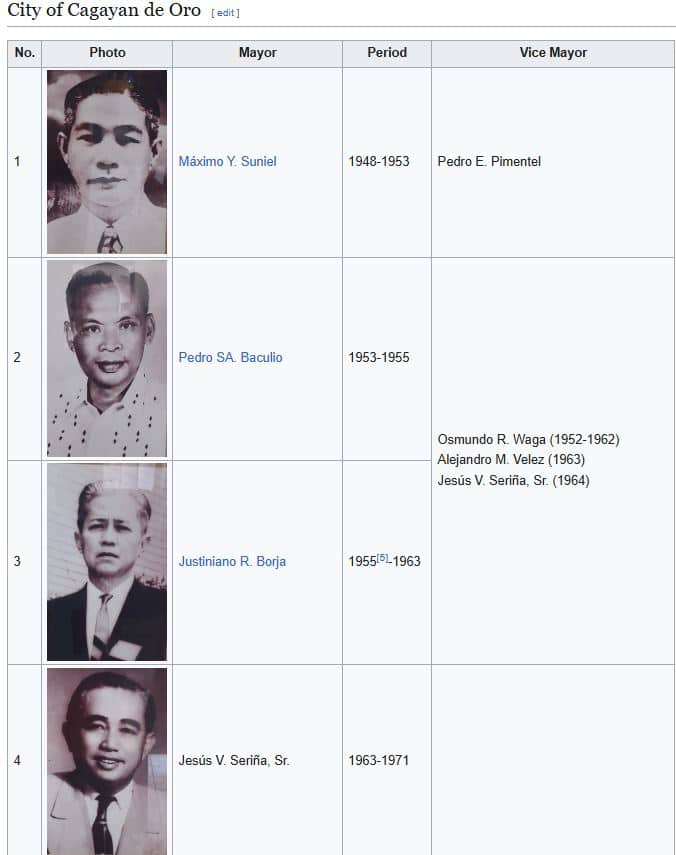
Vicente Y. Ysalina served as mayor from 1948 to 1950, prior to formal cityhood. His leadership during the postwar period helped lay the administrative and legislative foundation for Cagayan de Oro’s transformation into a chartered city in 1950.
Max Y. Suniel served as the first mayor of chartered Cagayan de Oro from 1950 to 1953. His administration laid the groundwork for transforming the former municipal district into a full-fledged city. He is recognized for institutionalizing local offices under the new charter.
Pedro SA. Baculio served as mayor from 1953 to 1955. He had earlier championed the cityhood bill in Congress and was a sitting Congressman when he filed House Bill No. 54 in December 1949, which became Republic Act No. 521. Though his mayoral term was brief, his authorship of the charter law remains a defining legacy.
Justiniano R. Borja, fondly called El Maestro, served from 1955 to 1963 and left a legacy of ethical leadership and inclusive governance. He was known for his accessibility to the masses and straightforward style of public service. His monument at Plaza Divisoria remains a city landmark, symbolizing good governance.
Jesús V. Seriña Sr. served as mayor from 1963 to 1971. He focused on urban planning, land use management, and further institutionalized the city’s administrative functions during a period of national transition.
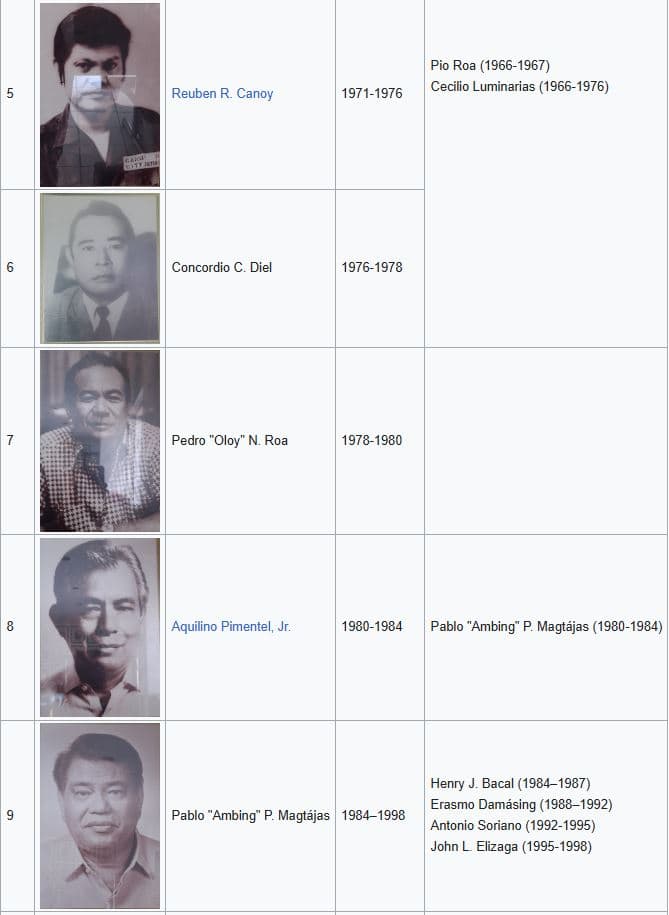
Reuben R. Canoy, an intellectual and writer, served from 1971 to 1976. He championed local autonomy and cultural identity, later becoming a strong advocate for Mindanao independence. His leadership helped spark a political awakening in the region.
Concordio C. Diel (1976 to 1978) presided over the city during a politically restrained period under martial law. His administration emphasized bureaucratic continuity while navigating the limitations of centralized governance.
Pedro “Oloy” N. Roa (1978 to 1980), remembered for his civic generosity, served a brief but active term. The family’s legacy is visible in schools, roads, and programs that carry the Roa name.
Aquilino “Nene” Q. Pimentel Jr. served as mayor from 1980 to 1984, remembered for his principled governance and courageous opposition to martial law. His legal mind and advocacy for democracy brought national attention to Cagayan de Oro and helped lay the groundwork for the eventual passage of the Local Government Code of 1991.
Pablo “Ambing” Magtajas succeeded Pimentel and served as mayor from 1984 to 1998, a span that covered the final years of the Marcos regime and the post-EDSA democratic transition. His three elected terms following the 1988 local elections were marked by urban development, strong public engagement, and investment in education. Known for his accessible leadership, he fostered partnerships with barangays and oversaw important infrastructure improvements.
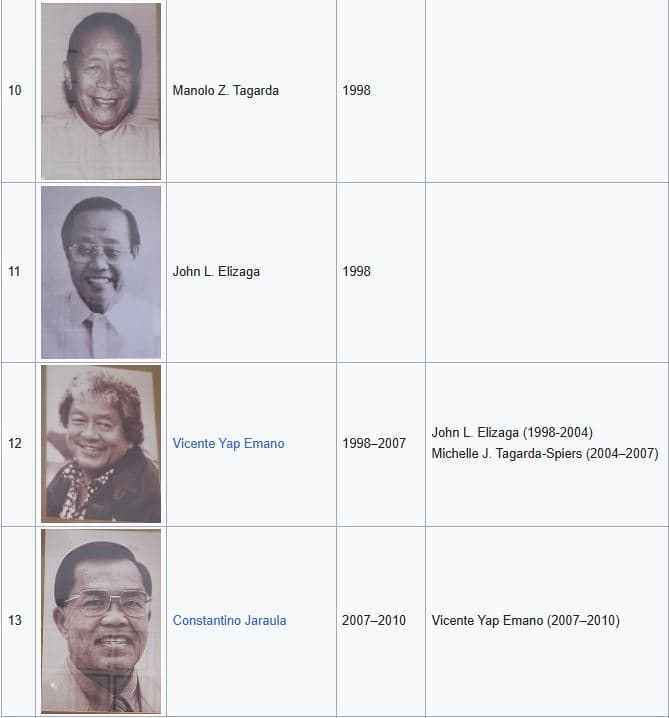
Manolo Z. Tagarda briefly assumed office in 1998 following Magtajas’ final term. His short stint coincided with the election transition period that ushered in a new political era.
John L. Elizaga also briefly served as caretaker mayor in 1998 before the elected mayor officially took office. These transitions reflected the political maneuvering and electoral volatility of the post-EDSA period.
Vicente “Dongkoy” Y. Emano assumed the mayoralty later in 1998 and served until 2007, then returned from 2010 to 2013. Known for his populist approach, Emano championed pro-poor programs, mass housing projects like the relocation sites in Calaanan, and the establishment of the JR Borja General Hospital. His administration was both admired for grassroots appeal and criticized for disaster risk handling, particularly during Typhoon Sendong.
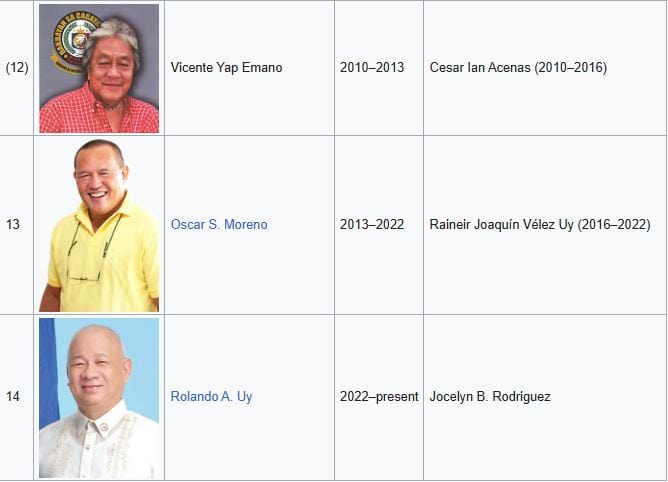
Constantino “Tinnex” G. Jaraula, former Congressman, served as mayor from 2007 to 2010. His tenure emphasized tourism promotion, cultural heritage, and city beautification. He initiated events like the Kagay-an Festival and supported efforts to revive historical identity and civic pride.
Oscar S. Moreno, former governor of Misamis Oriental, was elected mayor in 2013 and served three full terms until 2022. He emphasized good governance, transparency, and infrastructure rehabilitation. His administration strengthened public education through the “Schools Build Schools” program, expanded road networks, invested in health and disaster preparedness, and professionalized local bureaucracy.
The current mayor, Rolando “Klarex” Uy, assumed office in 2022. Known for his grassroots appeal and long tenure as Congressman of the city’s First District, Mayor Uy has focused on market redevelopment, improved waste management, and solutions to traffic congestion. His mass-oriented programs, including the regular People’s Day and Klarex nga Serbisyo sa Barangay (KSB), have reinforced his reputation as a mayor who listens and delivers directly to the people. These initiatives provide accessible government services at the barangay level, addressing health, social welfare, and livelihood needs. In parallel, Mayor Uy maintains an excellent relationship with the business sector, which he regards as a critical partner in the city’s economic development and job creation. His term coincides with the city’s 75th Charter Anniversary, balancing commemoration with forward-looking programs aimed at inclusive urban transformation.
As we look back on these mayors and their respective terms of service, we find that the city’s growth is a story of evolving leadership. From Borja’s principled simplicity to Emano’s mass housing, from Moreno’s systemic reforms to Uy’s people-first approach, each mayor has left an indelible mark on the cityscape and citizenry.
These leaders navigated postwar recovery, dictatorship, democratization, decentralization, and globalization. Their cumulative legacies are visible in public infrastructure, urban zoning, market centers, schools, and even the collective memory of Kagay-anons.
Cagayan de Oro’s stewardship, as seen through the office of the mayor, underscores the importance of integrity, vision, and genuine service. As the city steps further into the 21st century, may its future leaders draw wisdom from these stories of local governance and continue building a city that is inclusive, progressive, and proud of its past.
Photo credits
All official mayoral photographs used in this article are sourced from the public image archives on Wikipedia: Mayor of Cagayan de Oro
Layout and compilation by the author based on historical records and photographic listings as of June 2025
Sources
• City Mayor’s Office historical records
• CDO Heritage Society
• Nanette V. Roa’s Cagayan de Oro political archive
• Wikipedia: Mayor of Cagayan de Oro
• News clippings and interviews with past city officials
About the Author
Ray G. Talimio Jr. is Past President and Past Chairman of the Board of the Cagayan de Oro Chamber of Commerce and Industry Foundation Inc. Oro Chamber; Co Chairman of the Economic Development Committee of RDC X; Chairman of the MSME Development Council of Misamis Oriental and Cagayan de Oro City; Chairman of BIMP EAGA for Northern Mindanao; National Officer, Past Senior Regional Director, and Past Chapter President of the Philippine Institute of Certified Public Accountants PICPA; Advocate for MSME development, public accountability, regional infrastructure, and customs and trade facilitation reform.