

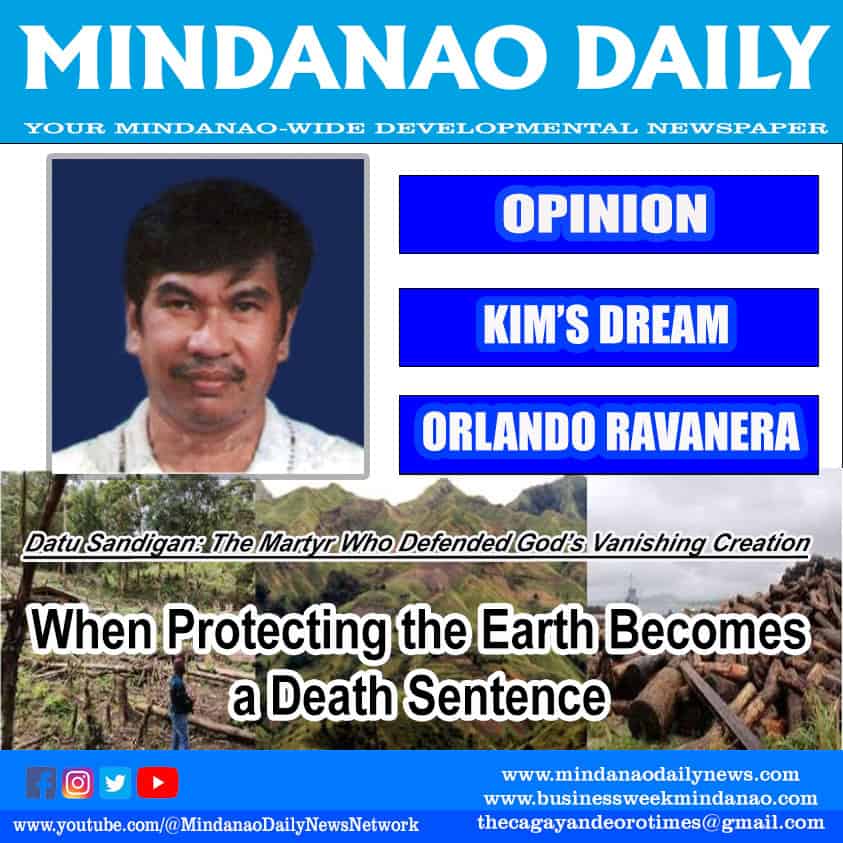
Datu Sandigan: The Martyr Who Defended God’s Vanishing Creation
Kim’s Dream Orlan Ravanera
In the upland barangay of Pigsag-an in Cagayan de Oro lived a man whose courage would challenge the powers of greed and violence. His name was Fausto Orasan, known among his people as Datu Sandigan, chieftain of the Higaonon. He was not merely a tribal leader by title; he was a guardian of the land, a defender of creation, and a living embodiment of his people’s belief in Magbabaya, the Creator whose presence is reflected in nature itself. For the Higaonon, the forest is not a warehouse of timber, nor are mountains mere deposits of minerals. The rivers are living veins, the trees ancient elders, and the soil sacred ground entrusted to human care. Their culture is rooted in the profound truth that everything is interconnected: human beings, animals, plants, water, air, and spirit. To wound the earth is to wound oneself. To destroy creation is to dishonor the Creator.
Datu Sandigan lived this truth with unshakeable conviction. During the 1990s, illegal logging and illegal mining operations reached alarming levels in Northern Mindanao. In the dead of night, while the people of Cagayan de Oro slept, long convoys of ten-wheeler logging trucks rumbled through the city streets, carrying away centuries-old trees from the uplands. It was reported that as many as fifty trucks could pass from midnight until dawn, silent theft under the cover of darkness.
At the same time, illegal mining ravaged the mountains. Backhoes clawed open the earth in reckless open-pit operations. Hydraulic mining, powered by high-pressure water pumps, eroded slopes and flushed toxic sediments into rivers. The once-clear waters of the Iponan River turned murky brown, earning the bitter nickname “the chocolate river.” Some would mockingly say that if Bohol has its Chocolate Hills, Cagayan de Oro now has its chocolate river. The city’s very name, “De Oro,” meaning “of gold,” speaks of the mineral richness of its uplands. These mountains contain high-quality mineral deposits sought by powerful interests. But what many fail to understand is that the wealth beneath the soil is not worth the devastation above it. Gold cannot replace forests. Minerals cannot resurrect extinct species. Profit cannot restore poisoned rivers.
In 2013, the Court of Appeals issued a Writ of Kalikasan, an extraordinary legal remedy for environmental protection upon the petition of Sulog, an organization advocating ecological justice. The writ recognized that the environmental destruction posed serious threats to life, health, and property. A Task Force Kinaiyahan was organized, composed of law enforcement agencies and local government units, to implement environmental protection measures. Datu Sandigan became a crucial ally in monitoring the upland areas. His knowledge of the terrain, his moral authority among Indigenous communities, and his unwavering commitment made him indispensable. Yet courage comes at a price. Datu Sandigan survived multiple attempts on his life. Armed men fired high-powered guns at his residence. Bullets rained down, yet he miraculously escaped death. When jokingly told that he must possess an “anting-anting”, a mystical charm, he would reply with serene confidence: “If Magbabaya is with us, who can defeat us?” His faith was not superstition. It was a deep spiritual grounding. He believed that when one stands for truth and protects creation, one stands in alignment with the Creator.
On the eighth attempt on his life, the assassins succeeded. While riding his motorcycle in Barangay Tuburan one afternoon, he was treacherously shot from behind. The bullets silenced his voice but not his cause. His death forces us to confront painful questions: How many more must die defending forests and rivers? Why are environmental defenders, especially Indigenous leaders, the ones who fall, while powerful perpetrators remain untouched? Datu Sandigan’s struggle was not isolated. It was part of a broader system of environmental exploitation where powerful interests operate beyond accountability.
Illegal logging and mining are rarely the work of small players alone. They are often protected by networks of influence, corrupt officials, financiers, and armed groups. During operations against illegal mining, authorities once discovered grenades and AK-47 rifles in miners’ camps. Foreign nationals operating with only tourist visas were arrested, yet within a week, they were allowed to return to their country, reportedly even escorted by an elected official.
What does this reveal? It reveals a painful truth: in environmental cases, the rule of law is frequently weak, compromised, or selectively enforced. The destruction of 17 million hectares of dipterocarp forest did not happen by accident. It happened through systemic neglect, corruption, and profit-driven priorities. The killing of Datu Sandigan remains unresolved. No one has been arrested. This silence speaks volumes. Perhaps the deeper tragedy lies not only in the bullets that killed him, but in the blindness that fuels environmental destruction. Many people profess faith in God. They kneel in churches, gaze upon religious paintings such as those imagined by masters like Leonardo da Vinci, and recite prayers.
But do they hear the cry of the forests being razed? Do they feel the anguish of rivers choking with silt and chemicals? Do they mourn the extinction of flora and fauna sacrificed on the altar of profit? True worship cannot be confined within church walls. Protecting God’s creation is among the highest forms of reverence. To defend the forest is to defend life itself. Datu Sandigan understood this deeply. His spirituality was not abstract theology. It was lived solidarity with the earth. He recognized that human beings are not masters of nature but part of it. Everything is interconnected, from the smallest flower to the most distant star.
To many, his fearlessness seems extraordinary. How could he continue despite repeated attempts on his life? Perhaps because he saw life not as mere physical existence, but as participation in a greater spiritual reality. If one’s consciousness is rooted in the Eternal Being, then death loses its ultimate power. As Khalil Gibran wrote, “Death is stronger than life, but love is stronger than death.” Love for the land, for his people, and for future generations gave Datu Sandigan courage beyond self-preservation. Those driven by unbridled materialism and consumerism often measure life by wealth and status. Yet such pursuits are shallow and fleeting. A system obsessed with profit but devoid of spirituality eventually collapses under its own moral bankruptcy.
Datu Sandigan showed another way, a path of sacredness, simplicity, and responsibility. His life is not merely a story of martyrdom. It is a mirror held up to society. Why must civilians and Indigenous leaders bear the brunt of environmental defense, while institutions tasked with protection remain passive or compromised? Why do we tolerate systems that allow plunder of resources in exchange for short-term gains? We are at a crossroads. Climate change intensifies. Biodiversity declines. Rivers dry up or flood violently due to deforestation. These are not isolated phenomena; they are consequences of choices rooted in greed and spiritual disconnection.
Datu Sandigan’s legacy calls us to awaken from the fallacies of unchecked consumerism, from religious formalism without ecological responsibility, from political complacency. He reminds us that safeguarding the earth is not optional; it is a moral imperative. The sacredness and oneness with nature are not a romantic idea. It is a survival principle. When forests disappear, floods and landslides follow. When rivers are poisoned, communities suffer. When Indigenous wisdom is ignored, society loses ancient knowledge essential for balance. His blood may have been spilled on the road in Tuburan, but his spirit endures in every person who refuses to be silent in the face of injustice.
The question now is not only who killed Datu Sandigan. The deeper question is this: will we allow his sacrifice to be in vain? Can we feel the interconnectedness of all creation? Can we recognize that protecting the earth is protecting ourselves? Can we finally move from passive observation to active stewardship? Datu Sandigan showed us the way. The path is difficult, but it is clear: live in reverence for creation, resist systems of greed, and root our actions in a spirituality that sees the divine in every forest, river, and living being. The awakening must begin now. All for God’s greater glory.
###