
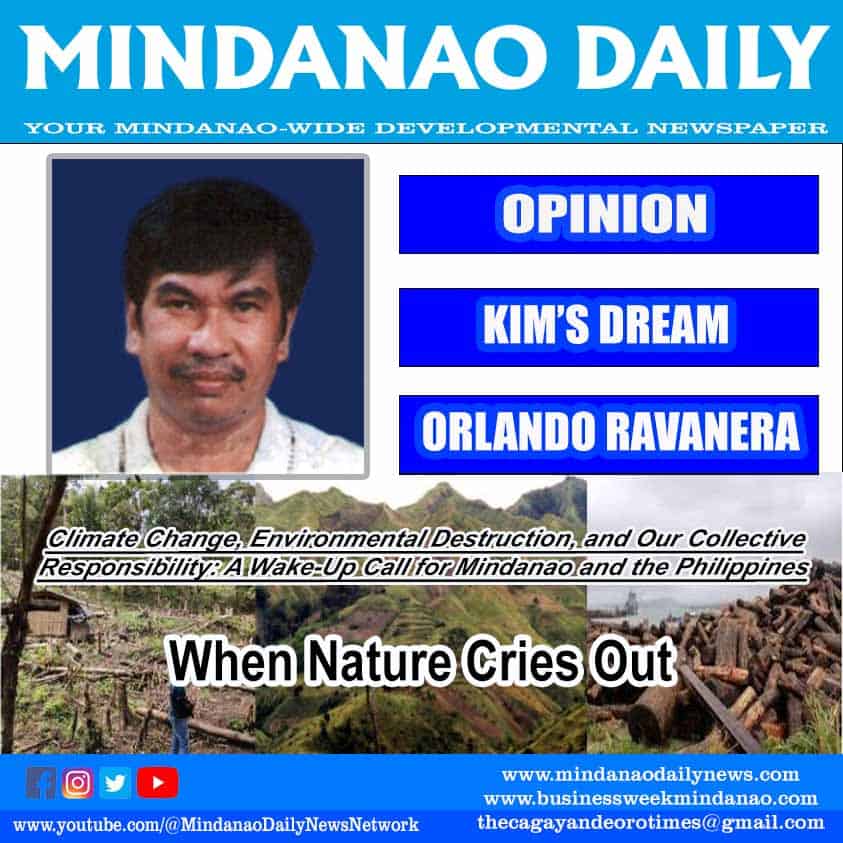
Climate Change, Environmental Destruction, and Our Collective Responsibility: A Wake-Up Call for Mindanao and the Philippines
Kim’s Dream Orlan Ravanera
The devastating floods, landslides, stronger typhoons, prolonged droughts, and other natural disasters that we are witnessing today are no longer isolated incidents or mere acts of nature. These events have become increasingly frequent and more destructive over the past few decades. While climate change is undeniably a global phenomenon driven by rising greenhouse gas emissions, many of the disasters experienced in the Philippines, particularly in Mindanao, are significantly intensified by human activities that continue to destroy our natural environment. Climate change is not merely a scientific theory or a political issue. It is a reality that affects every person regardless of social status, religion, political affiliation, or economic condition. The Philippines, despite contributing only a small percentage of the world’s total greenhouse gas emissions, remains one of the countries most vulnerable to the effects of climate change. Rising temperatures, changing rainfall patterns, stronger tropical cyclones, flooding, sea-level rise, and prolonged dry seasons are already affecting millions of Filipinos.
However, climate change alone does not explain the severity of many disasters occurring in Mindanao. Human actions have made these disasters far worse. Illegal logging, irresponsible mining operations, quarrying, indiscriminate land conversion, and widespread deforestation have significantly weakened our natural defenses against floods and landslides. The mountain ranges and forests of Mindanao serve as natural barriers that absorb rainfall, stabilize the soil, regulate water flow, and protect communities living downstream. When forests are destroyed, and mountains are excavated for mining and other extractive activities without proper environmental safeguards, the land loses its ability to absorb large volumes of rainwater.
As a result, whenever heavy rainfall occurs, enormous volumes of water rapidly flow down from the mountains into rivers, cities, and municipalities. Instead of slowly being absorbed into healthy forest ecosystems, rainwater rushes into communities carrying mud, rocks, and debris that destroy homes, infrastructure, farms, and livelihoods. This reality has become increasingly evident in various parts of Mindanao, including Northern Mindanao, the Davao Region, General Santos City, and many surrounding provinces. Communities continue to experience severe flooding, landslides, and environmental degradation that threaten both lives and economic development.
The question, therefore, arises: Who should be held accountable? Should we blame climate change alone? Should we blame illegal miners? Should we blame irresponsible corporations? Should we blame government agencies that fail to strictly enforce environmental laws? Should we blame local officials who allow destructive activities to continue? Or should we also look at ourselves? The truth is that responsibility does not belong to one individual or one institution alone. Governments have the legal responsibility to protect the environment by enforcing existing environmental laws fairly and consistently. Environmental permits should never become licenses to destroy ecosystems. Illegal mining operations must be stopped. Illegal logging must be prosecuted. Protected areas should remain protected. Environmental impact assessments must be conducted honestly and transparently, and violators should be held accountable regardless of their political or economic influence.
Private companies likewise have moral and legal obligations to operate responsibly. Economic growth should never come at the expense of human lives and environmental sustainability. Natural resources are not unlimited. Mountains cannot simply be excavated without consequences. Forests cannot continue disappearing without affecting future generations. Communities also have an important role to play. Environmental protection cannot depend solely on government action. Every citizen shares responsibility in preserving forests, rivers, coastal areas, and biodiversity. Small actions such as proper waste management, tree planting, reporting illegal environmental activities, supporting sustainable agriculture, reducing pollution, and educating younger generations collectively contribute to environmental protection.
Unfortunately, many people only begin paying attention after disasters have already claimed lives. Only after homes are washed away do people ask why floods have become worse. Only after mountains collapse during landslides do questions arise about illegal mining and deforestation. Only after farmers lose their harvests because of drought or flooding do we realize how dependent we are on healthy ecosystems. The greatest tragedy is not only the disasters themselves but also humanity’s tendency to forget the lessons they teach. How many more typhoons must destroy our communities before we recognize the seriousness of environmental destruction? How many more floods must occur before stronger environmental protection becomes a national priority? How many more families must lose their homes? How many more children must lose their future? How many more lives must be sacrificed before meaningful action is taken? These questions should challenge every Filipino, not only our leaders but also every citizen.
Environmental destruction is driven largely by human greed. Excessive exploitation of forests, minerals, and other natural resources often prioritizes short-term financial gain over long-term sustainability. While economic development is necessary for national progress, development that destroys ecosystems ultimately creates greater costs than benefits. The price is paid not only in money but in human suffering. Destroyed homes. Lost livelihoods. Damaged agriculture. Disrupted education. Food insecurity. Health problems. Loss of biodiversity. Psychological trauma. And, most painfully, the loss of human lives. The irony is that the poorest communities are usually those who suffer the most despite contributing the least to environmental destruction. Families living near rivers, coastal communities, indigenous peoples, small farmers, and fisherfolk often bear the greatest burden of climate-related disasters.
This raises an important issue of environmental justice. Those who benefit economically from exploiting natural resources are not always the same people who experience the devastating consequences. Climate justice, therefore, requires accountability, transparency, and responsible governance. Scientific evidence consistently demonstrates that healthy forests reduce flood risks, protect watersheds, preserve biodiversity, store carbon, and help regulate local climates. Conserving forests is therefore not simply an environmental concern; it is also a public safety issue, an economic issue, and a humanitarian issue.
Mindanao possesses some of the richest ecosystems in the Philippines. Its forests support countless plant and animal species, provide water for agriculture, generate hydroelectric power, regulate climate, and sustain indigenous cultural heritage. Protecting these ecosystems means protecting human life itself. Prayer remains an essential source of hope, faith, and spiritual strength. Throughout history, prayer has comforted people during times of crisis and inspired compassion and resilience. However, genuine faith should inspire responsible action. Faith without responsibility cannot solve environmental problems. Praying for protection while continuing to destroy forests contradicts our responsibility as stewards of God’s creation. Every religious tradition teaches respect for creation, compassion for others, and responsibility toward future generations. We have not been placed on Earth merely to consume its resources but to protect and preserve them. Each person has a purpose. Each citizen has a responsibility. Each generation has an obligation to leave behind a healthier environment than the one it inherited.
The fight against climate change and environmental destruction cannot be won by governments alone. Scientists cannot solve it alone. Environmental organizations cannot solve it alone. Religious leaders cannot solve it alone. The responsibility belongs to all of us. We must support stronger environmental policies. We must encourage sustainable development. We must protect watersheds and forests. We must oppose illegal environmental activities. We must educate our children to value nature. We must demand accountability from both public officials and private institutions. Most importantly, we must recognize that protecting nature is ultimately protecting ourselves. Nature is not our enemy. It is our greatest life-support system.
If we continue to destroy forests, mountains, rivers, and oceans, the consequences will become increasingly severe not only for our generation but for generations yet unborn. Climate change is already here. Environmental degradation is already happening. The warning signs are already visible. The question is no longer whether we should act. The real question is whether we will act before it is too late.
History will judge our generation not by how much wealth we accumulated or how many natural resources we extracted, but by whether we had the wisdom, courage, and compassion to protect the Earth entrusted to us. The future of Mindanao, the Philippines, and our planet depends on the choices we make today. We can continue on a path of environmental destruction fueled by greed and indifference, or we can choose a future founded on responsibility sustainability, accountability, and respect for creation. The choice is ours, and the time to act is now. All for God’s greater glory.
###