From the Sidelines
By: Ray G. Talimio Jr.
“The sale of Holcim Philippines is a multibillion-peso corporate transaction, but for Misamis Oriental and Iligan City, an important question deserves an answer: What happens to the land, limestone, communities and Filipino ownership behind the cement?”
The proposed acquisition of Holcim Philippines, Inc. (HPI) by Huaxin Building Materials is more than a change of corporate ownership. For Northern Mindanao, it should trigger an examination of who owns, controls and benefits from the land and mineral resources feeding the Holcim cement plant in Lugait, Misamis Oriental.
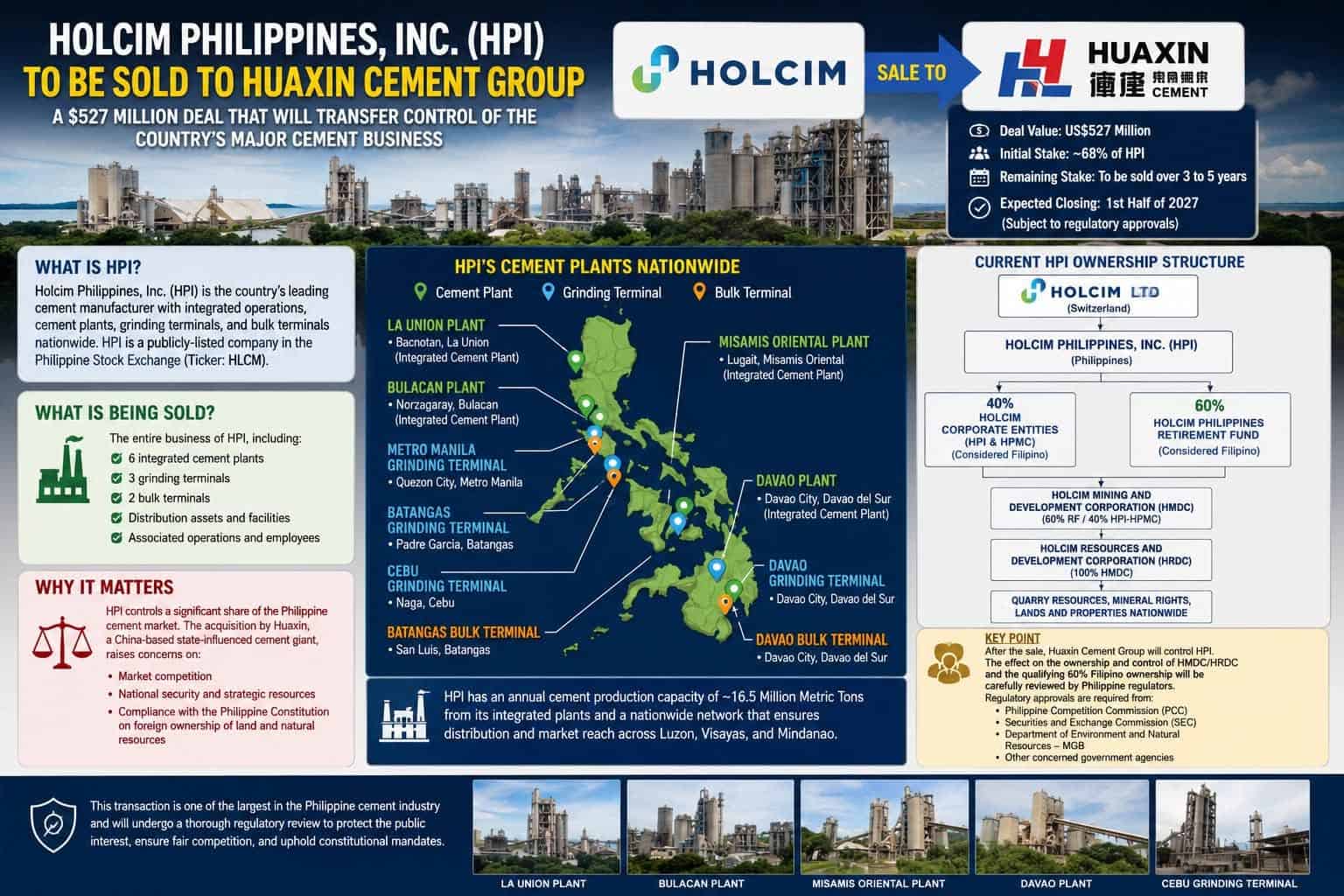
Holcim’s Philippine operations include major cement plants in Lugait, Misamis Oriental; Davao City; Norzagaray, Bulacan; and Bacnotan, La Union.
The Lugait plant has deep roots in Northern Mindanao. It began as Floro Cement Corporation, which started commercial operations in 1972. It was later acquired by the Alcantara Group and became Alsons Cement Corporation before eventually becoming part of Holcim Philippines.
Now another corporate transition is coming.
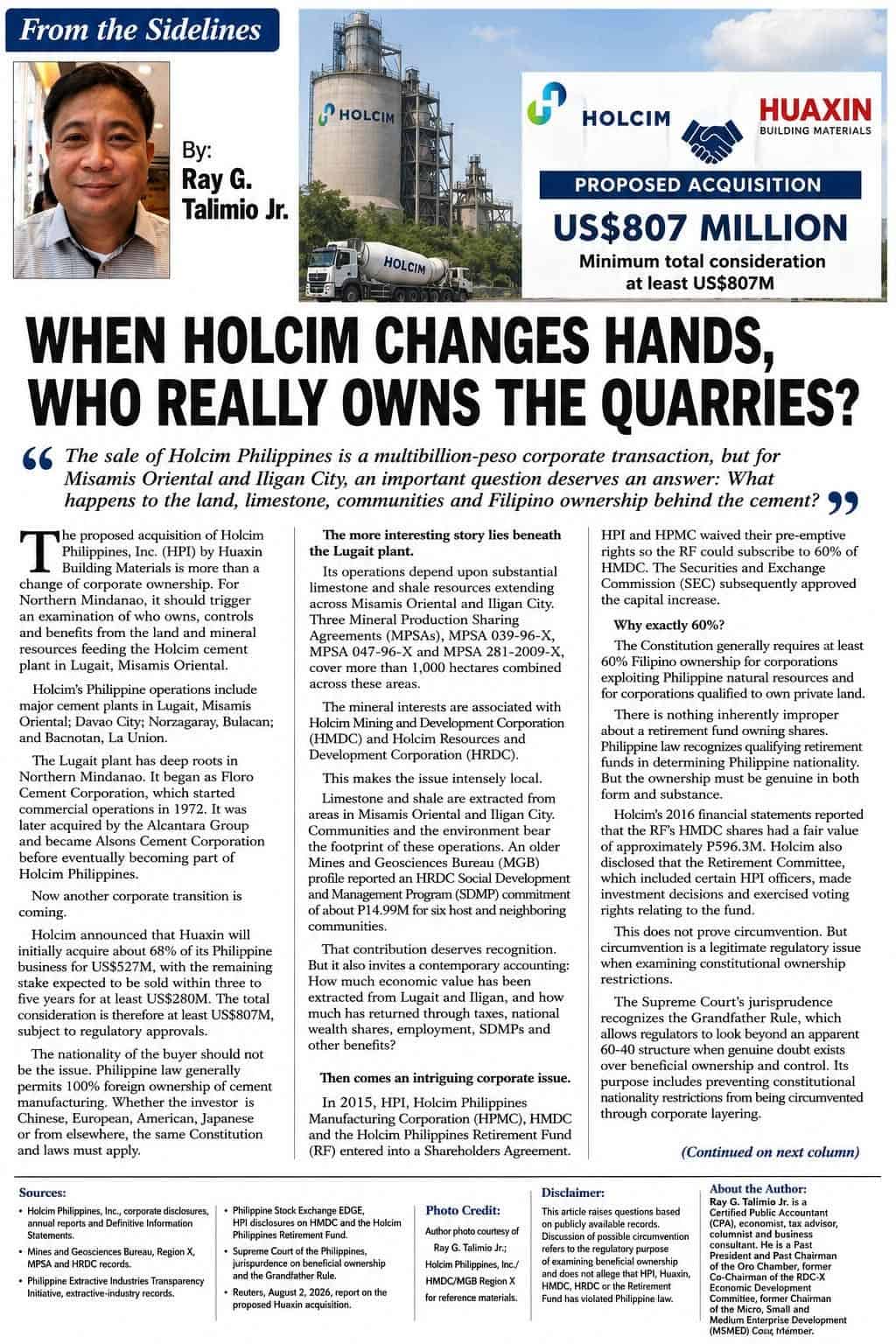
Holcim announced that Huaxin will initially acquire about 68% of its Philippine business for US$527M, with the remaining stake expected to be sold within three to five years for at least US$280M. The total consideration is therefore at least US$807M, subject to regulatory approvals.
The nationality of the buyer should not be the issue. Philippine law generally permits 100% foreign ownership of cement manufacturing. Whether the investor is Chinese, European, American, Japanese or from elsewhere, the same Constitution and laws must apply.
The more interesting story lies beneath the Lugait plant.
Its operations depend upon substantial limestone and shale resources extending across Misamis Oriental and Iligan City. Three Mineral Production Sharing Agreements (MPSAs), MPSA 039-96-X, MPSA 047-96-X and MPSA 281-2009-X, cover more than 1,000 hectares combined across these areas.
The mineral interests are associated with Holcim Mining and Development Corporation (HMDC) and Holcim Resources and Development Corporation (HRDC).
This makes the issue intensely local.
Limestone and shale are extracted from areas in Misamis Oriental and Iligan City. Communities and the environment bear the footprint of these operations. An older Mines and Geosciences Bureau (MGB) profile reported an HRDC Social Development and Management Program (SDMP) commitment of about P14.99M for six host and neighboring communities.
That contribution deserves recognition. But it also invites a contemporary accounting: How much economic value has been extracted from Lugait and Iligan, and how much has returned through taxes, national wealth shares, employment, SDMPs and other benefits?
Then comes an intriguing corporate issue.
In 2015, HPI, Holcim Philippines Manufacturing Corporation (HPMC), HMDC and the Holcim Philippines Retirement Fund (RF) entered into a Shareholders Agreement. HPI and HPMC waived their pre-emptive rights so the RF could subscribe to 60% of HMDC. The Securities and Exchange Commission (SEC) subsequently approved the capital increase.
Why exactly 60%?
The Constitution generally requires at least 60% Filipino ownership for corporations exploiting Philippine natural resources and for corporations qualified to own private land.
There is nothing inherently improper about a retirement fund owning shares. Philippine law recognizes qualifying retirement funds in determining Philippine nationality. But the ownership must be genuine in both form and substance.
Holcim’s 2016 financial statements reported that the RF’s HMDC shares had a fair value of approximately P596.3M. Holcim also disclosed that the Retirement Committee, which included certain HPI officers, made investment decisions and exercised voting rights relating to the fund.
This does not prove circumvention. But circumvention is a legitimate regulatory issue when examining constitutional ownership restrictions.
The Supreme Court’s jurisprudence recognizes the Grandfather Rule, which allows regulators to look beyond an apparent 60-40 structure when genuine doubt exists over beneficial ownership and control. Its purpose includes preventing constitutional nationality restrictions from being circumvented through corporate layering.
The RF arrangement therefore deserves examination, not condemnation.
If the RF owns 60% of HMDC, regulators should determine whether its economic participation, voting rights, exposure to gains and losses, residual interests and liquidation rights are genuinely commensurate with that ownership. They should establish who appoints its trustees, who exercises effective control and what happens to its HMDC shares if the number of Filipino employee-beneficiaries substantially declines.
The proposed change in HPI’s foreign controlling shareholder provides an appropriate opportunity for that review.
The Philippine Competition Commission (PCC) should examine the Huaxin transaction beyond purchase price and cement market shares. Corporate nationality falls primarily within the SEC’s jurisdiction, while mineral agreements involve the Department of Environment and Natural Resources (DENR) and MGB. These agencies should coordinate because the acquisition cannot be fully understood without examining HMDC, HRDC and the RF structure.
Huaxin deserves neither suspicion nor preferential treatment because of its nationality. Any investor acquiring such a strategic Philippine enterprise deserves clear rules, regulatory certainty and rigorous scrutiny.
Misamis Oriental and Iligan City deserve something too: a transparent accounting of what their resources have contributed and what their communities receive in return.
A US$807M transaction may be negotiated far from Northern Mindanao. But part of its value comes from limestone beneath Lugait and Iligan.
The people living above it deserve answers.
Sources: Holcim Philippines, Inc., corporate disclosures, annual reports and Definitive Information Statements.
Mines and Geosciences Bureau, Region X, MPSA and HRDC records.
Philippine Extractive Industries Transparency Initiative, extractive-industry records.
Philippine Stock Exchange EDGE, HPI disclosures on HMDC and the Holcim Philippines Retirement Fund.
Supreme Court of the Philippines, jurisprudence on beneficial ownership and the Grandfather Rule.
Reuters, August 2, 2026, report on the proposed Huaxin acquisition.
Photo Credit:Holcim Philippines, Inc./HMDC/MGB Region X.
Disclaimer:This article raises questions based on publicly available records. Discussion of possible circumvention refers to the regulatory purpose of examining beneficial ownership and does not allege that HPI, Huaxin, HMDC, HRDC or the Retirement Fund has violated Philippine law.
About the Author:Ray G. Talimio Jr. is a Certified Public Accountant (CPA), economist, tax advisor, columnist and business consultant. He is a Past President and Past Chairman of the Oro Chamber, former Co-Chairman of the RDC-X Economic Development Committee, former Chairman of the Micro, Small and Medium Enterprise Development (MSMED) Council of Misamis Oriental and Cagayan de Oro, former Chairman of BIMP-EAGA Northern Mindanao, a PICPA National Officer and an ACPAPP member.
#HolcimPhilippines#IliganCity#MisamisOriental