
By CHRIS V. PANGANIBAN
SAN FRANCISCO, Agusan del Sur — Tricycle drivers in this town have raised concerns over gasoline prices that are reportedly P10 to P15 higher than those in neighboring municipalities, saying the increase has made it more difficult for them to make ends meet.
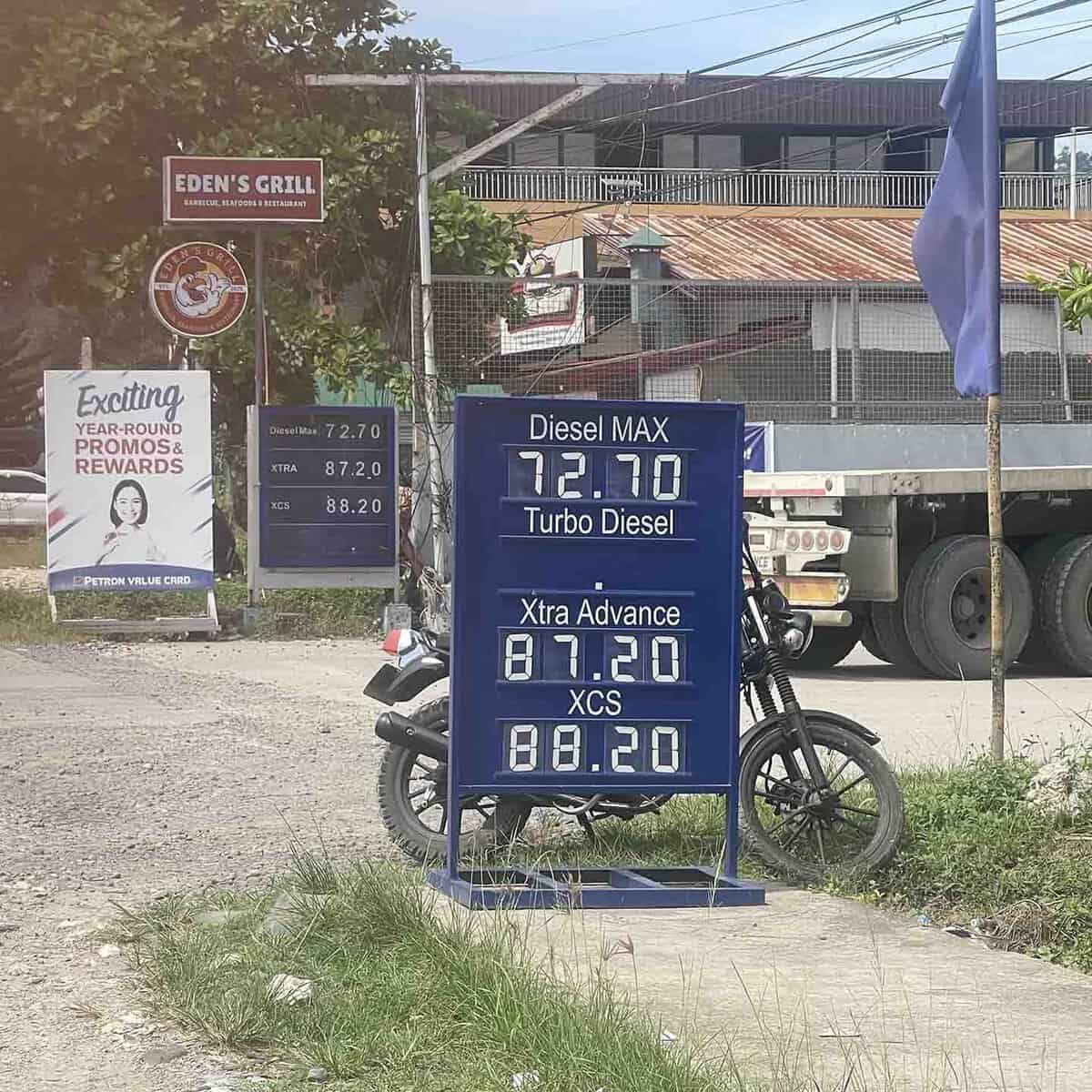
Jonathan Perez, a tricycle driver plying the Zone 1 route around the town center, said gasoline prices in most fuel stations in San Francisco range from ₱87 to ₱89 per liter. He noted that these prices are significantly higher compared to those in nearby towns such as Prosperidad and Rosario in Agusan del Sur, as well as Barobo and Tagbina in Surigao del Sur.
Perez said he visited Tagbina last Sunday and observed that gasoline was being sold at around ₱72 per liter in local gas stations, while a fuel station in Barangay Tambis, Barobo, priced gasoline at ₱75 per liter.
Another driver, who hails from Prosperidad town, said gasoline prices there range only from ₱78 to ₱81 per liter.
“The gasoline boys always tell us that the reason fuel prices are higher in San Francisco is because taxes imposed by the local government are high. But how come they only pay taxes once a year?” Perez asked.
Perez said the high cost of gasoline has greatly affected his family’s daily income. He said he earns only around ₱200 to ₱300 a day, making it harder to provide for their basic needs.
Sangguniang Bayan Member John CD Paredes, brother of Mayor Grace Carmel Paredes-Bravo, also observed that gasoline prices in San Francisco are indeed higher compared to those in neighboring towns.
“Lately, I have seen a lot of posts, received messages, and been tagged, together with the LGU, regarding the price difference of fuel between San Francisco and nearby towns like Prosperidad, Rosario, and Barobo. It seems that fuel prices are higher in our town compared to neighboring localities,” Paredes said in a social media post.
Paredes said that based on his personal observation, gasoline prices in San Francisco are noticeably higher than in other towns. However, he added that diesel prices appear to be comparable, and in some cases even lower, than those in nearby areas.
He noted that gasoline is mostly used by motorcycles, small cars, and similar vehicles, while diesel is commonly used by SUVs, trucks, buses, and industrial engines such as generators and water pumps.
Citing Republic Act No. 8479, or the Downstream Oil Industry Deregulation Act of 1998, Paredes explained that the national government no longer imposes price controls on petroleum products. The law liberalized the oil industry, allowing oil companies to adjust pump prices based on supply, demand, foreign exchange rates, and other market factors without prior government approval.
He clarified that local government units do not control fuel prices. According to him, the role of the LGU is limited to administrative, safety, and oversight functions at the community level.
These functions include zoning and land use regulation, issuance of building permits, fire safety clearances, and business permits prior to the establishment and operation of fuel stations. The LGU may also conduct periodic inspections of gas pumps to ensure that consumers receive the exact amount of fuel they pay for and that dispensing equipment is properly calibrated.
“Simply stated, the local government unit has no control over the pricing of fuel products,” Paredes said.
However, he also expressed concern over the apparent uniformity of gasoline prices among fuel stations in the town.
“On a personal note, when businesses are supposed to be competing with each other, I have observed that most gasoline stations here have the same pump prices. Whether this is due to collusion or simply similar pricing decisions, the consumer is left with no choice because of the uniformity of prices,” he added.
###