
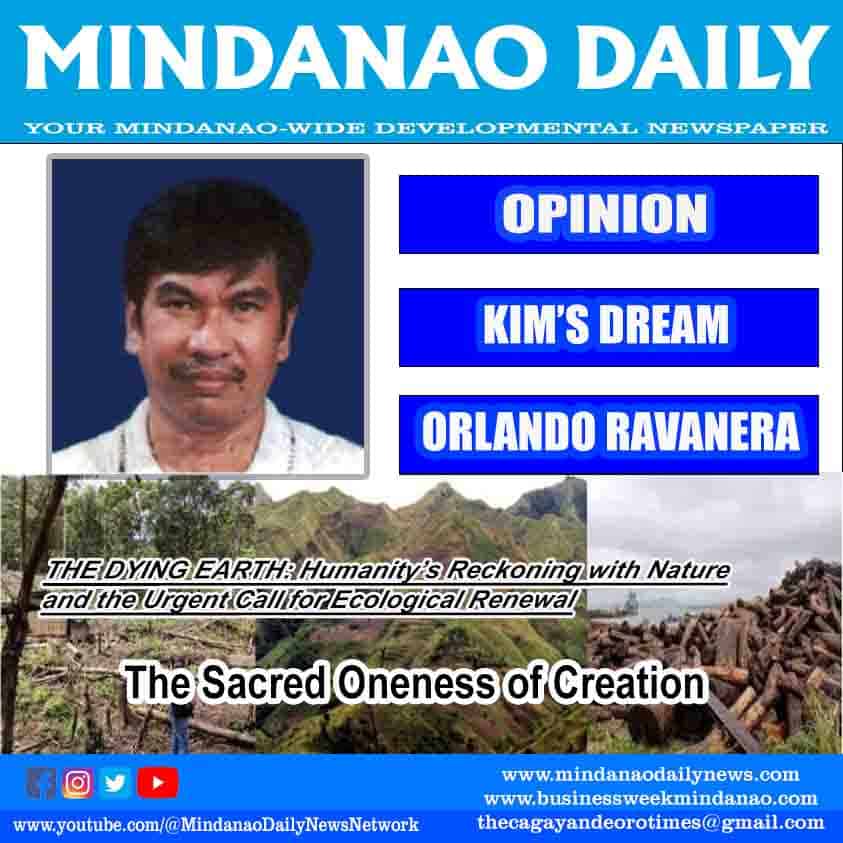
THE DYING EARTH: Humanity’s Reckoning with Nature and the Urgent Call for Ecological Renewal
Kim’s Dream Orlan Ravanera
At the foundation of all existence lies a simple but profound truth: everything in creation is interconnected. No organism, species, or ecosystem exists in isolation. The air we breathe, the water we drink, the food we eat, and the climate that sustains life are all part of an intricate web of relationships woven by nature over billions of years. Without the sun, there is no life. Without forests, there are no rivers. Without rivers, there are no farms. Without farms, there is no food. The laws of nature remind us that every living and non-living element of our planet is connected to every other. This principle of interconnectedness is perhaps the most important law governing life on Earth.
Yet humanity has largely forgotten this truth. Modern society has embraced a development model driven by endless economic growth, material accumulation, and consumerism. In pursuit of profit, forests have been destroyed, rivers polluted, oceans depleted, and ecosystems sacrificed. The consequences of these actions are now becoming impossible to ignore. Today, humanity stands at a crossroads. We must decide whether to continue exploiting nature until the foundations of life collapse, or whether to restore our relationship with the Earth before it is too late. Long before human beings appeared on Earth, countless forms of life flourished. Plants, animals, and microorganisms inhabited the planet for billions of years, creating the ecosystems that sustain life today.
Compared to this immense history, humanity is a relatively recent arrival. Yet within a remarkably short period, humans have altered the planet more dramatically than any other species. Forests that took millions of years to develop have been destroyed in decades. Species that evolved over millennia are disappearing at unprecedented rates. This raises an important moral question: Do humans have the right to destroy life forms that existed long before our own species emerged?
The extraordinary biodiversity of our planet is not merely a collection of resources for human consumption. Every species has intrinsic value and plays a role in maintaining ecological balance. Forests regulate climate, protect watersheds, enrich soil, and provide habitat for countless organisms. Coral reefs sustain marine ecosystems. Mangroves protect coastlines and serve as breeding grounds for fish. When these systems are destroyed, the consequences extend far beyond environmental degradation. Entire communities lose their livelihoods, food security declines, disasters become more frequent, and future generations inherit a diminished world.
The tragedy is that much of this destruction is not driven by necessity but by greed. The relentless pursuit of profit has often overshadowed the responsibility to protect the natural systems that make human life possible.
History reveals a troubling aspect of human nature. The twentieth century witnessed some of the greatest atrocities ever committed. Two world wars claimed tens of millions of lives. Genocides and political purges led to unimaginable suffering. Human beings demonstrated a capacity for violence against their own kind that is rarely observed elsewhere in nature. If humanity can inflict such devastation upon fellow humans, it is perhaps unsurprising that nature has also become a victim of exploitation. Forests are cleared without regard for future generations. Rivers become dumping grounds for waste. Oceans are treated as limitless reservoirs of resources. Wildlife is displaced, hunted, or driven to extinction. This pattern reflects a worldview that places short-term gain above long-term survival. It ignores a fundamental truth: humanity is not separate from nature. We are part of it. Every act of destruction directed at the natural world ultimately returns to affect human society. The deterioration of ecosystems is therefore not merely an environmental issue. It is a moral crisis that challenges how humanity understands its place within creation.
The Philippines is among the most biologically diverse countries in the world. Despite its relatively small land area, it possesses extraordinary levels of endemic species found nowhere else on Earth. It has long been recognized as a global center of marine biodiversity and ecological richness. However, this natural wealth is rapidly disappearing. Vast areas of the country’s dipterocarp forests have been lost through logging, land conversion, and unsustainable development. As forests disappear, watersheds are damaged, rivers dry up, and soil erosion intensifies. Many rivers that once sustained communities are now heavily polluted or biologically degraded. Waterways that should support agriculture, fisheries, and human settlements have become symbols of environmental neglect.
The country’s coastal ecosystems have suffered similar destruction. Coral reefs, often described as the rainforests of the sea, have been severely damaged by pollution, destructive fishing practices, and climate change. Mangrove forests, essential nurseries for fish and natural barriers against storms, have been cleared to make way for commercial and residential development. The consequences are evident in the lives of ordinary people. Coastal communities and fisherfolk, who depend directly on healthy marine ecosystems, are among the poorest sectors of society. As fish populations decline and coastal habitats disappear, livelihoods become increasingly precarious. What was once considered one of the world’s greatest centers of marine life now faces ecological collapse in many areas. Environmental degradation and poverty are deeply interconnected.
When forests disappear, farmers lose fertile soil and reliable water sources. When rivers become polluted, communities lose access to clean water. When marine ecosystems collapse, fishermen lose their primary source of income. The result is a cycle of poverty that becomes increasingly difficult to escape. Ironically, those who produce society’s necessities often suffer the most. Farmers who grow food frequently struggle to feed their own families. Workers who generate economic wealth often live below the poverty line. Malnutrition, undernourishment, and stunted growth among children remain serious concerns in many communities. These conditions are not simply economic problems; they are symptoms of a larger ecological imbalance.
A society cannot thrive when the natural systems supporting food production, clean water, and livelihoods are being systematically destroyed. Economic progress that comes at the expense of environmental sustainability is ultimately self-defeating. It creates short-term gains while undermining long-term prosperity. Nature operates according to laws that cannot be ignored indefinitely. One of these laws is that every action has consequences. The destruction of forests increases the likelihood of floods and landslides. The loss of mangroves exposes coastal communities to storm surges. Climate change intensifies extreme weather events.
The devastating impacts of disasters such as Typhoon Sendong served as painful reminders of this reality. While natural hazards have always existed, environmental degradation often magnifies their destructive effects.
When watersheds are damaged and forests removed, rainfall that would normally be absorbed by vegetation rushes rapidly into rivers and urban areas. Floods become more severe, and communities become more vulnerable. These disasters should not be viewed merely as isolated tragedies. There are warnings that humanity has exceeded ecological limits Nature is not exacting revenge. Rather, human societies are experiencing the predictable consequences of violating the principles that sustain ecological balance. What we do to nature inevitably returns to us.
The environmental crisis extends far beyond national borders. Around the world, rising temperatures, melting glaciers, sea-level rise, biodiversity loss, desertification, and extreme weather events signal that the Earth is undergoing profound changes. Scientists warn that many ecosystems are approaching critical tipping points. Species are disappearing at rates unprecedented in human history. Oceans are warming and becoming more acidic. Forests that once absorbed carbon emissions are increasingly threatened by deforestation and wildfires.
Climate change is not merely an environmental issue. It is a humanitarian, economic, political, and moral challenge affecting every nation. The most vulnerable populations often suffer the greatest impacts despite contributing the least to the problem. This reality raises fundamental questions about justice, responsibility, and the kind of future humanity wishes to create. At the heart of the crisis lies a flawed development model that equates progress with endless consumption and perpetual economic expansion. Under this model, success is measured primarily through profit, production, and growth. Environmental costs are often treated as secondary concerns or externalities.
Yet infinite growth is impossible on a finite planet. The Earth’s resources are limited. Ecosystems require time to regenerate. Natural systems cannot sustain unlimited extraction and exploitatioThe image of a giant running uncontrollably captures the essence of this paradigm. To avoid collapse, the giant must keep moving faster and consuming more. In the process, it tramples communities, destroys ecosystems, weakens the atmosphere, and destabilizes the very foundations of life. True development must be measured not only by economic indicators but also by ecological health, social justice, human well-being, and the preservation of future generations’ opportunities.
The challenges facing humanity are immense, but they are not insurmountable. The first step is recognizing that environmental protection is not separate from human survival. Protecting forests, rivers, oceans, and biodiversity is ultimately about protecting ourselves. Governments, businesses, communities, educational institutions, religious organizations, and individual citizens all have roles to play. Reforestation, sustainable agriculture, responsible consumption, renewable energy, ecological restoration, and environmental education must become priorities rather than afterthoughts. More importantly, humanity must rediscover a sense of stewardship and reverence for life. The Earth is not merely a warehouse of resources; it is our shared home. We must build a powerful collective movement dedicated to restoring ecological balance and protecting future generations. The task requires courage, cooperation, and a fundamental shift in values. The choice before us is clear. We can continue down the path of ecological destruction and face increasingly severe consequences, or we can embrace a future rooted in sustainability, justice, and respect for all life.
The fate of future generations depends on the decisions we make today. Humanity has reached a defining moment in history. The signs of ecological decline are visible everywhere: disappearing forests, polluted rivers, damaged oceans, climate instability, and growing poverty linked to environmental degradation. The Earth is sending unmistakable warnings. We can no longer afford indifference. The interconnectedness of all life teaches us that our survival is inseparable from the health of the natural world. If we continue to destroy nature, we ultimately destroy ourselves. But if we choose restoration, stewardship, and ecological wisdom, there is still hope. The future remains unwritten. The question is not whether nature can survive without humanity. The question is whether humanity can survive without nature. The answer should guide every decision we make from this day forward. All for God’s greater glory.
###