
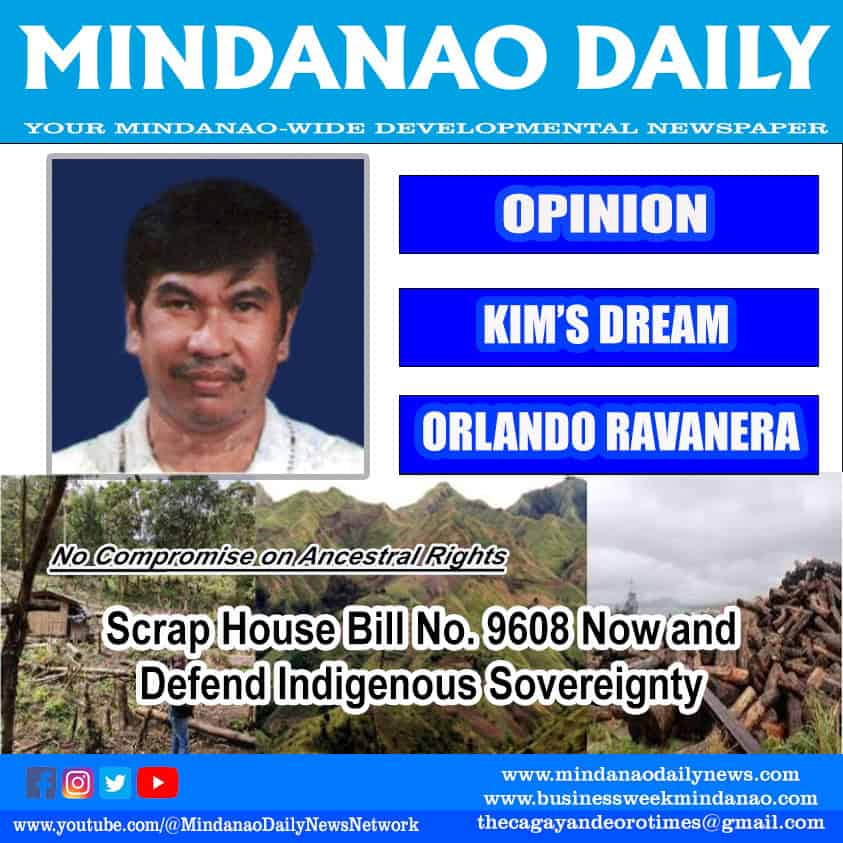
No Compromise on Ancestral Rights
Kim’s Dream Orlan Ravanera
The proposed House Bill No. 9608 has sparked deep concern among Indigenous Peoples (IPs), advocates, and human rights defenders across the Philippines. Framed as an administrative reform, the bill seeks to amend the Indigenous Peoples’ Rights Act of 1997 (IPRA) by reorganizing the National Commission on Indigenous Peoples (NCIP), including the transfer of its Ancestral Domain Office to the Department of Environment and Natural Resources (DENR). While its proponents present it as a step toward efficiency and streamlined governance, a closer and more grounded examination reveals a far more troubling reality, one that risks eroding the very foundation of Indigenous rights, not only in law, but in lived experience.
To understand the gravity of this issue, one must first recognize what IPRA represents. It is not simply a policy instrument or a bureaucratic framework. It is the result of generations of struggle by Indigenous communities who fought to have their existence, identity, and rights formally acknowledged by the state. Before IPRA, Indigenous Peoples were largely invisible within the legal system, treated as occupants of land rather than rightful owners, excluded from decision-making, and displaced in the name of development.
IPRA changed that narrative. It affirmed that ancestral domains are not public lands to be distributed or reclassified at will, but private, community-held territories belonging to Indigenous Peoples by virtue of time immemorial occupation. It recognized that land is not just an economic resource; it is deeply tied to identity, culture, spirituality, and survival. To protect these rights, the NCIP was created as an independent body with a clear mandate: to uphold, defend, and advance the rights of Indigenous Peoples in a manner that respects their unique cultural and social contexts.
House Bill No. 9608 threatens to undo this progress.
By transferring the Ancestral Domain Office from the NCIP to the DENR, the bill fundamentally alters how ancestral lands are treated. What was once recognized as a matter of historical justice and cultural integrity risks being reduced to a technical issue of land classification. Under the DENR’s system, land is categorized into timberland, mineral land, agricultural land, and protected areas classifications that often serve as gateways for state control and commercial exploitation. This shift is not merely administrative; it is philosophical. It changes the lens through which ancestral domains are viewed: from living, cultural landscapes to resources subject to regulation, extraction, and reallocation.
The danger of this shift becomes clearer when we consider the inherent conflict of interest within the DENR’s mandate. As an agency, it is responsible not only for environmental protection but also for regulating and, in many cases, approving the use of natural resources. This includes mining operations, logging concessions, and other large-scale projects that frequently overlap with ancestral domains. Placing Indigenous land rights under such an institution raises a critical question: how can an agency tasked with facilitating resource use also serve as a neutral and effective protector of Indigenous ownership?
This is not a hypothetical concern. It is already unfolding on the ground.
In Lantud, Talakag, Bukidnon, an Indigenous community’s experience reveals the human consequences of this structural imbalance. Seeking clarity and security over their ancestral lands, the community requested a survey from the DENR. Their goal was simple: to understand the extent of the land they had cultivated and depended upon for generations.
What they encountered instead was a process marked by exclusion and opacity.
The results of the survey were not transparently shared. Community members were not given copies of the findings, nor were they adequately informed of how their land was classified. Eventually, they discovered that their land had been declared “timberland,” a designation that effectively undermines their rights and opens the possibility for external control or displacement. This classification contradicted existing documentation, including Certificates of Land Ownership Award (CLOA), raising serious concerns about the basis of the decision.
Even more alarming was the absence of meaningful consultation. Under IPRA, Indigenous communities are guaranteed the right to Free, Prior, and Informed Consent (FPIC) before any action affecting their land is undertaken. This is not a mere procedural step; it is a safeguard designed to ensure that communities are not sidelined in decisions that directly impact their lives.
When FPIC is ignored, the consequences are profound. Communities are left powerless, stripped of both information and agency. Decisions are imposed rather than negotiated. Rights are diminished not through open confrontation, but through silent, bureaucratic processes that are difficult to challenge.
What happened in Lantud is not an isolated incident. It reflects a broader and deeply rooted pattern across the country. Indigenous Peoples, despite having legal recognition, often find themselves at a disadvantage when confronting more powerful actors, whether they be corporations, influential individuals, or even state-backed projects. The imbalance is not just legal; it is economic, social, and political. Many IP communities lack access to legal representation, financial resources, and institutional support. Even when they possess valid documents supporting their claims, asserting these rights requires navigating complex systems that are often inaccessible to them. In contrast, those seeking to acquire or exploit land frequently have the means to influence processes, accelerate approvals, or bypass safeguards. The result is a system where rights exist on paper but are difficult to enforce in reality.
The human cost of this system cannot be overstated. Beyond legal disputes and policy debates are the real lives of families who depend on the land for food, income, and identity. There have been cases where Indigenous individuals, overwhelmed by the loss of their ancestral lands and the apparent futility of seeking justice, have fallen into deep emotional distress. Some have reached the point of contemplating ending their lives, not because they are weak, but because the systems meant to protect them have failed so profoundly. These are not isolated tragedies. They are symptoms of a larger failure, a failure to translate legal recognition into genuine protection.
In this context, the argument that House Bill No. 9608 will “improve efficiency” becomes deeply problematic. Efficiency, when detached from justice, can become a tool of exclusion. Faster processes that bypass consultation, streamlined systems that centralize authority, and simplified procedures that ignore cultural complexities do not serve Indigenous communities. Instead, they risk accelerating dispossession. True reform should not focus on making systems faster at the expense of rights. It should aim to make them more just, more transparent, and more inclusive.
Rather than weakening the NCIP, efforts should be directed toward strengthening its capacity, improving its accountability, and ensuring that it can effectively fulfill its mandate. At the same time, coordination between the NCIP and the DENR should be enhanced not through subordination, but through partnership. Environmental governance and Indigenous rights are not opposing goals; they are deeply interconnected.
Indigenous Peoples have long been among the most effective stewards of the environment. Their knowledge systems, rooted in generations of interaction with the land, have preserved forests, protected biodiversity, and maintained ecological balance. Weakening their control over ancestral domains not only harms them but also undermines broader environmental sustainability.
When Indigenous governance is displaced, the consequences are often immediate and severe. Forests become vulnerable to illegal logging. Mountains are open to mining. Agricultural lands are converted without regard for long-term impacts. What follows is not development, but degradation of both the environment and the communities that depend on it.
The implications of House Bill No. 9608, therefore, extend far beyond administrative restructuring. It raises fundamental questions about the direction of governance in the Philippines. Are Indigenous Peoples recognized as equal partners in shaping the nation’s future, or are they treated as obstacles to be managed? Are their rights seen as inherent and non-negotiable, or as flexible and subject to reinterpretation? These are not abstract questions. They shape policies, influence decisions, and determine outcomes that affect millions of lives.
At its core, this issue is about justice. Indigenous communities are not asking for special privileges. They are asserting rights that have already been recognized by law. They are defending lands that have sustained them for generations. They are calling for transparency, accountability, and respect for principles that should form the foundation of any democratic society. Ignoring these calls does not make the problem disappear. It deepens it.
As citizens, policymakers, and members of a shared nation, there is a responsibility to look beyond policy language and examine real-world impacts. The voices of Indigenous Peoples must not be treated as secondary in discussions about their own lands. Their experiences must inform decisions. Their rights must guide actions. House Bill No. 9608, in its current form, fails to meet this standard.
It risks weakening legal protections, creating institutional conflicts, and exposing already vulnerable communities to greater harm. It does not resolve existing issues of inefficiency or injustice; instead, it threatens to intensify them. At a time when the country faces growing environmental challenges, widening inequality, and questions about governance, the path forward should be clear. It must be grounded in inclusion, respect, and justice. Strengthening Indigenous rights is not a barrier to progress; it is essential to achieving sustainable and equitable development. The situation we see today is a wake-up call.
What is happening in communities like Lantud reflects deeper systemic issues that demand urgent attention and action. If left unchallenged, these patterns will continue, and more communities will face the same struggles, the same losses, and the same silence. The choice before us is not complicated, but it is critical: uphold the spirit and intent of the Indigenous Peoples’ Rights Act of 1997, or allow it to be gradually weakened through policies that undermine its purpose.
This is not just an Indigenous issue. It is a national issue. It speaks to the kind of society we are building, one that protects the vulnerable and upholds justice, or one that allows power and influence to determine who gets to keep their land, their identity, and their future. Awareness is only the beginning. What is needed now is collective action, sustained attention, and a firm commitment to justice. The call is not only to understand but to stand. All for God’s greater glory.
###