

By: Ray G. Talimio Jr.
“Why the Economic Managers Oppose the Legislated Wage Hike”
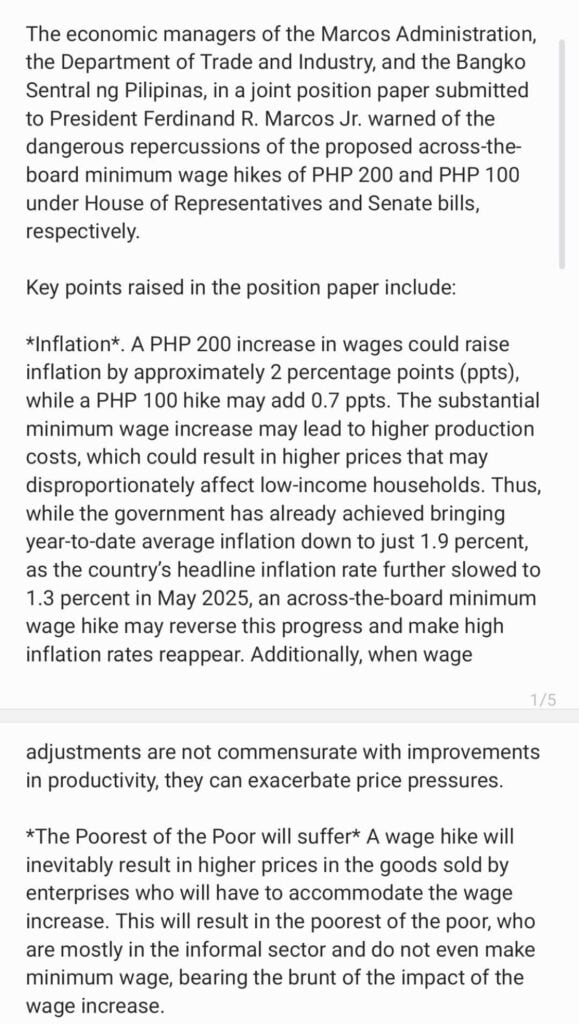
The opposition of the country’s economic managers to the proposed legislated wage hike has drawn strong reactions from both labor advocates and business groups. But beyond the headlines, their position paper provides deeper insight into the difficult balance between economic intent and operational reality.
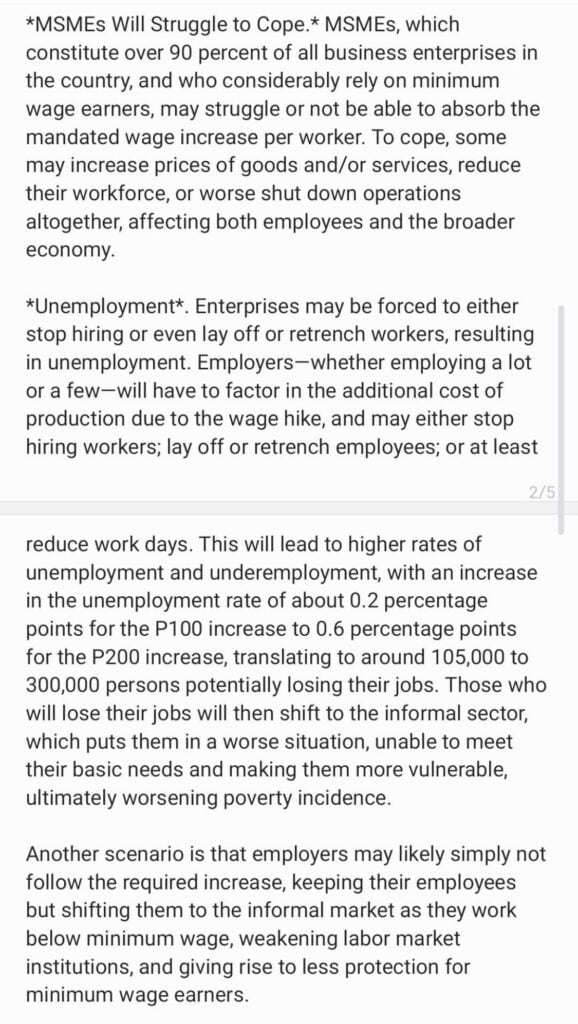
The economic team, composed of officials from the Department of Finance, National Economic and Development Authority, and Department of Budget and Management, projects that the ₱100 daily wage hike could increase unemployment by 0.2 percentage points, or about 105,000 job losses. A ₱200 increase could lead to up to 300,000 displaced workers. Most of those affected would be from micro, small, and medium enterprises, which make up over 99 percent of all registered businesses in the country and employ nearly 64 percent of the workforce.
Their concern is clear. A mandated wage increase applied uniformly across all regions and sectors will strain employers differently. MSMEs that operate on tight margins and rely heavily on minimum wage earners will be forced to reduce their workforce, limit operations, or in the worst cases, shut down. Those who lose their jobs may end up in the informal economy where wages are lower, benefits are absent, and labor protections are weak. This shift, in their view, would worsen rather than solve poverty.
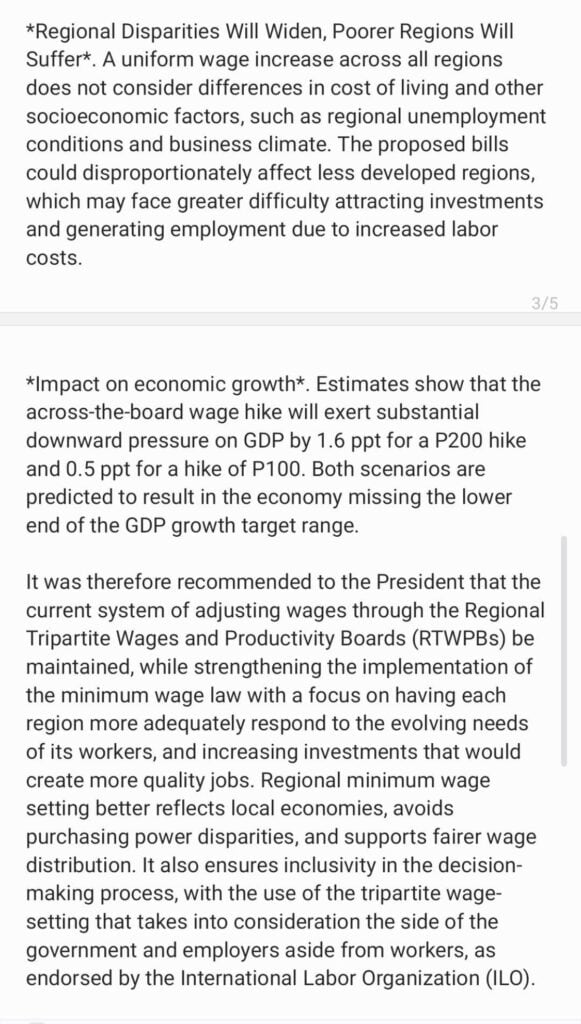
What is often missed in public discourse is that the economic managers are not rejecting the need for better wages. They are opposing the manner in which it is being pursued. The paper reaffirms that there is room to improve the lives of workers, but through policy tools that are regionally responsive, economically sound, and administratively feasible.
Three key alternatives or mitigating measures emerge from their analysis:
First, the government already has an existing mechanism under Republic Act No. 6727 through the Regional Tripartite Wages and Productivity Boards. These boards are empowered to issue wage orders based on regional conditions, taking into account inflation, cost of living, capacity to pay, and productivity. This mechanism allows wage setting to be more nuanced and tailored, and it includes provisions for exemption or deferment for enterprises with fewer than ten employees or those in financial distress.
Second, wage subsidies or transitional support can be offered to help MSMEs absorb mandated increases. If the government insists on passing a national wage hike, a portion of the revenue collected from improved exports, digital services tax, or fiscal reforms can be redirected as temporary relief for small businesses. This is a way to honor labor welfare without collapsing the enterprises that sustain them.
Third, the long-term solution still lies in industrial growth and higher productivity. If jobs are better, if skills are improved, and if more value is created, then wages will rise naturally. The government’s role must include serious support for innovation, regional industrialization, and labor upskilling, not just compliance enforcement.
In short, the message of the economic managers is not a dismissal of labor demands. It is a call for balance. Wage increases must be part of a comprehensive strategy that includes enterprise support, regulatory streamlining, and sectoral development.
If the President signs the bill, implementation must be paired with safety nets. If the bill is vetoed or lapses without clear exemptions, then it is incumbent upon the Executive and Congress to offer a credible and timely alternative.
The position paper reads like a warning, but also like a roadmap. It tells us what could go wrong, but also suggests how we might still get it right.
About the author
Ray G. Talimio Jr. is a Past President and Past Chairman of the Board of the Cagayan de Oro Chamber of Commerce and Industry Foundation Inc. (Oro Chamber). He currently serves as Co Chairman of the Economic Development Committee of the Regional Development Council Region X, Chairman of the MSME Development Council of Misamis Oriental and Cagayan de Oro, and Chairman of BIMP EAGA for Northern Mindanao. He is a long time officer and Past Chapter President of the Philippine Institute of Certified Public Accountants and also served as Past Senior Regional Director of PICPA. He is a staunch advocate for MSME development, regional economic integration, good governance, and public private partnerships.
Disclaimer
The views expressed in this article are those of the author and do not reflect the official position of any agency, institution, or organization with which he is affiliated. This column is based on publicly available documents and personal analysis of current developments.
Sources
1. Position paper of Philippine economic managers on legislated wage hike (as published by Philippine Star and official channels)
2. Republic Act No. 6727 – Wage Rationalization Act
3. Republic Act No. 9178 – BMBE Law
4. Statements from DOF, NEDA, DBM, and labor and business groups
5. MSME data from DTI and PSA
6. RTWPB exemption guidelines and policy issuances
Photo credits
Screenshots from official social media posts and position paper excerpts as publicly circulated by the Philippine Star and Messenger platform.