
By Chris V. Panganiban
Inquirer Mindanao Bureau
SAN FRANCISCO, Agusan del Sur — Residents of Barangay Navarro in Tubajon, Diangat Islands have raised fresh opposition to a proposed nickel mining project in this town, demanding public disclosure and scrutiny of its environmental safeguards as two lawmakers pressed national government officials to permanently close controversial mining applications in other parts of the province instead of merely suspending them.
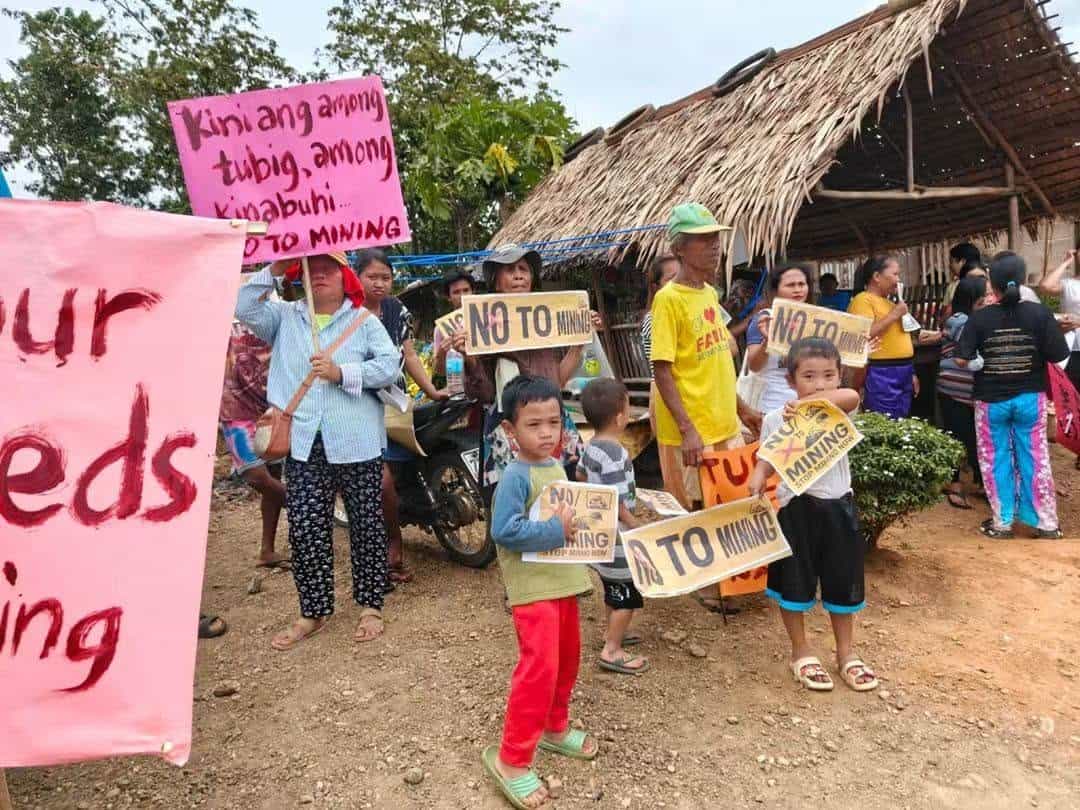
Residents, including children, gathered outside the Navarro Barangay Hall on Aug. 27 carrying “No to Mining” placards as concerns mounted over the proposed mining activities of Core Mining Corporation (CMC).
The gathering coincided with a meeting initiated by the Tubajon People’s Council to discuss issues surrounding the proposed mining project and its Impact Management Plan, or IMP.
The meeting was expected to bring together five barangay captains, representatives of CMC and other concerned officials and stakeholders. Provincial officials were also expected to attend.
Residents said they were concerned that the proposed IMP could be endorsed without affected communities first being given adequate opportunity to examine the document, understand its contents and assess the possible consequences of mining in the area.
They raised questions over the project’s possible impact on the Navarro and Imelda watersheds, coastal waters relied upon by fishing communities, agricultural areas near the proposed mining site and the long-term availability of water.
The meeting, however, did not push through, according to the residents.
Environmental Management Bureau records show that CMC is the proponent of the Tubajon Nickel Mining Project covering Barangays Diaz, Imelda, Mabini, Navarro and Sta. Cruz in Tubajon.
The proposed project involves the extraction of metallic minerals over an area of about 2,187 hectares, with a proposed production capacity of 6 million metric tons a year, according to an EMB notice for a public hearing held in February 2025.
Residents said they feared that local officials could endorse the company’s environmental management measures without communities first being given sufficient opportunity to examine the documents and understand their potential consequences.
They particularly questioned how mining could affect the Navarro and Imelda watersheds, coastal waters supporting fishing communities, agricultural lands near the proposed mining area and the long-term availability of water.
The residents said their concerns had become more urgent because Dinagat Islands was already experiencing a severe water shortage after prolonged dry conditions.
The provincial government formally placed Dinagat Islands under a state of calamity in August because of the worsening water crisis brought about by the prolonged dry spell.
Provincial disaster officials reported that around 18,000 residents were already affected or considered at immediate risk because of declining water sources, interrupted water services and increasing dependence on water hauling and rationing.
In Navarro, residents said some communities had endured water shortages for about three months.
“If mining proceeds, what will happen to the remaining watershed? Where will the barangay get its water?” the residents asked in their statement.
They said CMC and government officials should answer these questions before any local endorsement of the mining project is considered.
Residents called on municipal and barangay governments to conduct comprehensive public consultations in all affected communities and to provide the public and local governments with copies of the IMP and accompanying documents.
They also called for the protection of the remaining watersheds in Navarro and Imelda.
“The environment is our life and our future,” their statement said.
Residents warned of possible siltation affecting fishing grounds, disruption of water sources and damage to agricultural areas if mining operations were allowed to proceed without adequate environmental safeguards.
These remain concerns raised by the communities and would have to be assessed against the company’s environmental studies, mitigation plans and findings of government regulators.
The local protest unfolded as Dinagat Islands Rep. Kaka Bag-ao raised separate mining controversies in the province before officials of the Department of Environment and Natural Resources during the House budget deliberations.
Joining Bag-ao in raising the Dinagat mining concerns was APEC party-list Rep. Sergio Dagooc, a Dinagat Islands resident who attended the hearing to support Bag-ao’s call for stronger government action on controversial mining applications in the province.
Both lawmakers urged the Mines and Geosciences Bureau (MGB) to go beyond merely suspending the disputed mining applications and to finally close or terminate them.
They argued that suspension could leave open the possibility that mining applications might later be revived, while outright closure would provide greater certainty to communities seeking permanent protection of their water sources and environmentally sensitive areas.
Their demand came after the MGB posted on social media that the mining application had been suspended.
Bag-ao said permanent closure was especially crucial because Dinagat Islands was already under a state of calamity due to the severe water crisis brought about by the prolonged dry spell.
She cited the roughly three-month water shortage affecting about 18,000 people across the province.
For the lawmakers, unresolved mining claims over watersheds and other environmentally sensitive areas posed an added concern at a time when communities were already struggling to secure sufficient water.
During the budget proceedings, Department of Environment and Natural Resources (DENR) officials gave several commitments in response to the concerns raised by Bag-ao and Dagooc.
DENR Undersecretary Analiza Rebuelta-Teh said funding under other regional activities could be tapped to strengthen monitoring of mining operations in Dinagat Islands.
Undersecretary Joselin Marcus Fragada, meanwhile, committed that DENR officials would visit Dinagat Islands, particularly Gibusong Island, to personally examine conditions and meet affected residents.
The department also committed to ensuring that there would be no mining operations within the Bonsai Forest in Mt. Redondo in Loreto.
DENR-Caraga was tasked to issue an official statement on the Gibusong Island controversy for proper dissemination to residents and local government officials, instead of relying solely on social media announcements.
A designated officer from the Provincial Environment and Natural Resources Office was also expected to focus on monitoring mining areas as part of the DENR’s continuing review or “cleansing” of mining claims.
DENR officials also said Gibusong Island, which covers Barangays Helen, Liberty and Magsaysay, could eventually be formally declared a no-mining area following the required assessment.
For residents of Navarro and other communities opposing mining projects, however, the government commitments did not end their concerns.
They said communities must continue to participate in decisions affecting their watersheds, farms, fishing grounds and other natural resources.
Residents vowed to monitor future meetings involving CMC, barangay officials, the Tubajon People’s Council and the municipal government and to demand transparency over documents connected with the proposed Tubajon project.
They said any environmental plan should first undergo meaningful public scrutiny before officials issue resolutions endorsing it.
“Unsa na may mabilin sa atong mga anak ug apo? Gutom? Huwaw? Lapok?” the residents said in their statement.
“What will be left for our children and grandchildren? Hunger? Drought? Mud?”
For the protesting communities, the issue has increasingly become intertwined with Dinagat’s worsening water crisis: whether the province should allow new mining activities in areas residents say are crucial to the watersheds and livelihoods of communities already struggling with dwindling water supplies.
###