

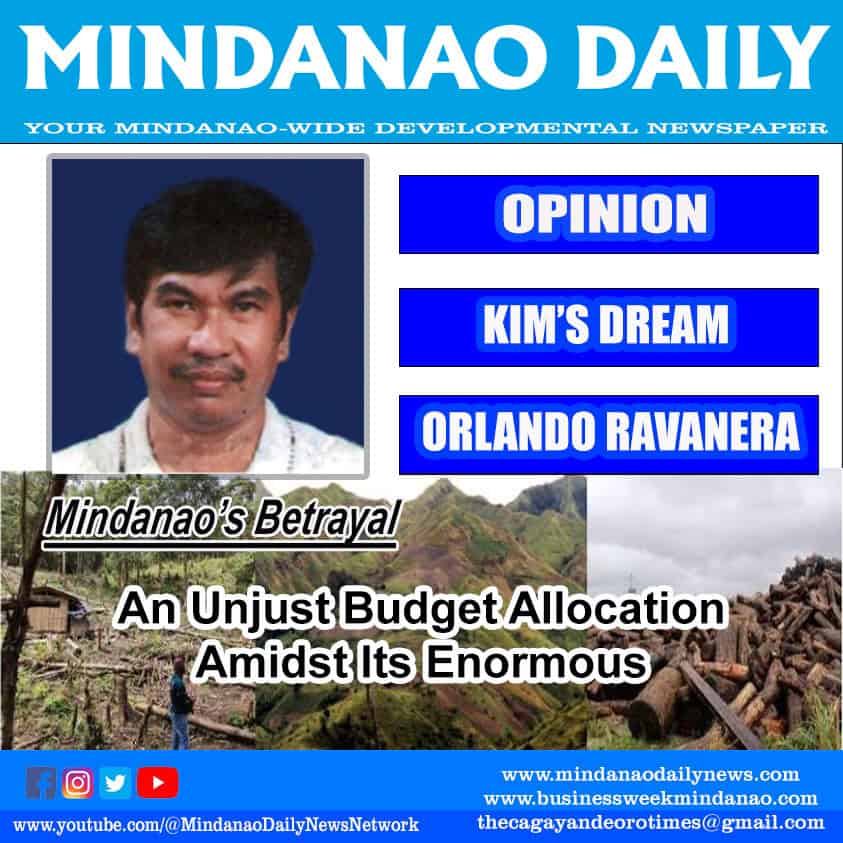
Mindanao’s Betrayal
An Unjust Budget Allocation Amidst Its Enormous Contribution to the Nation
It is both disheartening and disgusting to know that the Department of
Budget and Management (DBM) has allocated only a measly 15.4% of the national
budget to Mindanao, while Luzon receives some 24.4% and the National Capital
Region (NCR) enjoys 13.3%. This is not just a cold statistic, it is a painful truism
that shows a continuing pattern of neglect, marginalization, and injustice toward
Mindanao. Even more appalling is that this figure marks a decline in budgetary
allocation compared to previous years. Why is this so? Why is Mindanao, despite
its vast contributions to the national economy, continuously treated as a second-
class region?
This injustice becomes glaring when we examine the facts. Mindanao is one
of the largest contributors to the country’s Gross Domestic Product (GDP). It is
home to some 400,000 hectares of plantations, producing bananas, pineapples,
palm oil, rubber, and other crops for export. These plantations, operated mostly
by large multinational corporations, generate billions of pesos in taxes that flow
straight to the coffers of the national government. Yet despite this enormous
contribution, Mindanaoans see very little of that wealth returned in the form of
infrastructure, social services, or development projects. Instead, what they
experience is poverty, hunger, and ecological devastation.
Mindanao is not just rich it is overflowing with ecological abundance. It is
home to biodiversity found nowhere else in the country. Its forests once held
millions of hectares of dipterocarp trees and countless species of flora and fauna.
But over the decades, powerful logging companies protected by political patrons,
have plundered these forests, leaving behind bald mountains and fragile
ecosystems. The destruction of Mindanao’s forests has not only erased countless
species but has also increased the vulnerability of communities to floods,
landslides, and drought.
The wealth of Mindanao is not confined above the ground. Beneath its soil
lie 72 kinds of top-quality minerals: gold, silver, copper, nickel, and more. Yet
instead of being harnessed responsibly for the benefit of Filipinos, these minerals
are continuously being extracted illegally by foreign miners, most notably from
Korea and China. These operators import hundreds of millions worth of heavy
equipment, openly passing through the Bureau of Customs, which seems blind or
complicit. The question that screams for an answer is: Why has the government
allowed these destructive mining activities to continue, while local communities
suffer from polluted rivers, destroyed farmland, and ecological collapse?
If logging and mining were not enough, Mindanao also suffers from the vast
spread of corporate plantations. These massive agricultural estates use toxic
chemicals, herbicides, pesticides, and inorganic fertilizers, that have been banned
in many countries due to their health and environmental risks. Yet here in
Mindanao, they are sprayed liberally, poisoning the soil, contaminating the rivers,
and endangering the health of farmers and nearby communities. The land once
described as a paradise of biodiversity has now been converted into a chemical-
laden hellscape.
Foreign investors continue to profit from this exploitation. The high-value
fruits and palm oil they produce are exported abroad, satisfying consumerist
demands in advanced countries. The justification for allowing this destruction?
Their supposed “contributions” to the national GDP. But what kind of logic is this,
when the very land and people that generate this wealth are denied their fair
share of resources? Mindanao’s budgetary allocation remains so little, and the
people who sacrifice the most reap the least.
To add insult to injury, the government’s response to Mindanao’s ecological
collapse has been riddled with corruption. Billions of pesos have been allocated to
so-called flood control projects, supposedly to mitigate the disasters brought
about by deforestation and plantation expansion. Yet these projects are now
under Senate investigation, as many have been exposed as ghost projects,
phantom constructions designed only to channel money into the pockets of
contractors and corrupt officials. Instead of rebuilding ecological integrity and
uplifting the poor, public funds have become a playground for greed. This
corruption is doubly revolting when one considers that millions of Mindanaoans
live in hunger and extreme poverty, while a handful of the powerful grow fat on
ill-gotten wealth.
What should be foremost in the government’s agenda is the protection and
restoration of Mindanao’s ecosystems. Legislators must prioritize ending illegal
logging, illegal mining, and corporate plantation abuses, which are the root causes
of ecological disasters. Unfortunately, some lawmakers themselves are directly
involved in these exploitative activities, profiting from the destruction of the
environment they are sworn to protect.
The hypocrisy is staggering. Leaders speak of development, yet what they
deliver is destruction. They speak of economic growth, yet what they bring is
inequality. They boast of GDP contributions, yet they deny fair budgetary
allocation to the very region that sustains this economy.
It is time for Mindanawons to wake up. We cannot allow this dismal
budgetary injustice to continue. For too long, Mindanao has been treated as a
colony within a nation, its resources extracted, its environment destroyed, its
people neglected, its wealth stolen.
The message must be clear: Mindanao is the land of the brave and the free.
Its people must rise to demand what is rightfully theirs: a just share of the
national budget, respect for their environment, and recognition of their immense
contribution to the nation’s survival.
Let notice be served to the entire country: we will fight for what is right,
what is true, and what is just, all for God’s greater glory. The struggle for
Mindanao is not just about money. It is about dignity, justice, and the future of
our generation.
#