
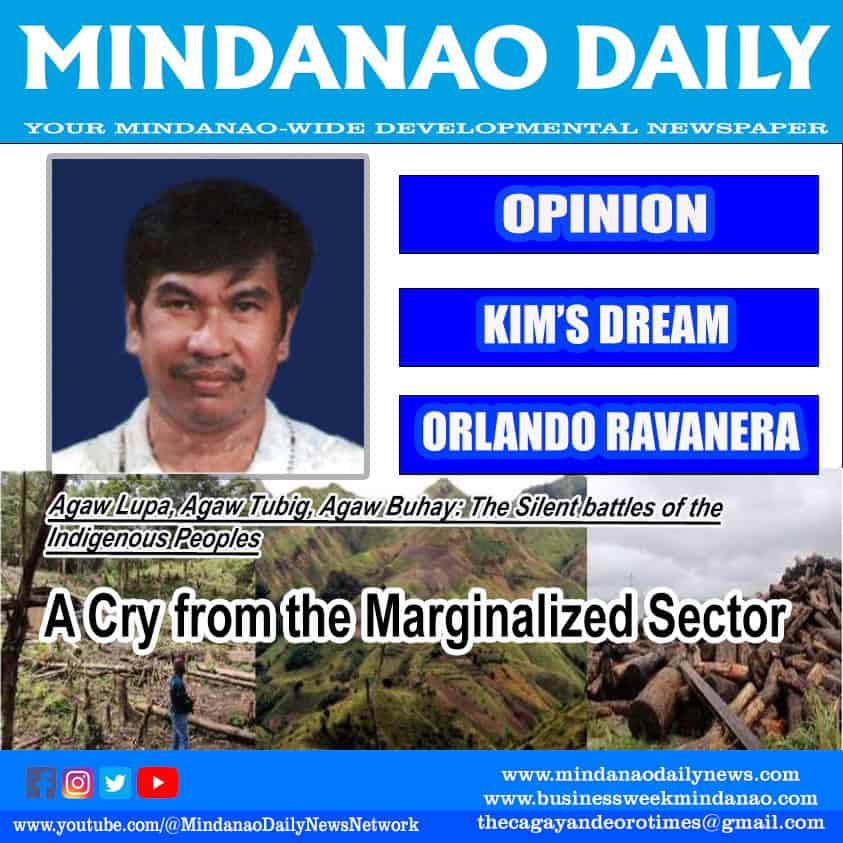
Agaw Lupa, Agaw Tubig, Agaw Buhay: The Silent battles of the
Indigenous Peoples
The Indigenous Peoples of the Philippines have long endured a painful
journey marked by displacement, injustice, and exploitation. Long before the
arrival of foreign colonizers, these communities thrived as highly civilized and
resilient societies. Their lives were deeply rooted in the land, rivers, forests, and
mountains that they considered sacred. For them, nature was not just a resource
to be consumed, but a home, a source of life, and the foundation of their culture,
spirituality, and identity.
Yet the paradise that once was the Philippines, a land overflowing with lush
forests, fertile soil, and rich biodiversity was gradually transformed into a haven
for greed and exploitation. What was once seen as a sacred gift became a
commodity in the eyes of colonizers, oligarchs, and modern corporations. The
blessings of nature that sustained our ancestors for centuries were taken,
commercialized, and exported for profit. Today, the Indigenous Peoples, the
original stewards of this land, find themselves among the poorest and most
oppressed in their own ancestral domains.
The Philippines was once blanketed by rich rainforests that stretched across
millions of hectares. These forests provided food, water, medicine, and shelter
not only for the Indigenous Peoples but for all Filipinos. But greed destroyed this
natural wealth. Unscrupulous loggers, driven by profit, decimated the forests,
leaving behind barren mountains and fragile ecosystems. The once-thriving
environment, home to countless species, was reduced to wastelands of
destruction.
As if logging were not enough, mining operations followed extracting
minerals from the very heart of the mountains. These destructive practices
poisoned rivers, displaced communities, and left gaping scars on the land. To
make matters worse, large-scale plantations of pineapple, banana, and cacao took
over vast tracts of land. These plantations, controlled by powerful corporations,
primarily serve wealthy foreign markets, while millions of Filipinos struggle with
hunger. It is a bitter irony: the land of abundance is now a land of scarcity for its
own people.
In the midst of this devastation, the Indigenous Peoples became the
greatest victims. Stripped of their ancestral domains, they were pushed to the
fringes of society. Their mountains and rivers were taken away, their sacred lands
desecrated, and their rights trampled upon. This phenomenon is not just about
environmental destruction, it is about the systematic disempowerment of the
very communities who have lived in harmony with nature since time immemorial.
One powerful example of this struggle is the story of Datu Ben Anoos, a
Lumad leader who has been courageously fighting for more than two decades to
reclaim the water source taken from his ancestral land in Talakag, Bukidnon. For
over 20 years, this water has been supplying thousands of residents, yet the
rightful Indigenous owners have been denied recognition and compensation.
Datu Ben has tirelessly sought the intervention of government institutions. He
requested an assessment from the National Commission on Indigenous Peoples
(NCIP), presenting legal documents and ancestral land titles to prove that he has
the rightful owner of the water source. Despite this, his claims have largely been
ignored, leaving him deprived of their basic rights.
Water is life. It flows from the earth as a gift of nature meant for all. Yet in
this case, what should be freely accessible to the Indigenous Peoples has been
commodified, controlled, and taken without due recognition of ancestral rights.
This is not merely a local dispute, it is a glaring symbol of how systemic injustice
operates in our country: the poor and powerless are denied justice, while the
wealthy and powerful continue to profit from stolen resources.
The struggle of Datu Ben is not an isolated case. It is the reality of countless
Indigenous leaders who, in defending their lands, often face threats, intimidation,
and even violence. Many Indigenous communities live in fear, caught between
powerful corporations, state neglect, and militarization. Yet, despite the fear, they
continue to fight not only for themselves but for the generations yet unborn.
Datu Ben’s story reflects a deeper truth: that the dispossession of Indigenous
Peoples is not just about land or water, but about life itself. “Agaw lupa, agaw
tubig, agaw buhay,” this is the painful reality. The grabbing of ancestral domains
strips communities of their livelihood, their identity, their dignity, and their
future. To steal the land and water of Indigenous Peoples is to steal their very
right to exist.
Still, despite poverty, hardship, and fear, leaders like Datu Ben refuse to
give up. Their struggle is not fueled by self-interest, but by a profound sense of
responsibility. They fight not only for their communities but for the greater
Filipino nation. After all, when Indigenous Peoples lose their lands, it is not only
their communities that suffer it is the entire country that bears the cost in the
form of environmental destruction, hunger, and social injustice. The plight of the
Indigenous Peoples is not just their fight; it is the fight of all Filipinos. The
destruction of our forests, rivers, and mountains affects every citizen. The hunger
of the tribe is a reflection of the nation’s hunger. The dispossession of ancestral
domains is the dispossession of our national soul.
True justice demands that the rights of Indigenous Peoples be recognized
and protected. Government institutions like the NCIP must not remain silent or
complicit. Instead, they must uphold the law, safeguard ancestral lands, and
ensure that Indigenous voices are heard. Corporations must be held accountable
for the harm they inflict, and society as a whole must stand in solidarity with our
Indigenous brothers and sisters. The story of Datu Ben Anoos is a reminder that
justice is not given freely it is fought for. It also reminds us that the Indigenous
struggle is not a relic of the past, but an urgent issue of the present. If we
continue to allow the exploitation of our Indigenous Peoples and the destruction
of our environment, we risk losing not only our natural wealth but also our
humanity.
In the end, this struggle is not just about land or water. It is about life. It is
about building a just society where no one is left behind, where the Indigenous
are honored as the first stewards of our land, and where the gifts of nature are
preserved for all and not plundered by the few. The time has come to say: enough
is enough! Let us stand with the Indigenous Peoples of the Philippines in their
fight for dignity, justice, and life.
###