
By Chris V. Panganiban
Inquirer Mindanao Bureau
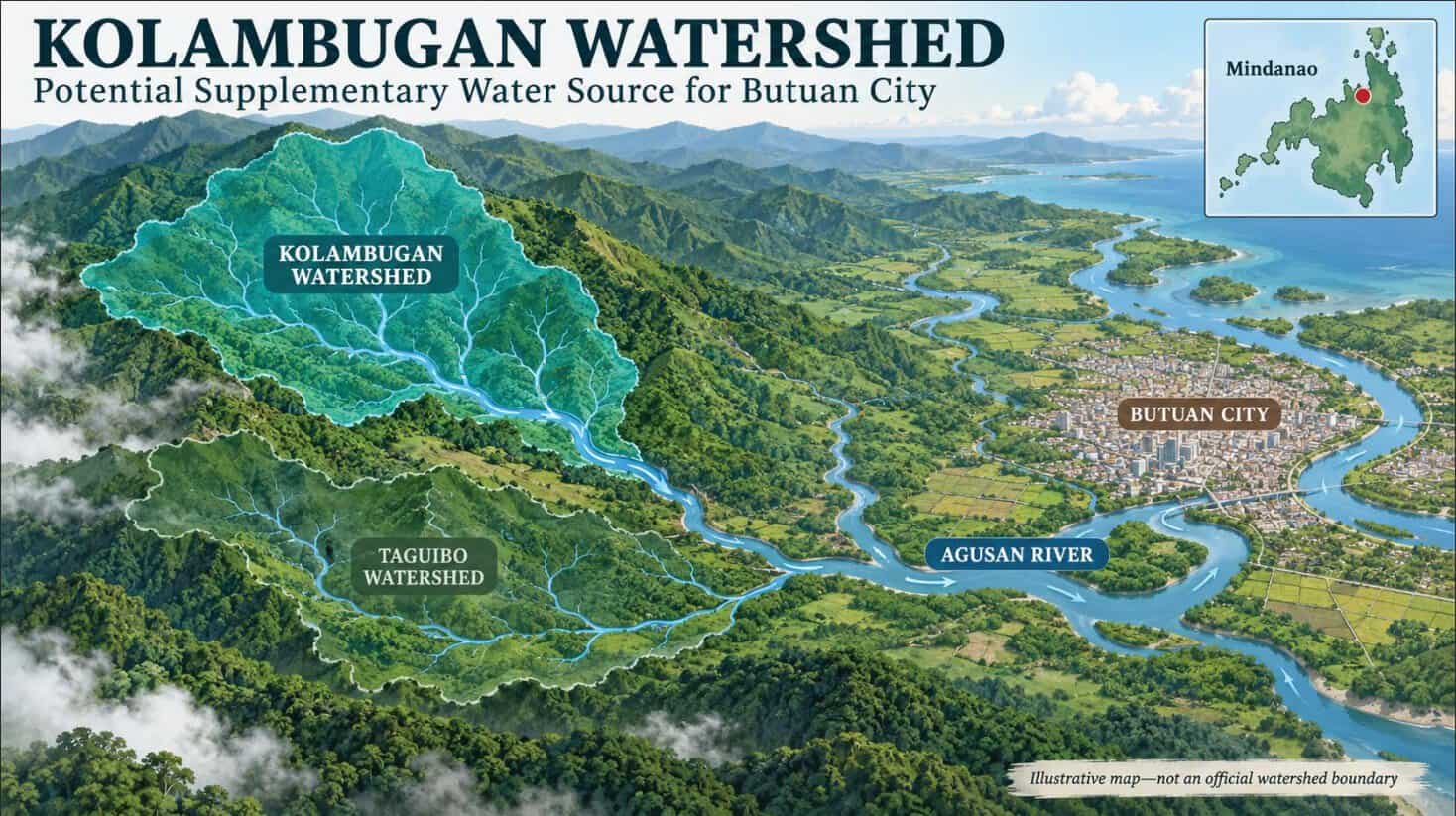
SAN FRANCISCO, Agusan del Sur — As Butuan City grapples with a severe water-supply crisis, a 2017 study identifying the Kolambugan watershed as a promising supplementary source is drawing renewed attention—and questions over whether its findings were ever acted upon.
Researchers from Caraga State University examined five watersheds near Butuan—Kolambugan, Padiay, Pianing, Simbalan and Guinabsan—amid concerns over the city’s increasing demand for potable water and heavy dependence on the Taguibo watershed.
The researchers compared the watersheds according to drainage area, river slope, soil characteristics and runoff potential. Kolambugan emerged as the most suitable candidate, with an area about three times larger than the Taguibo watershed, entirely silt-loam soil and the lowest average curve number among the sites assessed.
The study, presented at the 38th Asian Conference on Remote Sensing, was intended to guide authorities in identifying watersheds that could be explored as additional domestic water sources.
However, the research was only a preliminary watershed-characterization study—not a full feasibility assessment. It did not determine Kolambugan’s dependable year-round water yield, raw-water quality, environmental effects, treatment requirements, infrastructure needs or development cost.
Before Kolambugan could be tapped, authorities would still need to conduct detailed hydrological, environmental, water-quality and engineering studies. Water permits, land and right-of-way arrangements, community consultations and financing would also have to be secured.
The study did not examine the Agusan River as a direct source of potable water and should not be interpreted as proof that Kolambugan is immediately ready for development.
Nearly a decade later, no publicly accessible evidence has been found showing that the Butuan City Water District or the city government advanced Kolambugan to a full feasibility study. Neither has it been established that the recommendation was formally rejected.
One possible explanation is that BCWD was already heavily invested in the Taguibo Water Supply Development and Water Treatment Project before the CSU research was published. The existing project may have kept institutional attention and resources focused on improving Taguibo rather than developing a separate watershed.
The available evidence therefore supports only a cautious conclusion: Kolambugan was identified as a promising candidate based on preliminary characteristics, but it apparently did not progress—or cannot yet be shown to have progressed—to the comprehensive studies needed before development.
The question has become more urgent as prolonged dry conditions reduce the availability of water from Butuan’s existing sources.
Mayor Lawrence Fortun said declaring a state of calamity would allow the city government to accelerate emergency spending, mobilize additional agencies and establish temporary water systems. He acknowledged residents’ frustration but appealed for patience and cooperation while emergency measures were being implemented.
“This is not the time to quarrel. This is the time to work together as one community and one people of the city,” Fortun said. “We are one Balanghai.”
Beyond responding to the immediate shortage, the crisis has renewed calls for BCWD and other concerned agencies to explain what became of the alternative sources identified in 2017 and whether Butuan’s long-term water planning adequately diversified the city’s supply.
The key issue is no longer simply whether Kolambugan can provide water. It is whether the possibility was ever thoroughly investigated—and whether Butuan can afford to let another warning go unexamined.
###