N Insights
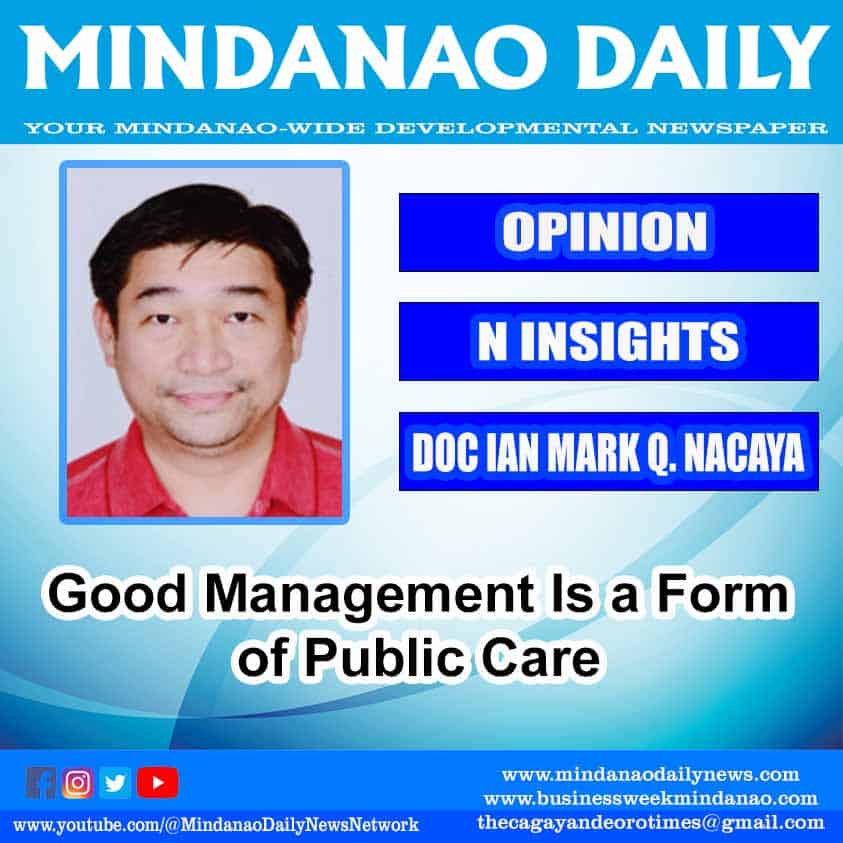
By Doc Ian Mark Q. Nacaya
Perspectives on Leadership and Community Life
Good management is not just paperwork; it is service that works.
When people think of public service, they often picture roads, schools, hospitals, or disaster response. Yet behind every successful government program is something less visible but equally important: good management. It may not attract headlines, but it determines whether public services reach people efficiently, fairly, and on time.
Good management is not merely about filing documents, preparing reports, or attending meetings. At its heart, it is about making systems work for people. Every policy, budget, project, or program succeeds only when it is supported by sound planning, organized implementation, consistent monitoring, and accountable leadership. In this sense, good management is one of the highest forms of public care because it transforms good intentions into meaningful outcomes.
However, the responsibility does not rest with government alone. Every organization, whether a private company, school, hospital, cooperative, non-government organization, homeowners’ association, or community group, depends on good management to serve people well. Likewise, every citizen contributes by respecting processes, providing honest feedback, participating responsibly, and holding institutions accountable. Good management is therefore a shared responsibility between institutions and society.
One of the greatest benefits of good management is that it creates clear and reliable systems. When procedures are organized, responsibilities are well-defined, and information is accessible, people receive faster and better service. Citizens spend less time waiting in lines, businesses process permits more efficiently, students receive educational services on schedule, and communities experience quicker responses during emergencies. A clear system reduces confusion, prevents unnecessary delays, and builds public confidence.
Good management also requires discipline in planning and follow-through. Plans should never remain as documents sitting on shelves. They must be translated into concrete actions, monitored regularly, and evaluated honestly. Effective managers ask important questions: Are our objectives being achieved? Are resources being used wisely? What problems need immediate attention? Continuous follow-up ensures that commitments become accomplishments rather than forgotten promises.
Equally important is accountability. Good managers do not simply assign responsibilities, they ensure that results are delivered. They welcome transparency, measure performance, and learn from both successes and failures. Accountability strengthens public trust because it assures citizens that every peso, every decision, and every action is directed toward the public good.
Time is another form of respect. Every hour a citizen spends waiting for a permit, clearance, medical service, or government assistance represents a cost. Public offices that value time, communicate clearly, simplify procedures, and focus on results demonstrate genuine concern for the people they serve. Efficiency is not about rushing work; it is about removing unnecessary obstacles while maintaining quality and fairness.
Ultimately, a well-managed office reflects a government that values its citizens. Clean records, organized workflows, responsive personnel, and measurable outcomes communicate a simple but powerful message: your time matters, your concerns matter, and your government is working for you.
In the end, public care is not shown only through speeches or ambitious programs. It is demonstrated every day through competent management, responsible leadership, and institutions that consistently deliver results. Good management may happen quietly behind office doors, but its impact is felt in every family served, every community strengthened, and every citizen whose trust in government is affirmed.
About the Author
Dr. Ian Mark Q. Nacaya is a public administration scholar, urban governance practitioner, and former six-term City Councilor of Cagayan de Oro City. He also served as a two-time Sectoral Representative to the City Council – first as SK City Federation President and later as Liga ng mga Barangay President, and was a three-term Majority Floor Leader. He is the Founder of NACAYA Public-SectoralDev Insights Consulting and serves as a graduate school professor in public administration courses.
###