

From the Sidelines
By: Ray G. Talimio Jr.
“A few billion pesos may look small inside a P7.2T national budget. Add thousands of questionable appropriations, shortcuts and insertions together, however, and they help explain why government keeps spending beyond its means.”
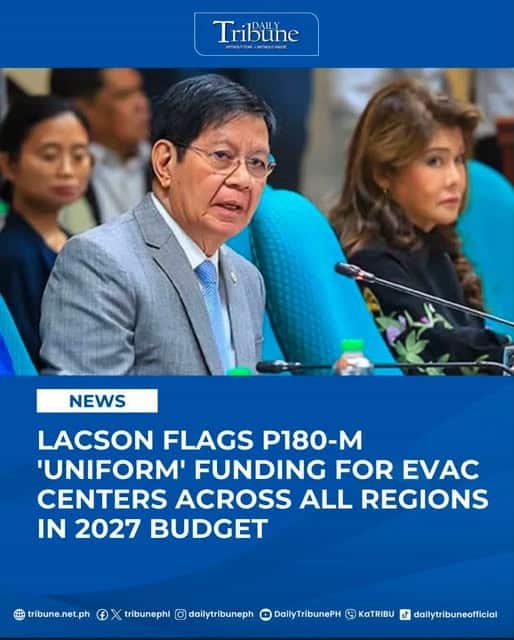
Senator Panfilo “Ping” Lacson has flagged a disturbing item in the proposed 2027 national budget: a uniform P180M allocation for evacuation centers in each of the country’s 17 regions, totaling more than P3B.
Evacuation centers are necessary. But how could 17 regions with vastly different populations, geography, disaster risks, land values and construction requirements conveniently need exactly P180M each?
Worse, Lacson said the allocations lacked crucial details, including specific locations.
Call it lazy or “tamad” budgeting.
A government project should begin with an identified need, location, capacity, engineering requirements and reasonable cost estimate. The appropriation should follow the project, not the other way around.
This becomes more disturbing because government already has an elaborate regional planning and budget-review process.
Regional Development Councils (RDCs), supported technically by the Department of Economy, Planning and Development (DEPDev) regional offices, review regional agency budget proposals for consistency with regional development priorities. These proposals eventually move to the central offices of the respective agencies for consolidation into their national budget submissions.
So what happened?
Where did the identical P180M evacuation-center allocation for every region originate?
Did 17 regions independently determine that they each needed exactly P180M? Or did these identical amounts appear later during agency consolidation or somewhere else in the national budget process?
Congress should find out.
Republic Act No. 12076, or the Ligtas Pinoy Centers Act, makes the question even more compelling. The law requires priority local government units to be identified based on coping capacity, hazard susceptibility, exposure, vulnerability and readiness. Annual targets and corresponding budgetary requirements are also required.
The Department of Public Works and Highways (DPWH) is tasked with constructing the evacuation centers, while the National Disaster Risk Reduction and Management Council, through the Office of Civil Defense, coordinates with DPWH and other agencies on specifications, cost estimates and construction details.
In short, need should determine the budget.
But lazy or “tamad” budgeting is only one way public spending unnecessarily grows.
Representative Toby Tiangco has raised another troubling issue involving the House of Representatives itself. He questioned why the House budget is not subjected to the same pre-plenary scrutiny imposed on executive departments.
Tiangco pointed to the dramatic expansion of the House budget during the previous budget process. An amount originally around P17B eventually reached approximately P27B after congressional action and insertions.
That is roughly P10B in additional spending involving just one institution.
His point raises a fundamental question: How can Congress demand detailed justification and accountability from executive agencies while its own budget does not undergo equivalent public scrutiny?
Put Lacson’s and Tiangco’s observations together and we begin seeing the bigger fiscal problem.
On one side are poorly detailed, conveniently uniform or inadequately scrutinized appropriations. On the other are billions added during congressional deliberations.
Then government wonders why the deficit keeps growing.
The Development Budget Coordination Committee (DBCC) projects a 2027 fiscal deficit of approximately P1.695T.
Now imagine scrutinizing every portion of the P7.2T proposed national budget with the same intensity.
Find P3B in questionable appropriations here. Remove P10B in unnecessary additions there. Discover another P20B in duplicated, excessive, poorly prepared or non-priority projects elsewhere.
Then keep going.
Billions become tens of billions. Tens of billions become hundreds of billions.
This is where seemingly small budgeting mistakes become a massive fiscal problem.
If thousands of appropriations were thoroughly scrutinized and the resulting savings accumulated, the projected P1.695T deficit could be substantially reduced. Combined with stronger revenue collection and disciplined expenditure management, government could conceivably drive the deficit dramatically lower, perhaps even move toward a balanced budget.
Every P1B removed from an unnecessary or excessive expenditure is potentially P1B government no longer needs to borrow.
Budget scrutiny is therefore deficit reduction.
This is precisely why the budget process should never be expedited merely to meet a legislative timetable. Congress is examining trillions of pesos involving thousands of programs and projects. Rushing that process creates fertile ground for shortcuts, duplication, questionable costing and insertions that escape scrutiny.
The 2027 budget should not be a race toward approval.
Congress must ask: Where is the project? Who requested it? Was it subjected to RDC review? How was the amount computed? When was it added? Who proposed or inserted it? Is it actually necessary?
And Congress must subject its own budget to exactly the same standard.
Before government tells Filipinos that another trillion-peso deficit is inevitable, it should first prove that it has exhausted every opportunity to eliminate waste, duplication, questionable insertions and lazy or “tamad” budgeting.
Because our fiscal deficit is not necessarily created by one gigantic mistake.
It can also be the accumulated cost of thousands of smaller ones that government failed to catch.
Enough with this mess.
Sources: Daily Tribune, report on Senator Panfilo Lacson’s scrutiny of uniform P180M evacuation-center allocations, August 18, 2026.
INQUIRER.net, report on Representative Toby Tiangco’s call for scrutiny and transparency of the House of Representatives budget, August 17, 2026.
Department of Economy, Planning and Development, FY 2027 RDC budget-review guidelines and regional budget-review issuances.
Republic Act No. 12076, Ligtas Pinoy Centers Act.
Development Budget Coordination Committee, FY 2027 fiscal program.
Photo Credit: Daily Tribune / Senate of the Philippines.
Disclaimer: The views and opinions expressed in this article are those of the author and are based on publicly available information and reports. They are intended to encourage discussion on fiscal responsibility, prudent government spending, transparency and public accountability.
About the Author: Ray G. Talimio Jr. is a Certified Public Accountant (CPA), economist, tax advisor, columnist and business consultant. He is a Past President and Past Chairman of the Cagayan de Oro Chamber of Commerce and Industry, former Co-Chairman of the Regional Development Council-X Economic Development Committee, former Chairman of the MSME Development Council of Misamis Oriental and Cagayan de Oro, former Chairman of BIMP-EAGA Northern Mindanao, a PICPA National Officer, and a member of ACPAPP. He writes on economics, taxation, governance, public accountability and national development.
###