From the Sidelines
By: Ray G. Talimio Jr.
“The peso breaking P62 to the dollar may help exporters earn more pesos, but in an import-dependent economy, that advantage can quickly disappear.”
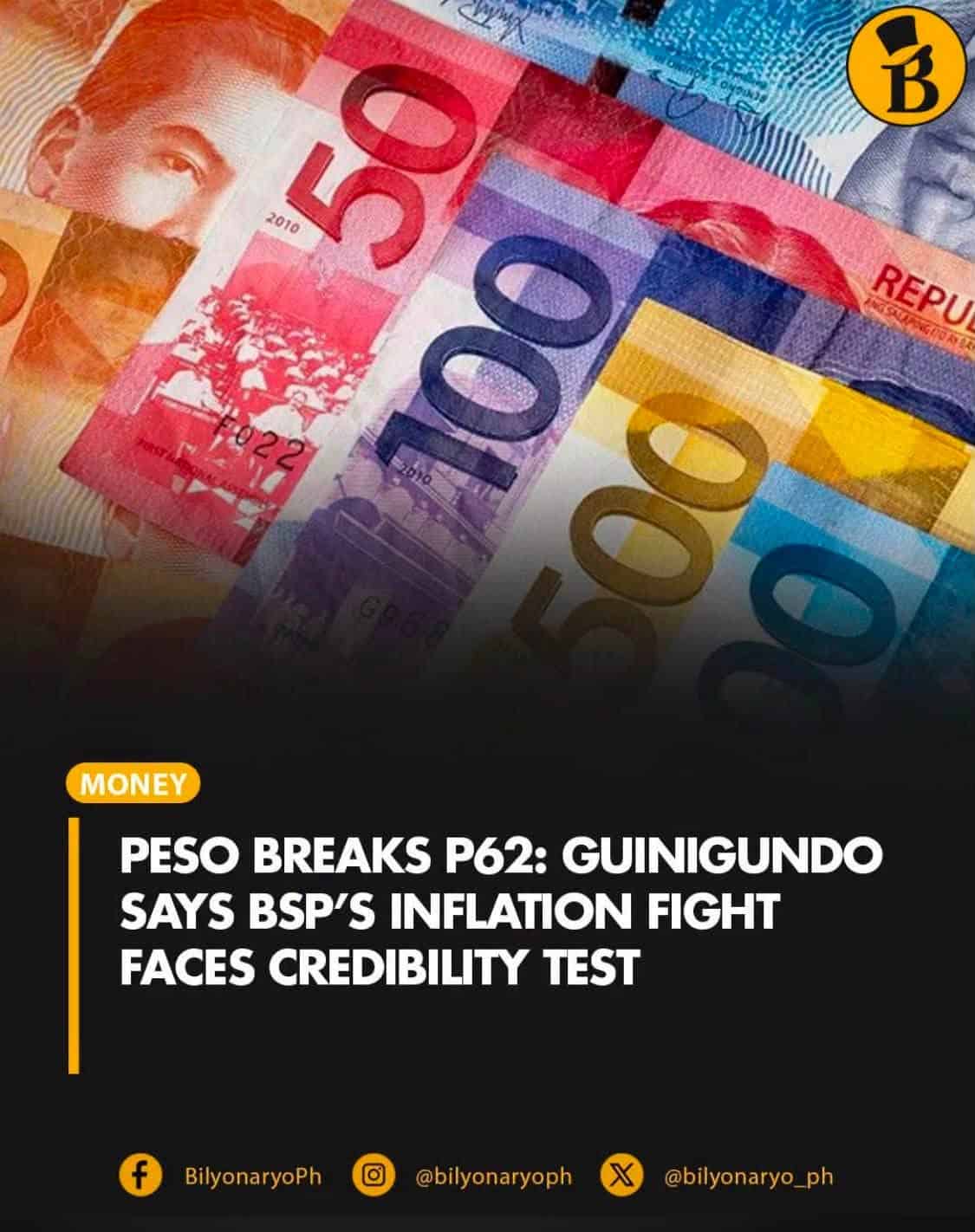
The Philippine peso has crossed another psychological barrier, weakening to around P62.40 to $1, despite the Bangko Sentral ng Pilipinas (BSP) raising its policy rate by 25 basis points to 5%.
Former BSP Deputy Governor Diwa Guinigundo warned that the BSP may have to do more to convince markets that it is committed to containing inflation. Normally, higher interest rates make peso investments more attractive, encourage demand for pesos and help stabilize the currency. But the peso continued weakening.
Why?
One explanation lies in our external accounts.
The Philippines recorded a $1.47B balance-of-payments (BOP) deficit in July, while the current-account deficit reached $5.66B in the first quarter of 2026.
In layman’s terms, the current account is like the country’s income-and-expense account for its regular transactions with the rest of the world.
We earn foreign currency when we export semiconductors, bananas and other products; when IT-BPM companies sell services overseas; when foreign tourists spend here; and when OFWs send money home.
We spend foreign currency importing petroleum, machinery, electronics, food, medicines, fertilizers and industrial raw materials.
If our regular foreign payments exceed these foreign-currency earnings, we have a current-account deficit.
This helps explain the pressure on the peso. From January to July 2026, merchandise exports reached approximately $54.92B, but imports climbed to $92.26B, producing a trade deficit of about $37.34B. Our strong IT-BPM earnings and OFW remittances help offset this huge merchandise deficit, but not always completely.
More imports mean greater demand for dollars. Importers sell pesos to buy dollars, increasing pressure on the exchange rate.
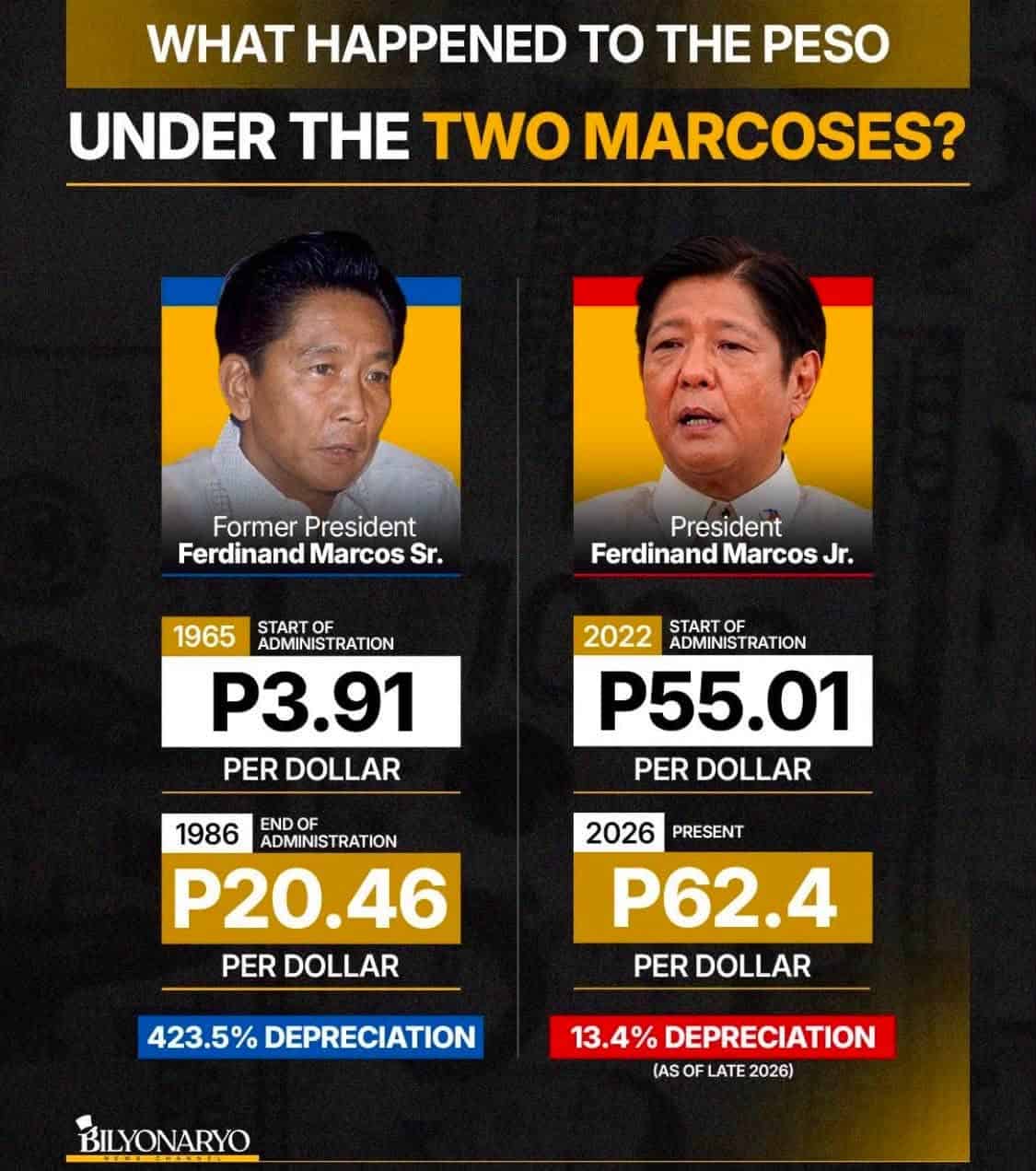
The historical comparison is also striking. When Ferdinand Marcos Sr. assumed office in 1965, the peso was around P3.91:$1. By 1986, it was above P20. President Ferdinand Marcos Jr. inherited a peso at around P55:$1 in 2022, compared with approximately P62.40 today.
But these figures should not be treated simply as presidential scorecards. Exchange-rate regimes and economic conditions across these periods were vastly different.
Neither should exporters automatically celebrate a weaker peso.
An exporter receiving $1M gets approximately P62M at P62:$1 instead of P55M at P55:$1. But Philippine exporters also import machinery, components, fuel and raw materials. What they gain from converting export dollars into pesos can therefore be eaten up by higher production costs.
The same weakness produces imported inflation. Oil, medicines, fertilizers, machinery and food become more expensive in pesos, eventually raising transportation, electricity, manufacturing and consumer prices.
The BSP can raise interest rates further, but there is a price. More expensive credit can discourage consumption, investment and business expansion.
The sustainable solution is structural: export more, produce locally more of what we import, strengthen manufacturing and domestic supply chains, move higher in the semiconductor value chain, and expand IT-BPM, tourism and other dollar-earning industries.
A weak currency is not necessarily a competitive currency.
Currency weakness is not economic competitiveness.
The objective should not simply be to defend a particular exchange rate. It should be to build an economy productive and competitive enough to earn the dollars it needs without continually putting the peso under pressure.
Sources: Bangko Sentral ng Pilipinas; Philippine Statistics Authority; GlobalSource Partners; Bilyonaryo.
Photo Credits: Bilyonaryo.
Disclaimer: Historical exchange rates are not directly comparable without considering differences in exchange-rate regimes, inflation and domestic and global economic conditions. This article is for economic analysis and public discussion.
About the Author: Ray G. Talimio Jr. is a Certified Public Accountant (CPA), economist, tax advisor, columnist and business consultant. He is a Past President and Past Chairman of the Oro Chamber, former Co-Chairman of the RDC-X Economic Development Committee, former Chairman of the Micro, Small and Medium Enterprise Development (MSMED) Council of Misamis Oriental and Cagayan de Oro, former Chairman of BIMP-EAGA Northern Mindanao, a PICPA National Officer and an ACPAPP member.
#PesoDollarExchangeRate
#TradeDeficit
#CurrentAccountDeficit
#PhilippineEconomy
###