
Digitalization is no longer a future trend; it has become the dominant force reshaping economies, workplaces, and human life. At the centre of this transformation is artificial intelligence (AI). This transformation changes how organizations make decisions, produce goods and services, communicate with customers, and manage knowledge. The critical challenge for universities is that technological development outside the classroom is moving faster than the traditional processes Universities should redesign, approve, and revise academic curricula.
The above condition creates a serious gap between university education and labour-market reality. Students may spend four years studying a curriculum that was relevant when it was designed but has become partially outdated by the time they graduate. Meanwhile, industries are increasingly demanding competencies in AI and big data, cybersecurity, technological literacy, creative thinking, and continuous learning. The World Economic Forum (2025) estimates that 39% of workers’ existing skill sets will be transformed or become outdated by 2030. AI and big data are also identified as among the fastest-growing skills, alongside technological literacy and cybersecurity.
The implication for universities is clear: a degree alone is no longer sufficient evidence of employability. Graduates must demonstrate that they can apply knowledge in rapidly changing contexts. Yet the problem is not simply that universities teach too little technology. In many cases, the deeper problem is that curricula remain too rigid, discipline-based, and disconnected from the speed of industrial transformation.
UNESCO IESALC (Valentini & Blancas, 2025) identifies a critical gap between the rapid adoption of AI and the institutional capacity of higher education to respond systematically. Universities may introduce individual AI courses or permit students to use generative AI, but isolated initiatives are insufficient. AI is becoming a cross-disciplinary technology that affects business, engineering, health, education, law, communication, and the humanities. Consequently, universities must develop AI literacy across disciplines rather than treating AI as the exclusive domain of computer science.
However, universities should not respond by simply replacing traditional knowledge with technical training. This would be another mistake. AI itself changes rapidly. A particular software application may disappear within a few years, while the ability to think critically, solve problems, evaluate evidence, communicate, collaborate, and learn independently remains essential. The OECD (2026) therefore emphasizes the importance of combining foundational knowledge, digital and ICT competencies, and complementary human skills such as creativity, critical thinking, and collaboration.
The real challenge, therefore, is curriculum agility. Universities should develop mechanisms for updating competencies more rapidly, using labour-market intelligence, industry partnerships, professional practitioners, and graduate feedback. The traditional curriculum review conducted every several years is increasingly inadequate for the digital economy.
Universities also need to strengthen experiential learning. Internships, industry projects, simulations, micro-credentials, and work-integrated learning can reduce the distance between academic knowledge and professional practice. Employers are increasingly searching not only for what graduates know, but also for what they can do.
Digital disruption is therefore not merely a technological problem. It is an institutional challenge. Universities must transform from institutions that primarily transfer established knowledge into organizations that continuously renew knowledge and competencies. If they fail to do so, graduates may possess degrees but lack market relevance. If they succeed, universities can remain essential institutions for preparing people not merely for their first job, but for repeated adaptation throughout their working lives.
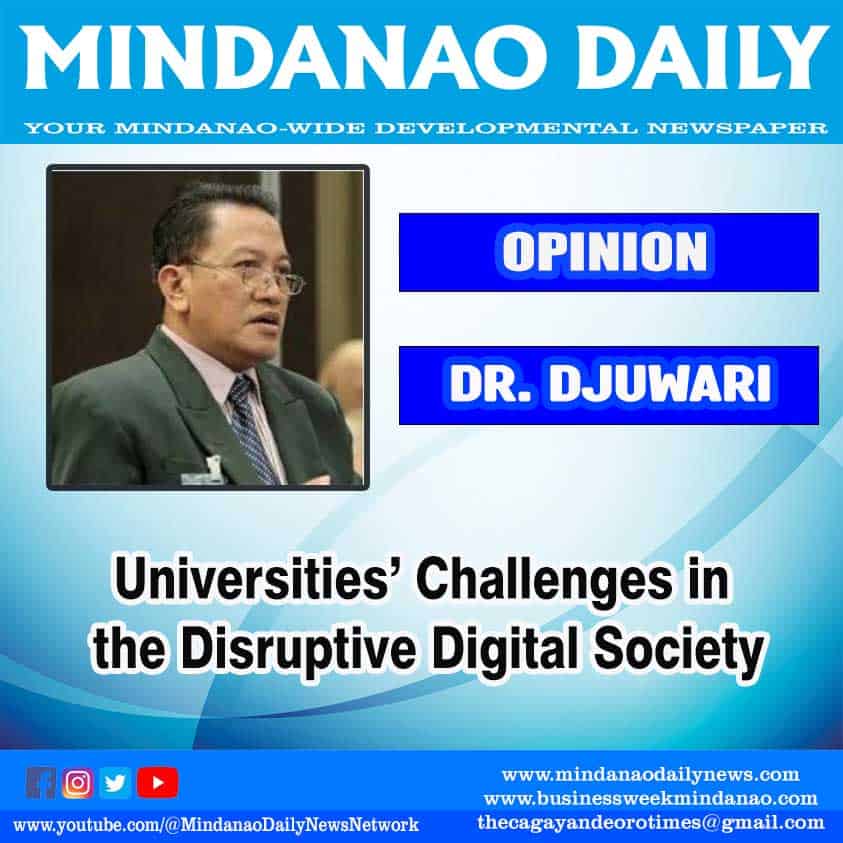
Dr. Djuwari is a scholar who received an Award of Peace and Humanity from the World United Humanitarian Organization (UHO), based in the UK, in 2026. The President of the International Association of Scholarly Publishers, Editors, and Reviewers (IASPER) lives in Surabaya, Indonesia
###