

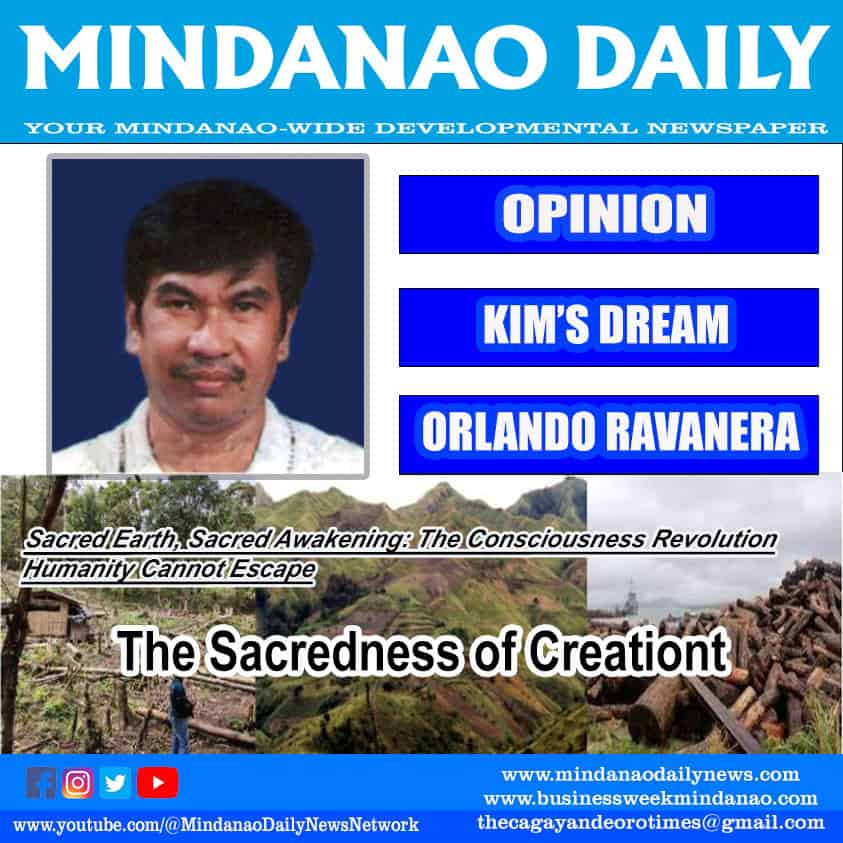
Kim’s Dream Orlan Ravanera
Sacred Earth, Sacred Awakening: The Consciousness Revolution Humanity Cannot Escape
In every sunrise that breaks over the mountains, in every river that carves its path through the valleys, and in every child born into this fragile world, there is a silent proclamation: Creation is Sacred. Res Ipsa loquitur. The thing speaks for itself. The breathtaking beauty of nature silently proclaims a truth that words can barely contain: creation reflects the Creator. The vast forests, cascading waterfalls, soaring mountains, and endless seas are not accidents of chaos. They are manifestations of the Unseen Being whom many call God. Throughout history, humanity has attempted to portray God in paintings, sculptures, and religious icons. One famous example is the artistic depiction attributed to Leonardo da Vinci. Yet we must ask: can the fullness of the Divine truly be captured by human imagination? Or is the truest image of God not found on canvas, but in the living masterpiece of creation itself?
Is it not more accurate to say that creation is the reflection of the Creator?
For many Indigenous Peoples, this is not a philosophical question but a lived reality. They do not worship a painted image; they revere the forests, rivers, mountains, and waterfalls as sacred manifestations of divine presence. To protect nature is, for them, the highest form of worship. They are willing, even ready to give their lives to defend the ecosystems that sustain all life.
In the Philippines, Indigenous communities have formed human barricades, lying down on roads to stop logging trucks from entering their ancestral forests. Imagine the courage it takes to face massive ten-wheeler trucks in the dead of night, risking death simply to protect trees, watersheds, and wildlife. This is not extremism; it is sacrificial love. Similarly, in India, the Chipko Movement demonstrated profound devotion to nature. Villagers, especially women, embraced trees with their bodies to prevent loggers from cutting them down. They declared that the axe must strike their backs before it touched the trees. Such acts reveal a truth often forgotten in modern society: there is no greater love than to give one’s life for something sacred.
This oneness with nature reflects the divinity of the Creator far more vividly than any artwork ever could. Consider Mindamora Falls in Mindanao. For Indigenous communities, such places are sacred. When they pray to Magbabaya, the Creator, they face the waterfall, not a painting in a church. The three-tiered cascade of flowing water from the watershed, the eagles circling overhead, the vibrant flowering plants, the towering trees, and the tarsiers leaping from branch to branch all form a living sanctuary. This is beauty beyond comparison. It is a beauty worth defending.
Yet, despite this sacredness, we have allowed the systematic destruction of our ecosystems. In the Mt. Kalatungan–Kitanglad Range, once considered an invincible water source, logging operations and sawmills were established within dipterocarp forests. Massive denudation followed. Hundreds of thousands of hectares were stripped bare. Flora and fauna species that had existed for millions, perhaps billions, of years were wiped out within a few decades.
Why have we allowed this? Why have we stood silent as forests, rivers, seas, and agricultural lands were destroyed in the name of greed and profit? These ecosystems were once home to billions of living beings. Today, many have vanished due to the actions or inaction of Homo sapiens, ironically named the wise human. Through sins of commission and omission, we have become the most destructive species on Earth. While we kneel inside churches, countless crimes against nature continue outside. Birds lose their habitats. Fish die in polluted waters. Animals are driven to extinction. Entire ecosystems collapse silently. Their suffering is invisible to us because we assume their problem is not our problem. But nature teaches us a fundamental law: everything is interconnected.
The destruction of forests leads to floods and landslides. The loss of biodiversity weakens food systems. The pollution of oceans disrupts climate patterns. What we do to nature inevitably returns to us. Thousands die each year from typhoons, floods, droughts, and hunger, many intensified by climate change. Our country ranks among the most vulnerable nations in the world to climate impacts. Scientists warn that humanity is in a planetary emergency metaphorically described as “one minute before midnight.” Mother Earth, often called GAIA, is facing what many scientists describe as the sixth mass extinction. Unlike previous extinctions caused by natural forces, this one is driven by human activity.
At the same time, nearly a quarter of the world’s population faces food insecurity due to declining soil fertility, water scarcity, and loss of genetic diversity. Yet the global economic system continues to chase the illusion of endless growth. A small percentage of corporations and elites control much of the world’s wealth, often sacrificing people and ecosystems on the altar of profit. This is not merely economic injustice; it is a form of invisible violence. Environmental destruction kills silently. It displaces communities, creates hunger, and deepens poverty. Some environmentalists describe this as a “Third World War,” a war waged in peacetime, without uniforms, yet involving the largest number of casualties.
Despite overwhelming scientific evidence, climate change denial persists. Networks of powerful interests, think tanks, corporations, and political groups have invested heavily in spreading confusion and delaying climate action. Even international gatherings such as global climate conferences often struggle against the pressure of corporate influence. Meanwhile, consumerism and materialism continue to dominate our culture. We have been created in the image and likeness of God. Yet instead of reflecting divine compassion and stewardship, humanity has often reduced God to its own image, projecting greed, domination, and control onto the Divine. What we urgently need is a new consciousness. This consciousness recognizes the sacredness and interconnectedness of all life. It understands that we are not separate from nature but part of it. We are connected to what mystics call the Great Stillness, the silent, sustaining Presence behind all existence.
True spirituality is not merely ritual. It is awakening. To reconnect with the Great Stillness of nature, the trees, the rivers, the birds, the stars, is to rediscover humility. It is to quiet the restless, ego-driven mind that seeks power, profit, and endless consumption. The current ecological crisis is not merely environmental; it is spiritual. It reflects a moral collapse and a deep inner disconnection. Yet there is hope. When we rediscover inner peace, a peace that “passes all understanding,” we begin to act differently. From that peace arises compassion. From compassion comes justice. From justice flows responsible stewardship. Saving the Earth does not begin only with policies and technologies, though these are important. It begins with awakening an inner transformation that leads to outer change.
We are stewards, not owners, of creation. The forests, rivers, oceans, and wildlife are not commodities to exploit but sacred trusts to protect. If we awaken to this truth, we can still prevent further destruction. If we reconnect with the sacredness and oneness of life, we can choose regeneration over ruin. The call is urgent, wake up, reconnect, protect what remains, restore what has been damaged, and defend the voiceless. Through inner peace and collective action, we can honor the Creator by safeguarding creation. The future of GAIA and of humanity itself depends on this awakening. May we have the courage to respond before midnight strikes.
###