

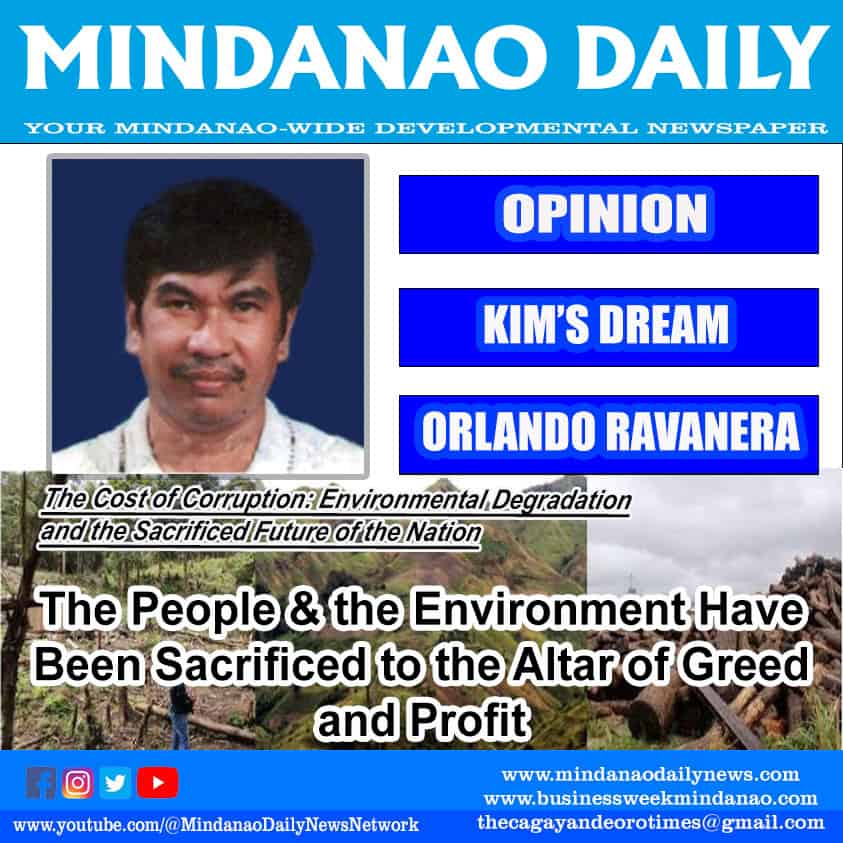
The Cost of Corruption: Environmental Degradation and the Sacrificed Future of the Nation
The Philippines, once described as an Eden-like paradise, was richly blessed with extraordinary ecological wealth and beauty. Towering forests, pristine rivers, fertile valleys, and abundant wildlife once defined our nation’s landscape. The earth beneath held treasures of mineral wealth, while above, vast dipterocarp forests stood as towering guardians of life, sustaining both people and countless endemic species. But this natural inheritance, our birthright was subjected to centuries of exploitation. First, through colonial plunder; then, through neo-colonial domination that reduced our country into either a source of raw materials or a captive market for foreign powers.
Today, we ask the painful question: Where have all our 17 million hectares of dipterocarp forests gone? The answer is both simple and tragic gone to loggers, one and all, as the Philippines became one of the world’s major suppliers of timber in the last century. This ecological destruction, fueled by greed and perpetuated by corruption, has left behind not only barren mountains and devastated watersheds but also a wounded people facing climate catastrophes, poverty, and displacement.
Mindanao, long celebrated as the “Land of Promise,” became one of the principal targets of logging companies. In the latter half of the twentieth century, at least six powerful logging corporations operated with impunity. Every midnight until dawn, convoys of fifty ten-wheeler trucks loaded with massive logs thundered through the streets of Cagayan de Oro, guarded by men carrying AK-47s and Armalites. These operations were far from legal. They cut deep into prohibited zones areas above 1,000 meters in altitude and slopes steeper than 50% gradient, places that should never have been touched because of their ecological sensitivity.
The trees felled were among the Philippines’ most precious species Almacega, Red lauan, Narra, mahogany giants of the forest whose timber commanded exorbitant prices abroad. A single shipment could yield profits of ₱360 to ₱400 million, money that was systematically shared with law enforcers, checkpoint guards, and officials from the very agencies tasked to protect the forests. What was meant to be preserved as the natural capital of the nation was instead converted into quick wealth for a select few. The ecological costs were devastating: eroded mountainsides, silted rivers, flooded communities, and the permanent loss of biodiversity.
Faced with the government’s inaction and complicity, people’s organizations had no choice but to take direct action. In the 1990s, Task Force Macajalar, an environmental coalition for peace, justice, and sustainability, launched human barricades in Cagayan de Oro. Hundreds of people lay down across the streets in Upper Carmen, fronting SEARSOLIN, daring logging trucks to run over them before they could pass.
The struggle was fraught with danger. One early dawn, a hand grenade an M2K2 was hurled at the barricade. By sheer miracle, it did not explode. Confrontations with loggers revealed the depth of corruption: one of them, a certain the late 2nd Lt. Modesto Eleazar, boasted that “you cannot stop us, as 90% of the personnel in that office are in our payroll.” Indeed, every logging truck that passed a checkpoint reportedly paid ₱5,000 in bribes. Worse, the trucks seized and turned over to authorities were released within a day or two, nullifying the sacrifices of environmental defenders.
This stark reality exposed what many had already suspected: systemic corruption was the root cause of ecological destruction. Laws were in place, but they were merely words on paper when government officials themselves were part of the plunder. The ecological tragedy of the Philippines is not confined to what was above ground. Beneath the earth lies another form of wealth: an estimated seventy-two kinds of high-quality minerals, particularly abundant in Mindanao. Like the forests, these resources became a magnet for exploitation, often by foreign corporations.
In 2014, Task Force Kinaiyahan, implementing a Writ of Kalikasan, apprehended five Chinese nationals engaged in illegal mining in Tumpagon, Cagayan de Oro. These men, carrying only tourist visas, had established a fully operational mining site. The camp contained heavy equipment backhoes, and bulldozers alongside high-powered firearms and even hand grenades. Yet despite these violations, the miners were detained for only a week before being escorted back to China by a high-ranking elected official.
Once again, systemic corruption revealed itself as the silent partner of plunder. Laws were bent, national sovereignty was compromised, and the environment paid the ultimate price. The disappearance of forests and the unregulated mining of mineral resources have had catastrophic consequences for both the environment and the Filipino people. The United Nations has ranked the Philippines as the fourth most climate-vulnerable country in the world. Massive flooding, landslides, and typhoons have already claimed thousands of lives and displaced millions more.
Forests once served as natural shields against flooding, absorbing rainfall and stabilizing soil. With their destruction, mountains have turned into open wounds, bleeding mud and rocks into rivers and lowland communities. Mining operations, meanwhile, poison rivers with heavy metals, rendering water unsafe for drinking and agriculture.
These disasters are not “acts of God.” They are man-made calamities, rooted in greed and facilitated by corruption. The poor suffer the most, losing their homes, farms, and livelihoods. Entire communities are condemned to cycles of disaster and poverty, while the wealthy corporations and complicit officials continue to amass profit. The narrative of environmental destruction in the Philippines cannot be divorced from the larger story of systemic corruption. From the release of seized logging trucks to the quick repatriation of illegal foreign miners, corruption ensures that laws meant to protect the environment are reduced to hollow words.
Officials entrusted with safeguarding the nation’s ecological wealth instead become partners of its destruction. Agencies meant to uphold justice and sustainability instead perpetuate injustice and ecological collapse. This paradox where guardians become violators reveals not only a governance crisis but also a profound moral decay.
Corruption does not merely steal money; it steals futures. It endangers millions of lives by destroying the environment upon which they depend. It transforms government into a predator instead of a protector. It erodes morality and spirituality, replacing them with unbridled materialism and consumerism. The crisis is not merely ecological or political, it is deeply moral and spiritual. When government officials collude with oligarchs and corporations to exploit the environment, they betray not only the people but also the very principles of justice, stewardship, and compassion.
Our country, once richly blessed, has been reduced to a jungle-like existence governed by the law of the survival of the fittest. In this jungle, morality is replaced by greed, compassion by indifference, and spirituality by the worship of a false god, the power of money. The result is a society that appears civilized on the surface but is, in truth, barbaric in its exploitation and disregard for life.
The story of the Philippines’ ecological destruction is a story of betrayal, betrayal of people, of future generations, of creation itself. It is also a story of resistance, embodied by communities and organizations that dared to confront the plunderers, often at great personal risk.
But resistance alone is not enough. What is needed is a radical transformation of governance and values. Corruption must be rooted out not only through legal reforms but also through a cultural and spiritual awakening that restores morality, compassion, and reverence for nature. Our Eden may have been pillaged, but renewal is still possible. If we confront corruption with courage, challenge greed with solidarity, and restore the sacredness of nature in our hearts and laws, then we may yet reclaim our nation’s true wealth not in money, but in life, justice, and sustainability To God be the glory!
###