

By Chris V. Panganiban
Inquirer Mindanao Bureau
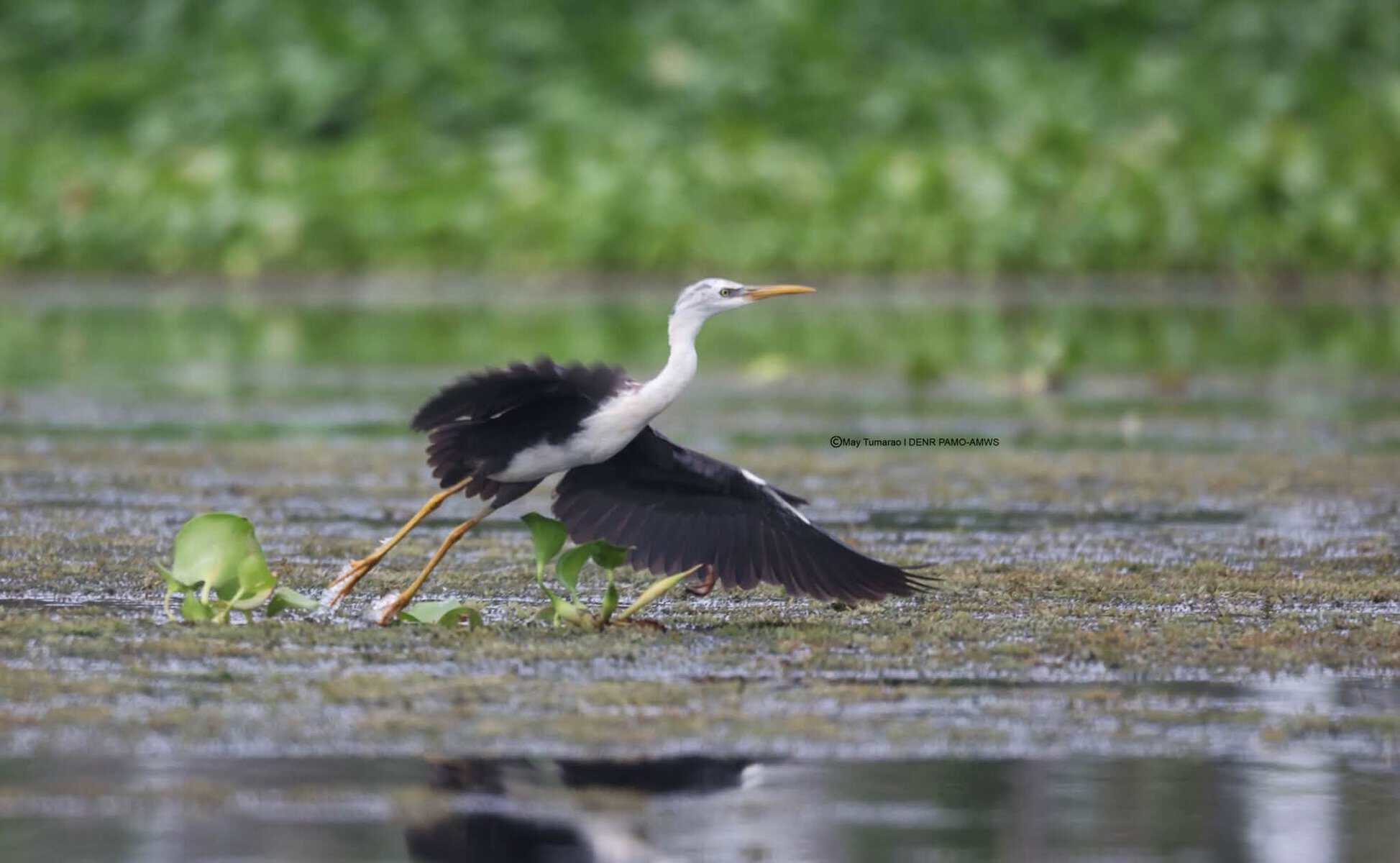
SAN FRANCISCO, Agusan del Sur — A team of biodiversity monitors has documented a Pied Heron (Egretta picata) at Lake Mambagongon in the Agusan Marsh Wildlife Sanctuary, potentially representing the first documented record of the species in the Philippines.
The observation, made by personnel of the Protected Area Management Office (PAMO) monitoring team, was recorded along the shallow margins of the lake, where the bird was seen foraging in wetland habitat.
The identification remains subject to the appropriate verification and review process, but the observation could add a significant species record to the country’s avifaunal inventory.
The Pied Heron was described as generally wary but loosely gregarious. It was observed foraging alone at times and alongside Javan Pond Herons (Ardeola speciosa) and other egrets in the shallow waters of Lake Mambagongon.
The bird displayed distinctive characteristics consistent with the species, including yellow to olive-yellow legs, yellow eyes and bill, glossy gray markings on the head, neck and upperparts, a predominantly white throat, breast and belly, and contrasting black wings.
It was also observed in steady flight, with deliberate wingbeats punctuated by short glides.
The observation was made at Lake Mambagongon at approximately 8°15.5271’ north latitude and 125°51.5605’ east longitude.
The species identification was verified by Desmond Allen.
Observers from the PAMO monitoring team were May B. Tumarao, Reo C. Entia, Jindy Queen A. Quidet, Sherrilyn A. Vasquez, Ed Joseph Otaza, Harold Jay Sumilhig and Darrie Campos.
The discovery highlights the ecological importance of the Agusan Marsh Wildlife Sanctuary, one of the country’s important wetland ecosystems and a major habitat for diverse bird species.
It also underscores the value of sustained biodiversity monitoring, field documentation and collaboration among wildlife researchers and protected-area managers, particularly in detecting rare or previously undocumented species.
The Agusan Marsh, with its extensive lakes, rivers, swamps and seasonally inundated forests, provides critical habitat for resident and migratory waterbirds.
If confirmed through the appropriate scientific review, the Pied Heron observation would further underscore the sanctuary’s significance as a site for avian biodiversity and could prompt closer monitoring for other species not previously documented in the Philippines.
###