

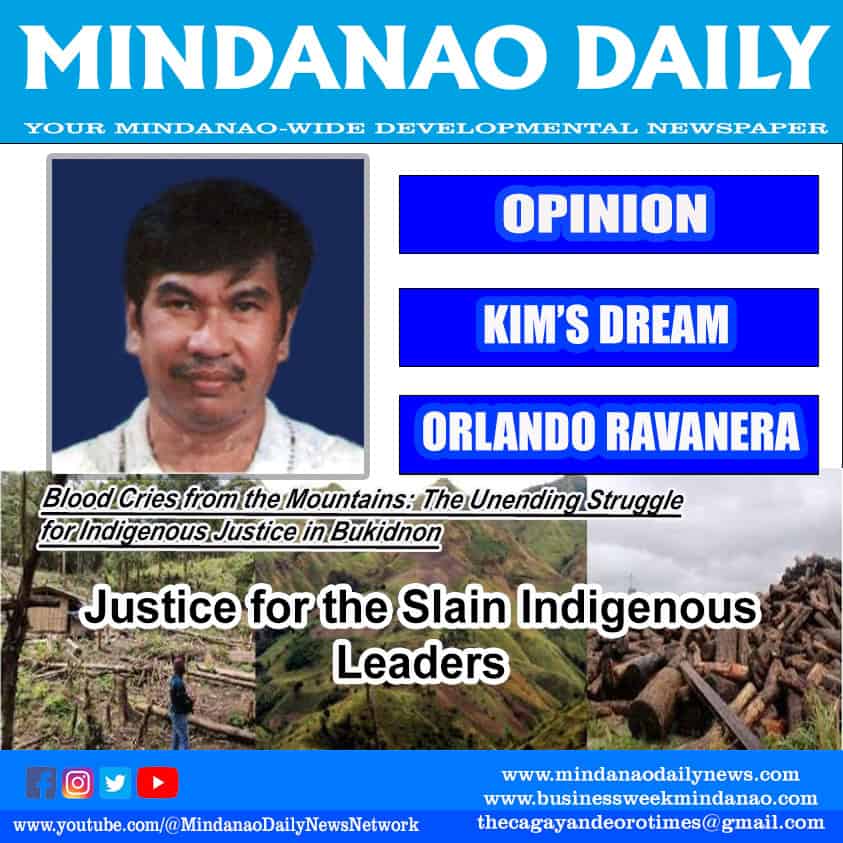
Blood Cries from the Mountains: The Unending Struggle for Indigenous Justice in Bukidnon
Life and death, as the philosopher Deepak Chopra once said, are not enemies but inseparable aspects of one continuous journey. The Bengali poet Rabindranath Tagore expressed it beautifully when he wrote, “The night kissed the fading day with a whisper: I am death, your mother, from me you will get new birth.” Yet, when death is born from violence, greed, and injustice, it is not a gentle whisper of renewal, it becomes a haunting cry that echoes through the land, demanding truth and justice.
Such is the tragic story of two remarkable chieftains Datu Wenifredo Sumael and Datu Raffy Saway Alim both Indigenous leaders from Bukidnon who devoted their lives to defending their ancestral lands and water rights. They were my friends, my companions in countless assemblies and dialogues with tribes across Mindanao. Together, we raised our voices against the continuing exploitation of the Indigenous Peoples (IPs) whose lands have long been grabbed by powerful corporations, shielded by armed men and protected by political influence.
On December 12, 2020, I spoke to Datu Sumael and Datu Alim for hours. They told me, with deep frustration, how a corporation supported by armed guards was harvesting the sugarcane they had planted on their ancestral farms. I advised them to document the incident for presentation at our upcoming national virtual meeting, “Indigenous Peoples: A Cooperative Liberating Force Against Poverty and Oppression,” scheduled on December 15.
But the following evening, December 13, 2020, I received a phone call that shattered my heart. Both chieftains had been shot dead in Purok 9, Prakatahan, Pualas, Don Carlos, Bukidnon. I later received confidential reports that an influential official had allegedly ordered their assassination offering a hundred thousand pesos to silence them. Their crime? Simply telling the truth.
In tribute to their bravery and love for their people, I composed a poem titled “Veritas Liberabit Vos,” The Truth Shall Set Us Free. It says: “My name is Veritas; so simple is my language. Humanity runs after me because I am precious. But to the oppressor, I am a threat, thus I must be killed. Yet there will always be lovers who will search for me, for they cannot live without my presence. The killers do not know that in the silence of my grave, my noble cause grows stronger. One day, I shall rise to liberate the poor and the oppressed.”
The deaths of Datu Sumael and Datu Alim are not isolated tragedies. They represent the continuing agaw-lupa, agaw-tubig, agaw-buhay the relentless seizure of ancestral lands, waters, and lives. Indigenous territories across Mindanao have become battlegrounds of greed, where corporate interests and local elites exploit natural resources with impunity. Despite the existence of the Indigenous Peoples’ Rights Act (IPRA) and international human rights covenants, the IPs remain dispossessed and displaced.
The violence against Indigenous communities in Bukidnon alone reveals a long history of unpunished crimes. In 2016, at Sumilao, Bukidnon, a powerful rancher fenced off around 5,000 hectares of ancestral land belonging to the Manobo Tribe in San Vicente. When Bae Merlita Mayantao, a brave woman leader, protested, her tribe was attacked at dawn. Three were killed including her son while three others were wounded. The gunmen, known members of the rancher’s security force, remain at large.
In Talakag, Bukidnon, violence continued. George Amihan was hacked to death; Anastacio Susina was shot; and Alfonso Sinahon was mutilated and cut into pieces. Their lands, planted with abaca, falcata, and lauan, were stolen by their murderers.
In 2006, the ancestral domain of Datu Ben Anoos was allegedly converted by the local government into a municipal water system without fair compensation. Similarly, in San Fernando, Bukidnon, Bae Leah, who courageously defended her tribe’s water rights, was killed in 2019. Eleven other IPs who resisted the entry of transnational corporations attempting to convert their lands into plantations were ambushed and slain.
These killings over 101 Indigenous leaders across the years are not mere statistics. They are names, faces, dreams, and families destroyed by greed and silence. Their blood cries out from the soil of Bukidnon and from every mountain where Indigenous Peoples stand guard over the sacred earth. The struggle of the Indigenous Peoples is the struggle of humanity itself to protect what is sacred, to defend truth, to live in dignity. The two datus, and all others who perished defending their lands, have shown a courage so rare in this age of corruption and apathy. Their bodies may have fallen, but their spirits live on in the mountains, the rivers, and the collective memory of the oppressed.
Until now, no killer has been arrested. No justice has been served. The killers walk free, while the truth is buried with those who dared to speak it. Yet justice cannot remain buried forever. As the poem says, truth will rise again stronger, louder, and more unstoppable than before.
We pray to Magbabaya, the Creator of all life, that justice be done though the heavens fall. These Indigenous heroes were not insurgents nor criminals, they were guardians of the land, protectors of rivers, caretakers of the earth’s ancient wisdom. They were human beings, not garbage. Their memory must awaken us to the sacred duty of defending the poor, the powerless, and the planet itself. Because every time an Indigenous leader is killed, a part of our humanity dies with them. But every time we speak their names, their spirits rise again reminding us that truth, though silenced, can never be killed.
###