
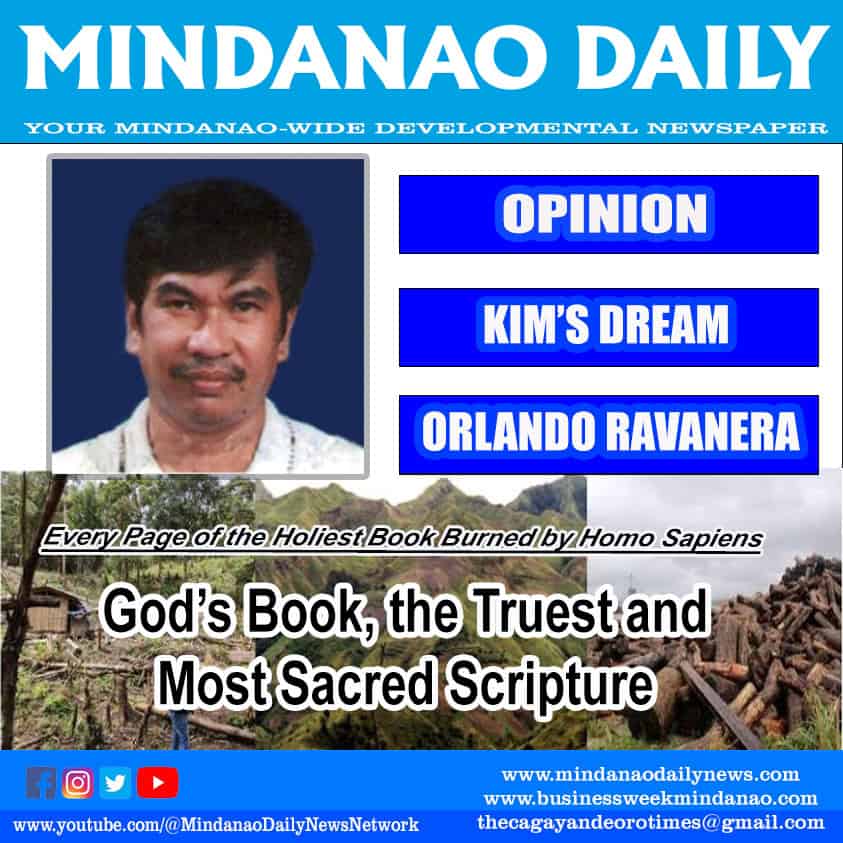
Every Page of the Holiest Book Burned by Homo Sapiens
Kim’s Dream Orlan Ravanera
The holiest of all books is not one written by evangelists, theologians, or even the most revered prophets of history. It is a book authored by God Himself, written patiently across billions of years and revealed through the beauty, order, and mystery of the universe. This sacred book is not written in words, nor confined to any language, culture, or religion. It is open twenty‑four hours a day, requires no literacy or formal education, and can be understood through the fullness of our being through sight, sound, touch, intuition, and inner awareness. This book belongs to everyone and no one. It can be read by a child gazing at the sky, by a farmer touching the soil, by fisherfolk listening to the tides, and by elders feeling the rhythm of the wind. It is accessible to the rich and the poor alike because it is not owned by institutions. It is the Book of Life itself.
This sacred scripture is known as the Book of Nature, a living manifestation of the Unseen. Its pages are the vastness of space and time; its alphabets are the primordial elements of existence: fire, water, earth, and wind. Written across epochs, it contains the mysteries of life and the laws that govern all beings without discrimination beyond race, color, belief, gender, or social class. These laws cannot be amended, negotiated, or ignored without consequence.
The countless stars scattered across the cosmos speak of the element of fire, a force that creates, sustains, and transforms. In our daily lives, fire reaches us through the sun, the great giver of life. Every sunrise is a cosmic proclamation: light returns, darkness recedes, and life continues. This daily phenomenon is not merely physical; it is a spiritual and moral lesson written into existence itself. Light reveals what darkness conceals. In the same way, truth ultimately prevails over lies, righteousness over cruelty, love over hatred, justice over injustice, and life over death. Yet the Book of Nature also teaches us that darkness has its role. Without night, the stars would remain unseen. Without silence, sound would lose meaning. Wisdom lies in balance, not denial.
Fire teaches responsibility. When respected, it warms and illuminates; when abused, it destroys forests, communities, and futures. Today, humanity plays recklessly with fire, burning fossil fuels, forests, and even the planet’s climate system, forgetting that every flame leaves consequences far beyond immediate profit.
From water, we learn one of the deepest truths of existence: life must flow. Movement sustains life; stagnation breeds decay, disease, and death. Flowing water nourishes fields, builds civilizations, and heals ecosystems. Stagnant water poisons both land and body. This law applies not only to nature, but to societies, economies, and the human heart.
Water seeks the lowest path, not the highest. In humility, it gains strength. Rivers carve mountains not through force, but through patience and persistence. In yielding, water prevails. During the height of the First Quarter Storm in the 1970s, activists echoed a profound ecological truth: “Let not a single drop of rain reach the sea without first serving the people.” This was more than a political slogan; it was an ethical principle rooted in nature itself, affirming that resources exist to sustain life, not to enrich the few.
Water also cleanses and heals. It cools the fires of anger, fear, and unrestrained desire within the human heart. Spiritually, it reminds us that purification comes not through control, but through surrender and balance. From the lowly earth rise mighty trees and delicate flowers. Soil contains decay and rot, yet from this decomposition springs new life. The earth teaches us that death is not an end, but a transformation within an eternal cycle.
All forms, kings and laborers, the wise and the powerful, the beautiful and the feared, ultimately return to the earth. It is the great equalizer. Form is temporary, but life itself is eternal. Every human being is not merely a body, but a living expression of the formless, unmanifested Being, the Source of all existence. When we reconnect with that inner Being, we experience the stillness reflected in forests, mountains, and flowers. In that stillness, the ego loosens its grip, and we remember that we belong not above nature, but within it.
The message of the earth is clear and uncompromising: humanity can only fulfill its destiny through humility. When humans flaunt arrogance and claim absolute dominion over creation, they sign their own death sentence. Increasing awareness of bio‑equality, interconnectedness, and oneness affirms that all species possess an inherent right to life.
The unseen wind carries one of the most powerful lessons in the Book of Nature. Its presence is rarely noticed, yet its absence is fatal. Without air, life ends within minutes. Still, humanity treats the atmosphere as an endless dumping ground. Like air, love, compassion, and consciousness are invisible, yet indispensable. We often realize their value only when they are gone, much like loved ones taken for granted until absence teaches their worth.
The Book of Nature teaches that everything is interconnected. When forests are destroyed, soil erodes. When soil erodes, rivers carry silt to the sea. When coral reefs are smothered, marine ecosystems collapse. When fish disappear, coastal communities suffer hunger and poverty. What humanity does in the uplands is felt in the lowlands. Environmental destruction is never merely ecological; it is moral, social, and spiritual injustice.
The intensifying floods, droughts, storms, and ecological disasters of our time are not coincidences. There are consequences. Nature is clear and uncompromising: there is no free meal. Every extraction demands repayment. Humanity has torn and burned the sacred pages of God’s book, mocking its laws in the name of profit and convenience. Yet nature does not negotiate. The bill always comes due. Corporate globalization has accelerated the desecration of the Book of Nature. Forests are reduced to timber, mountains to minerals, rivers to waste channels, and oceans to dead zones. Profit has become the dominant religion of our age.
Governments, institutions, universities, and even religious organizations have largely surrendered to this ideology, sacrificing the sacred to the mundane. Humanity kneels before images while remaining deaf to the cries of billions of species facing extinction. Many await a Second Coming, unaware that transformation awakens from within. Consciousness itself is the living Christ‑presence. Humanity is still evolving, still a work in progress, yet awakening remains possible. We do not possess life; we are life. To awaken is to move beyond identification with form, status, and possessions and return to the inner consciousness of the Formless.
As Jesus taught, “The Kingdom of God is within you.” This is not a distant promise, but an immediate invitation to awakening. Every page of the holiest book has been torn and burned by Homo sapiens, the most intelligent yet most self‑destructive of Earth’s species. Yet the book remains open. Its wisdom still whispers through forests, rivers, winds, and stars.
If humanity can rediscover humility, reverence, and stillness, we may yet restore our relationship with life. To honor this book is to protect life itself. To continue burning it is to hasten our own extinction. The choice before us is not merely political or economic; it is spiritual. May we be liberated from the tyranny of the egoic mindset now, collectively and insanely manifested through unbridled materialism and consumerism. May we relearn the language of energy, consciousness, and interconnected life. And may we finally stop burning the sacred pages of God’s book before no pages remain, all for God’s greater glory!
###