
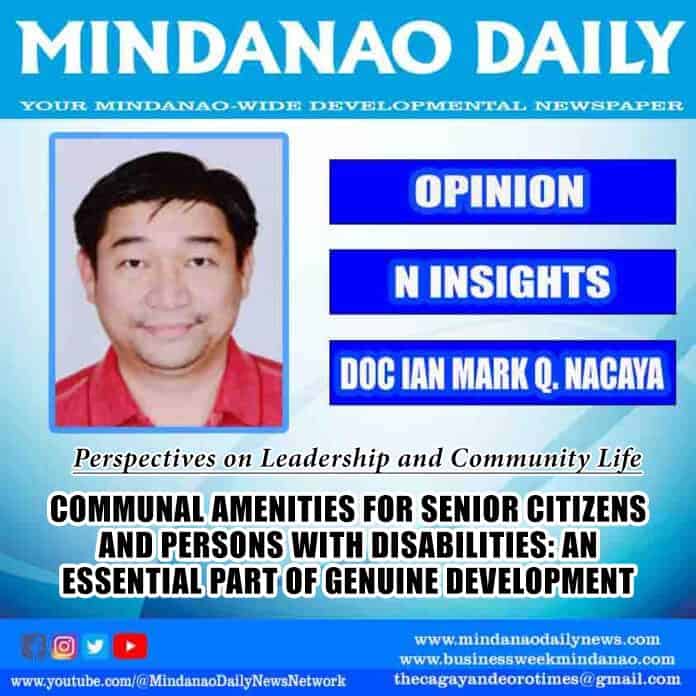
N Insights
By Doc Ian Mark Q. Nacaya
Perspectives on Leadership and Community Life
Inclusive Communities, Dignified Living, and People-Centered Local Governance
Development should never be measured solely by the number of roads constructed, buildings erected, investments attracted, or economic activities generated. The true measure of development lies in how communities improve the quality of life of their people, especially those who are most vulnerable to exclusion.
Among the sectors deserving greater attention in local development planning are our Senior Citizens and Persons with Disabilities (PWDs), whose needs must be incorporated into the physical, social, and institutional development of every community.
One important yet often overlooked dimension of inclusive development is the provision of communal amenities – accessible, safe, functional, and welcoming public spaces where senior citizens and PWDs can socialize, exercise, participate in community activities, access essential services, and enjoy meaningful lives.
These facilities should never be treated merely as optional government projects or charitable gestures. They are essential public investments that uphold human dignity, advance social inclusion, and strengthen community well-being.
Beyond Infrastructure: Development with a Human Face
Local governments traditionally prioritize roads, drainage systems, public markets, government buildings, and other infrastructure projects. While these are necessary, development planning must equally recognize the social infrastructure that enables people to participate fully in community life.
For senior citizens, communal facilities offer opportunities for active aging, social interaction, recreation, health promotion, and continued involvement in civic affairs For PWDs, accessible community facilities promote mobility, independence, participation, and equal opportunities.
Imagine a barangay where elderly residents can safely walk through landscaped pathways, sit comfortably under shaded areas, participate in wellness activities, and interact with fellow residents. Imagine a community where wheelchair users can enter public facilities without difficulty, individuals with visual impairments can navigate safely, and people with hearing disabilities can participate meaningfully in public gatherings.
These are not extraordinary privileges. They are fundamental attributes of an inclusive and progressive community.
Communal Amenities That Every Community Should Aspire to Provide
A people-centered approach to development should encourage LGUs to establish or improve communal amenities that respond to the practical needs of senior citizens and PWDs. The amenities need not always require expensive infrastructure. Through thoughtful planning, appropriate budgeting, and efficient utilization of existing public spaces, even barangays with limited resources can progressively establish inclusive facilities.
The greater consideration is not how grand these structures appear, but how accessible, useful, safe, and responsive they are to the people they are intended to serve.
An Obligation of Governance, Not Merely an Act of Compassion
The Philippines already has important legal foundations supporting inclusive infrastructure and community facilities. Republic Act No. 7876, or the Senior Citizens Center Act of the Philippines, provides for the establishment of senior citizens centers in cities and municipalities. Batas Pambansa Blg. 344, otherwise known as the Accessibility Law, establishes accessibility requirements for covered buildings, establishments, and public facilities. Republic Act No. 10070 likewise strengthens local institutional mechanisms for implementing programs and services for PWDs through Persons with Disability Affairs Offices and designated focal persons, as applicable.
These laws remind public officials that accessibility and social inclusion are not matters of discretionary generosity. They are responsibilities embedded in public governance. However, legal compliance should represent the minimum standard, not the ultimate ambition of local governments. The greater challenge is translating these mandates into functional facilities, sustainable programs, responsive services, and genuinely inclusive public spaces.
Integrating Inclusive Amenities into Local Development Planning
Communal amenities for senior citizens and PWDs should become integral components of every LGU’s Comprehensive Development Plan (CDP), Local Development Investment Program (LDIP), Annual Investment Program (AIP), and barangay development priorities. Their provision should not depend solely on occasional appropriations, political initiatives, or requests from organized sectoral groups.
Instead, LGUs should undertake accessibility assessments of existing government facilities, identify underserved communities, establish reasonable development targets, and allocate resources for the construction, upgrading, operation, and maintenance of inclusive public amenities. Equally important is the participation of senior citizens and PWD representatives in planning, project design, monitoring, and evaluation.
After all, those who experience barriers to accessibility are often best positioned to identify the improvements that communities genuinely need. Meaningful consultation helps ensure that projects are not merely physically completed but actually usable, appropriate, and beneficial.
The Barangay as the Frontline of Inclusive Development
The barangay occupies a particularly important position in promoting accessible communal amenities because it is the government unit closest to everyday community life. Barangay officials understand the circumstances of elderly residents living alone, individuals with mobility limitations, and families caring for persons with disabilities. They are therefore strategically positioned to identify suitable communal spaces, mobilize partnerships, integrate inclusive amenities into barangay plans, and encourage community participation.
Collaboration among barangay councils, city and municipal governments, senior citizens organizations, PWD associations, civil society, private establishments, and community volunteers can make these initiatives more achievable and sustainable.
A modest barangay wellness garden, an accessible multipurpose hall, or a properly equipped community activity center can generate significant social benefits when designed and managed around actual community needs. Moreover, communal spaces that bring together younger residents, senior citizens, and PWDs help strengthen intergenerational understanding, mutual respect, and social solidarity.
An inclusive community is not one that simply provides separate facilities for vulnerable sectors, but one that creates shared spaces where everyone belongs.
A Measure of Leadership and Good Governance
The presence, condition, and accessibility of communal amenities should increasingly become indicators of local government performance. Local leaders must recognize that development is incomplete when public facilities remain inaccessible to certain sectors of society. A newly constructed public building without adequate accessibility features is an unfinished achievement.
A beautiful park that elderly residents cannot comfortably enjoy represents an incomplete investment. A community center that excludes individuals with mobility, visual, hearing, or other accessibility needs falls short of its public purpose.
Good governance requires not only the delivery of infrastructure but also ensuring that public investments produce equitable and lasting benefits. Local governments must therefore move beyond ceremonial recognition of senior citizens and PWDs toward sustained investments that improve their daily living conditions.
Development Where No One Is Left Behind
As communities continue to modernize, the challenge for public leadership is to ensure that growth remains inclusive, compassionate, and responsive to changing social needs. Our senior citizens have contributed their productive years to their families, institutions, and communities. They deserve environments that allow them to age with dignity, remain socially connected, and continue contributing to society.
Our fellow citizens with disabilities equally deserve opportunities to participate fully and independently in economic, social, cultural, and civic life. Providing accessible communal amenities is not simply about constructing ramps, parks, activity centers, or recreational facilities. It is about building communities that recognize the equal worth, dignity, and potential of every individual.
Ultimately, the true success of development is not reflected merely in how much infrastructure a community builds, but in how many people can meaningfully benefit from it. A progressive city or municipality should be judged not only by the opportunities it creates for the economically productive, but also by the dignity, comfort, accessibility, and quality of life it extends to senior citizens and persons with disabilities.
Because genuine development is not only about building better places. It is about building better places for everyone.
Dr. Ian Mark Q. Nacaya is a public administration scholar, urban governance practitioner, and former six-term City Councilor of Cagayan de Oro City. He also served as a two-time Sectoral Representative to the City Council, first as SK City Federation President and later as Liga ng mga Barangay President, and was a three-term Majority Floor Leader. He is the Founder of NACAYA Public-SectoralDev Consulting and serves as a graduate school professor in public administration courses. His work focuses on sustainable urban development, resilient local governance, climate adaptation, innovation in public service, and evidence-based local planning.