

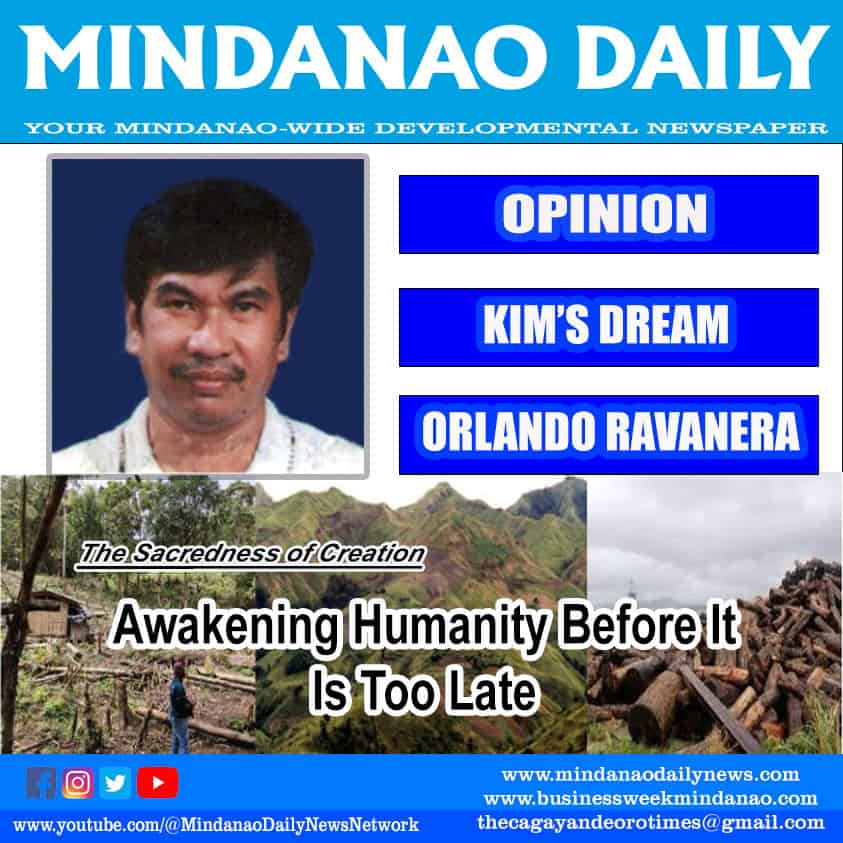
The Sacredness of Creation
Kim’s Dream Orlan Ravanera
It is res Ipsa loquitur; the truth speaks for itself that the breathtaking beauty of nature is not accidental. It is a living testimony, a visible reflection of the Unseen Being, the Divine Creator whom we call God. The vast forests, flowing rivers, towering mountains, and intricate ecosystems are not mere products of chance; they are manifestations of a higher intelligence, revealing a sacred presence that transcends human understanding. For centuries, humanity has attempted to portray the image of God through art and imagination. Questions have been raised, for example, about whether the revered images inside churches are merely interpretations shaped by artists such as Leonardo da Vinci. But this leads us to a more profound realization: Is not creation itself the most authentic reflection of the Creator? Why confine the Divine to human-made images when the entire universe already radiates His presence?
Indigenous Peoples have long understood this truth. For them, nature is not separate from the sacred; it is sacred. Protecting the forests, rivers, mountains, and all living beings is not merely an environmental act; it is the highest form of worship. Their spirituality is deeply rooted in the understanding that to destroy nature is to desecrate the Divine itself. This is why many Indigenous communities have courageously risked and even sacrificed their lives to defend what remains of God’s vanishing creation.
In the Philippines, we have witnessed powerful acts of resistance where communities formed human barricades, lying on roads to stop logging trucks from entering their ancestral lands. These were not acts of defiance alone, but expressions of profound love, a love willing to face death to protect life. Similarly, in India, the historic Chipko Movement demonstrated the same spirit. Villagers, particularly women, embraced trees with their own bodies, declaring that the axe must strike them first before harming the forest. Such acts embody the highest form of compassion and sacrifice.
Indeed, there is no greater love than to lay down one’s life for the preservation of creation. This is the essence of oneness with nature, a reflection of divine unity. Take, for example, the sacred beauty of Mindamora Falls. For Indigenous communities in Mindanao, this is not merely a scenic location; it is a sacred space where the presence of the Creator, whom they call Magbabaya, is deeply felt. Wherever they may be, they face the direction of the falls when they pray not toward painted images, but toward living creation itself. Imagine the magnificence: cascading waters flowing from a pristine watershed in a three-tiered waterfall, surrounded by lush forests teeming with life. Eagles soar above the canopy, while delicate creatures such as the Philippine tarsier leap from branch to branch. This is not merely beauty; it is a sacred sanctuary, a living cathedral that no human structure can replicate. And yet, this sacredness has been violated.
In the once-thriving forests of the Mount Kalatungan Range and Mount Kitanglad Range, destructive activities such as illegal logging and sawmill operations have caused massive deforestation, devastating vast areas of dipterocarp forests. These ecosystems, which sustained life for millions, if not billions of years, have been reduced to barren landscapes. Countless species of flora and fauna have been wiped out, their silent extinction unnoticed by a world preoccupied with profit. Why has this been allowed to happen? Why have we permitted the destruction of forests, rivers, seas, and agricultural lands, the very systems that sustain life?
The answer lies in humanity itself. Among all species, “Homo sapiens” has become the most destructive not necessarily out of necessity, but out of greed, ignorance, and indifference. Through both action and inaction, sins of commission and omission, we have contributed to the systematic destruction of life on Earth. While many kneel in places of worship, countless ecological crimes continue unchecked outside their walls. Forests are cut, rivers are polluted, oceans are overfished, and species are driven to extinction. The cries of birds, animals, and marine life, though unheard, are real. They are being erased from existence, not by natural causes, but by human hands. Perhaps we once believed that their suffering was separate from ours. But this illusion can no longer be sustained.
The fundamental law of nature is interconnectedness. Everything is linked. Every act of destruction inflicted upon nature inevitably returns to humanity. We are now witnessing this truth unfold through increasing disasters, stronger typhoons, widespread flooding, landslides, droughts, and food insecurity. Thousands have died. Millions have been displaced. Entire communities have been plunged into hunger and poverty.
The Philippines, in fact, ranks among the most vulnerable countries to climate change. Scientists around the world warn that humanity is now facing a planetary emergency described as being “one minute before midnight.” We are living at the brink of the Earth’s sixth mass extinction. This is not a distant threat; it is happening now. As soil fertility declines, water sources diminish, and biodiversity collapses, nearly a quarter of the global population faces the risk of hunger. Yet, despite these realities, the dominant global system continues to pursue endless economic growth, driven by a small elite, the one percent, who control vast resources and power. This model of development, rooted in exploitation and profit maximization, sacrifices both people and the planet. This is not merely environmental destruction; it is a form of violence and invisible war.
Environmentalists have aptly described this as a “Third World War,” a war waged in peacetime, without weapons in the conventional sense, yet responsible for the greatest number of deaths and suffering. It is a war against nature, against the poor, and ultimately, against humanity itself. Despite overwhelming scientific evidence, climate change denial continues to spread. A powerful web of denial, composed of corporations, political interests, think tanks, and even segments of media and religious institutions, works to obscure the truth. This deliberate misinformation delays meaningful action and perpetuates destruction. Even global efforts such as COP26 have struggled to produce decisive outcomes, as competing interests and economic agendas overshadow the urgency of the crisis.
Yet, amid all this, there is still hope. The crises we face, such as environmental collapse, social injustice, and even global pandemics, can be seen as wake-up calls. They are urgent invitations for humanity to awaken from a state of unconsciousness dominated by materialism, consumerism, and distorted beliefs. We have forgotten who we are. Human beings were created in the image and likeness of God, yet we have reshaped that image according to our own ego and desires. We have reduced the sacred to something we can control, rather than recognizing the sacredness that surrounds and sustains us.
What is needed now is a new consciousness, a profound awakening grounded in the recognition of the oneness and sacredness of all creation. We are not separate from nature; we are part of it. We are connected to what may be called the Ocean of Consciousness, the formless, unseen source of all existence. To reconnect with this truth, we must return to stillness. We must listen not to the noise of a restless and ego-driven mind but to the quiet wisdom of the natural world.
The trees, the rivers, the mountains, the birds, and even the stars all invite us into this Great Stillness. It is in this stillness that we rediscover peace, a peace that transcends understanding. And from this inner peace arises the strength to act not out of fear, but out of love. A love that protects. A love that restores. A love that is willing to sacrifice. The task before us is immense, but not impossible. If humanity awakens and we reclaim our role not as exploiters but as stewards of creation, then together, we can still protect and restore what remains of our living planet, our Mother Earth, our GAIA. The call is urgent. Awaken. Reconnect. Protect.
For in saving creation, we are also saving ourselves. All for God’s greater glory.
###