


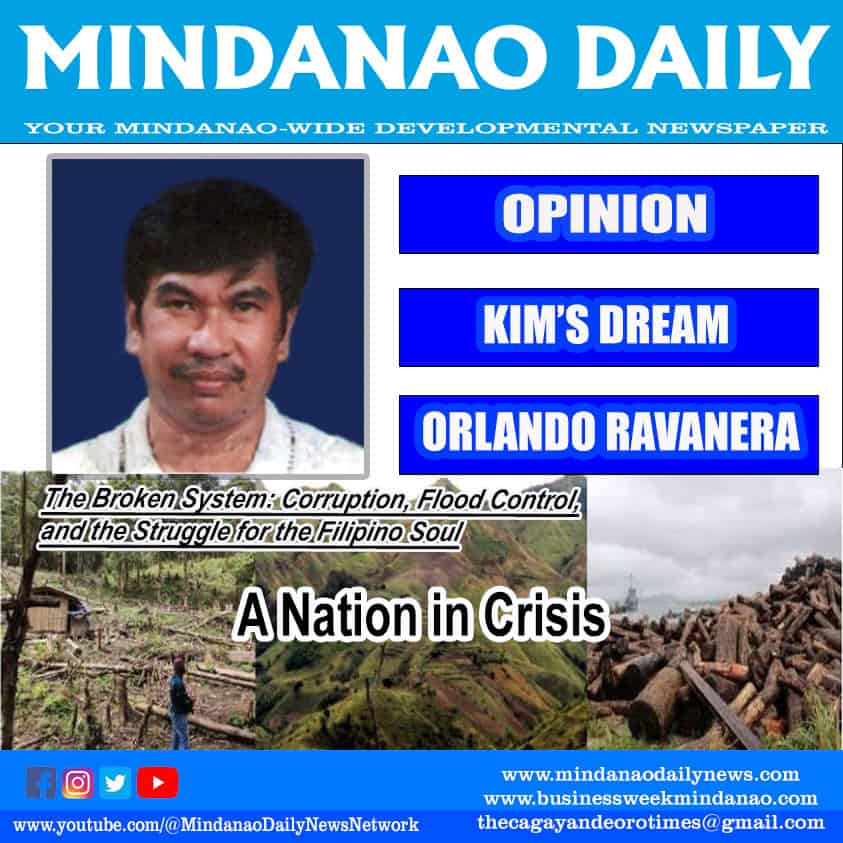
The Broken System: Corruption, Flood Control, and the Struggle for the Filipino Soul
The Philippines today stands at a crossroads. The events unfolding in our society reveal a system that has grown both disappointing and destructive. It is a system not shaped by the genuine will of the people, but by the dictates of a small political and economic elite, politicians allied with oligarchs who control the nation’s resources, businesses, and, tragically, its governance. These oligarchs have long manipulated the machinery of government for their own benefit, leaving ordinary Filipinos with little power to shape their own destiny.
Our nation was once hailed as a land of the brave, “Maharlika”, a people proud, courageous, and resilient. Filipinos have fought for independence, resisted colonizers, and endured hardships with unbreakable spirit. But today, instead of uniting against the corrupt structures that exploit us, Filipinos are being divided, pitted against one another by those who profit from our dis-unity.
At the core of this crisis lies corruption. Corruption is not just a weakness of our government it is the lifeblood of the ruling system. It has infiltrated every institution, poisoned every program, and denied justice to millions. Its effects can be seen not only in poverty and inequality but also in the very disasters that ravage our land. One of the clearest examples is the issue of flood control, where trillions of pesos are spent, and yet lives and livelihoods continue to be washed away year after year. This is more than a political issues, it is a moral and spiritual crisis. Our leaders, entrusted with the sacred duty to serve, have abandoned integrity and dignity. Many bows before their oligarch patrons, sacrificing the welfare of the people for wealth, comfort, and power. Even worse, they have exploited the hunger and ignorance of the poor, manipulating them into silence and submission. The soul of the Filipino nation is being eroded, and unless we confront this reality, we risk losing not only our freedom but our humanity.
Corruption in the Philippines is not an isolated problem; it is systemic. It manifests in countless forms: vote-buying, ghost projects, overpriced contracts, bribery, nepotism, and the misuse of public funds. It has been normalized to the point where many Filipinos expect politicians to steal, considering it a cost of doing business in politics. But corruption is not just about stolen money it is about stolen lives. When funds meant for schools, hospitals, or disaster preparedness are pocketed, it is the poor who pay the price. Children go hungry because feeding programs are underfunded. Patients die because hospitals lack medicine. Families drown because flood control projects are left unfinished.
The most tragic part is how corruption preys on the most vulnerable. In rural areas and among the urban poor, poverty makes people easy targets for manipulation. Politicians exploit their desperation, offering a few hundred pesos in exchange for votes, or short-term relief goods in exchange for loyalty. This cycle of exploitation ensures that corruption not only survives but thrives. The more corruption spreads, the deeper poverty grows. The deeper poverty grows, the easier it becomes for corruption to continue. Thus, the cycle feeds itself, consuming the nation’s resources, eroding its dignity, and destroying its future.
The issue of flood control is a clear window into how corruption devastates lives. The Philippines is one of the most disaster-prone countries in the world. Typhoons, monsoons, and rising sea levels continually threaten millions of lives. Flood control should therefore be a national priority. Every year, billions of pesos are allocated for dredging rivers, constructing dikes, reinforcing seawalls, and improving drainage. Yet every year, we see the same tragic pattern: heavy rains arrive, rivers overflow, communities drown, and lives are lost. Why? Because much of the money does not go where it should. Instead of building resilient infrastructure, funds are siphoned off through overpriced contracts, ghost projects, and substandard materials.
Typhoon Ondoy (2009) exposed the weakness of Metro Manila’s drainage systems. Billions had been allocated for upgrades, yet floodwaters submerged entire cities.
Typhoon Sendong (2011) devastated Cagayan de Oro and Iligan, killing thousands. Residents had long warned of illegal logging and poor flood defenses, but officials ignored them.
Typhoon Yolanda (2013) brought storm surges that wiped out communities in Leyte and Samar. Billions of aids poured in, but corruption ensured much of it never reached survivors.
Typhoon Ulysses (2020) again flooded Metro Manila and parts of Luzon. Despite decades of flood control budgets, families clung to rooftops as waters rose.
These disasters are not “acts of God.” They are acts of betrayal. Natural hazards become human tragedies because of corruption and negligence. Flood control projects are treated as cash cows rather than lifelines. Some are deliberately built to fail so that new contracts can be awarded again-and-again. The result is predictable: every time the rain falls, lives are lost, farms are destroyed, and poverty deepens. Money that could have saved lives has instead built mansions, paid for foreign vacations, and filled the secret accounts of the corrupt.
Corruption does not exist in a vacuum. It is sustained by a powerful alliance of oligarchs, foreign corporations, and political dynasties. The oligarchs control industries: energy, water, construction, and mining. They secure government contracts, dictate policies, and manipulate markets to serve their interests. Flood control projects, for example, are often awarded to companies tied to political families or business elites. Profit, not public welfare, becomes the priority. Foreign interests also play a role. Loans from international financial institutions often fund infrastructure projects, including flood control. These loans come with conditions that benefit foreign corporations, technology suppliers, consultants, and contractors. Meanwhile, the Filipino people are left to pay the debts, even when projects fail or funds are stolen.
This combination of domestic oligarchy and foreign influence ensures that corruption is not just a matter of bad leaders but of a distorted system designed to benefit a few at the expense of the many. Beyond economics and politics, the corruption crisis reveals a deeper wound: the loss of spirituality and moral responsibility. Filipinos are known as a deeply religious people, but religiosity without genuine spirituality can be dangerous. When faith becomes ritual without substance, it can coexist with corruption rather than oppose it.
True spirituality means recognizing the sacredness of life, the dignity of every human being, and the moral obligation to serve the common good. But many leaders have abandoned these values. They sit in air-conditioned offices, enjoying luxury and privilege, while millions suffer. They justify their actions by claiming that “everyone does it,” numbing their conscience while the nation bleeds. Even ordinary Filipinos are affected. Some accept corruption as normal. Others, out of desperation, participate in it, selling their votes, tolerating bribes, or looking the other way. This erosion of moral values weakens national unity and makes resistance harder. Without a revival of moral and spiritual consciousness, no political reform will succeed. Laws and systems can change, but without integrity, they will be corrupted again. The fight against corruption must therefore be not only political but also moral and spiritual. It is easy to talk about corruption in abstract terms budgets, projects, percentages but at its core, corruption is about people.
Consider the farmer whose rice fields are destroyed because floodwaters washed away the dike that was never properly built. Consider the mother who loses her child in a flood because the evacuation center promised by politicians never existed. Consider the students who cannot study because their schools are submerged every rainy season while funds for drainage were pocketed. These are not statistics; they are lives. Each peso stolen is a meal lost, a medicine unavailable, a shelter denied. Corruption kills not with guns but with neglect, incompetence, and greed. The question then is: what must the Filipino people do to break free from this cycle?
1. Awakening to the Truth. We must awaken to the reality that the root of our suffering is not fate, not natural disaster, but corruption. It is a man-made problem, and therefore it can be solved by human action.
2. Rejecting the Politics of Bribery. We must resist the manipulation of votes through money. Every peso offered in exchange for a vote is a chain that binds us to six more years of poverty and betrayal.
3. Strengthening Accountability. Citizens must demand transparency. Budgets for flood control and other programs must be publicly monitored. Civil society, media, and communities must work together to ensure projects are real, not ghost constructions.
4. Empowering the Poor. Poverty makes people vulnerable to corruption. By providing education, livelihoods, and social protection, we reduce the power of politicians to exploit desperation.
5. Reviving Spirituality and Integrity. We must reclaim our sense of spirituality not in empty rituals but in living values of honesty, justice, and compassion. Public service must be restored as a vocation of dignity, not an avenue for enrichment.
6. Building People Power Again. Change will not come from above. It must come from below from the united strength of the people. Just as Filipinos once toppled dictatorship through collective action, so too can we dismantle the structures of corruption today.
The crisis of corruption and failed flood control is not just a political scandal it is a mirror of our nation’s soul. It shows how far we have strayed from the values of dignity, unity, and responsibility that once defined us. But the story does not end in despair. Within every Filipino lies the potential for renewal. We are still a people of courage and resilience. If we awaken, unite, and act with integrity, we can rebuild not only our government but our nation. The struggle is not merely for political reform but for the very soul of the Philippines. It is a call to reclaim our identity as Maharlika brave, noble, and free. It is a call to reject corruption, confront betrayal, and build a nation where justice, compassion, and integrity reign. Only then will the Philippines rise again not as a land of endless tragedy, but as a nation of dignity, unity, and hope.
###


