

N Insights
By Doc Ian Mark Q. Nacaya
Perspectives on Leadership and Community Life
During my visit to the province of Cremona in Italy, one seemingly ordinary feature of its road network caught my attention: the presence of roundabouts, even along relatively narrow roads and modest intersections.
What fascinated me was not their size or appearance, but how naturally they formed part of the traffic system. Vehicles slowed down, yielded when necessary, and proceeded toward their destinations without the constant need for traffic lights or personnel directing every movement. Some roundabouts were compact, while others served larger road intersections. Yet their purpose remained the same: to organize the movement of vehicles safely and efficiently.
I found myself asking a question: If roundabouts can function along narrow roads in Italy, why should we not seriously consider more of them in Cagayan de Oro, particularly along Masterson Avenue in the city’s rapidly developing Uptown area?
This observation strengthened a position I had already advocated during my years in the City Council.
An Old Proposal Worth Revisiting
During my incumbency as a member of the Sangguniang Panlungsod, I delivered a Special Report calling for a feasibility study on the establishment of roundabouts along Masterson Avenue and its major intersections.
My concern then was straightforward. Uptown Cagayan de Oro was developing rapidly, with residential subdivisions, educational institutions, commercial establishments, and other developments increasing the demand on its principal road corridor. Even then, it was apparent that conventional traffic management would eventually become insufficient without corresponding improvements in road design and connectivity.
Today, that concern has become more relevant.
Anyone who regularly travels along Masterson Avenue understands how congestion affects the daily movement of students, employees, business owners, residents, and public transport operators. At certain periods, what should be a relatively manageable journey becomes an exercise in patience.
Road widening, alternative routes, and traffic enforcement are undoubtedly important. But we should also ask whether some of our intersections can be redesigned to accommodate more efficient traffic movement.
The Cremona Experience: It Is Not Always About Road Width
One important lesson I brought home from Cremona is that an effective road network does not necessarily require exceptionally wide roads.
In some places, carefully designed compact roundabouts help organize vehicle movement within limited road space. Of course, this does not mean that every narrow intersection can accommodate a roundabout. Road geometry, traffic volume, visibility, pedestrian activity, and vehicle types must first be considered.
Modern roundabouts come in different configurations, including mini-roundabouts, compact single-lane roundabouts, and larger multi-lane facilities. Their effectiveness depends less on how impressive they look and more on whether they are appropriately designed for their location. The photograph accompanying this article illustrates another important feature of European road management: clear priority signs and physical road guides that encourage motorists to slow down, yield, and follow an orderly path.
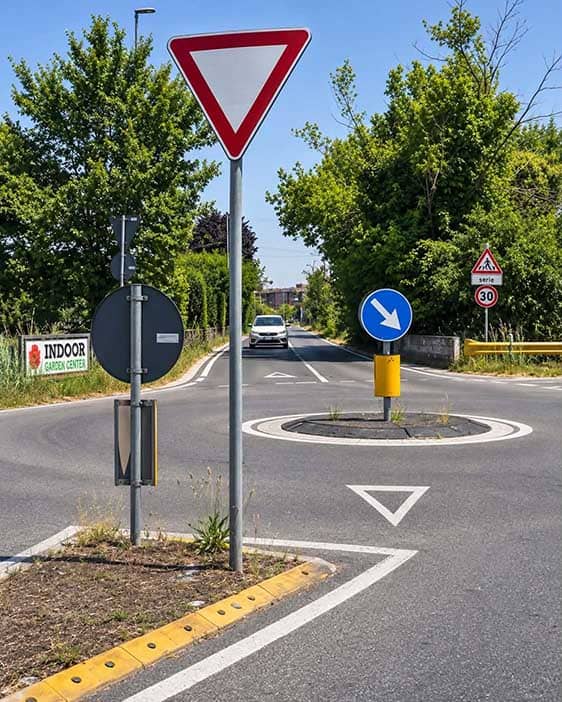
The underlying lesson is simple. Good traffic engineering influences driver behavior through road design, rather than relying entirely on enforcement.
Why Masterson Avenue Deserves Serious Consideration
Masterson Avenue is not an ordinary neighborhood road. It is a vital transportation corridor connecting Uptown communities and establishments with the rest of Cagayan de Oro. Its intersections accommodate different and sometimes competing traffic movements, particularly during school opening and dismissal hours, office peak periods, and commercial activity.
Strategically located roundabouts could offer several advantages.
First, they could reduce unnecessary stopping and waiting at intersections where traffic conditions permit continuous movement.
Second, properly designed roundabouts compel motorists to approach intersections at lower speeds, potentially reducing the severity of vehicular collisions.
Third, reducing prolonged idling could contribute to lower fuel consumption and vehicle emissions.
Fourth, roundabouts could reduce dependence on traffic signals at suitable intersections, including their associated electricity and maintenance costs.
Most importantly, they could introduce a more predictable and orderly traffic movement system.
International road safety research has consistently recognized modern roundabouts as an effective countermeasure against serious intersection crashes. However, these benefits depend on sound engineering and the circumstances of each location.
Start with a Comprehensive Traffic Engineering Study
I am not suggesting that roundabouts should immediately replace every traffic light or intersection along Masterson Avenue. That would be poor planning.
What I strongly recommend is a comprehensive corridor-wide feasibility study undertaken by the Roads and Traffic Administration (RTA), in coordination with the City Planning and Development Office, the Department of Public Works and Highways, and qualified traffic engineering professionals.
The study could initially examine major junctions, such as Masterson Avenue-Macapagal Drive and Masterson Avenue-El Camino Real, along with other intersections experiencing significant turning movements or congestion.
It should assess traffic volumes, directional flows, school-related congestion, turning requirements for buses and delivery trucks, road gradients, drainage, pedestrian safety, and available road space.
The safety of senior citizens, persons with disabilities, students, cyclists, and other pedestrians must also receive careful attention.
Where a roundabout is technically feasible, the city could consider a pilot installation accompanied by public information campaigns, road markings, appropriate signs, and traffic monitoring.
Where it is unsuitable, other intersection improvements should be pursued.
The objective is not to build roundabouts merely because they work elsewhere. The objective is to determine where they can genuinely improve mobility and safety in Cagayan de Oro.
Planning Ahead Rather Than Catching Up
One lesson I learned from serving in barangay and city governance is that public infrastructure decisions must anticipate the demands of development rather than simply respond when problems have already become difficult to manage. Traffic congestion does not happen overnight. It develops as communities grow, land uses change, and transport demand increases faster than the road network’s ability to accommodate it.
Unfortunately, many local governments are compelled to respond only when congestion has already become a daily public frustration.
The ongoing development of new road connections in Uptown, including the Manresa Access Road, presents an opportunity to rethink how Masterson Avenue and its adjoining intersections should function as one transportation system.
This is precisely when forward-looking traffic planning becomes necessary.
I believe our city can learn from international practices without necessarily copying them wholesale. What works in Cremona must be examined against the actual road conditions, traffic behavior, and development patterns of Cagayan de Oro.
But learning from other places is itself an important part of good governance.
A Small Roundabout, A Larger Governance Lesson
What stayed with me after my experience in Cremona was not merely the presence of roundabouts. It was the apparent recognition that the design of even a modest intersection deserves attention. Sometimes, we associate progress with wider highways, expensive flyovers, or massive infrastructure projects. Yet a relatively small, intelligently designed intersection improvement may also deliver meaningful public benefits.
I have long believed that governance should not be measured only by the magnitude of projects undertaken, but by how effectively public decisions address the everyday needs of citizens.
For Cagayan de Oro, particularly along Masterson Avenue, the establishment of strategically located roundabouts deserves serious technical consideration and, where feasible, implementation.
We do not always need bigger roads to achieve better traffic movement. Sometimes, we need better-designed intersections, more disciplined driving, and the willingness to adopt practical solutions that have worked elsewhere.
Cremona reminded me of that.
And perhaps it is time for Cagayan de Oro to give roundabouts another serious look.
About the AuthorDr. Ian Mark Q. Nacaya is a public administration scholar, urban governance practitioner, and former six-term City Councilor of Cagayan de Oro City. He also served as a two-time Sectoral Representative to the City Council, first as SK City Federation President and later as Liga ng mga Barangay President, and was a three-term Majority Floor Leader. He is the Founder of NACAYA Public-SectoralDev Insights Consulting and serves as a graduate school professor in public administration courses. His work focuses on sustainable urban development, resilient local governance, climate adaptation, innovation in government, and people-centered public policy.