

N Insights
By Doc Ian Mark Q. Nacaya
Perspectives on Leadership and Community Life
When we talk about flooding, agriculture, fisheries and local economic development, government often treats them as separate concerns. Agriculture is assigned to one office, flooding to another, fisheries to another, and infrastructure to still another.
But nature does not operate by government departments.
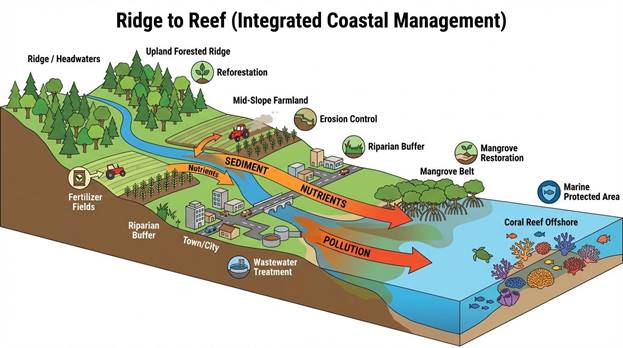
Water falling in our mountains travels through farms, forests, communities and rivers before reaching our coastal areas and the sea. What happens upstream eventually affects everyone downstream. This is why local governments should increasingly embrace the Ridge-to-Reef approach – planning and managing our territory as one interconnected ecological and economic system.
Helping Farmers Begins Upstream
At the ridge and upland portions of a watershed, forests and farms serve as our first line of defense. Reforestation, agroforestry, contour farming, soil conservation and proper water management can reduce erosion while improving the productivity of agricultural lands.
For farmers, this can mean healthier soil, better water retention and greater protection against drought and excessive rainfall. Instead of seeing environmental protection as a restriction on agriculture, we should view it as an investment in long-term agricultural productivity and food security.
Flood Prevention Cannot Begin in the City Alone
When heavy rains come, we often focus on drainage canals, dikes and flood-control structures downstream. These are necessary, but they address only part of the problem.
A ridge-to-reef strategy asks a more fundamental question: What is happening to the water before it reaches our cities and communities?
Denuded watersheds, erosion, uncontrolled land conversion and silted waterways can increase surface runoff and worsen flooding. Restoring forests, protecting riverbanks, improving agricultural practices and managing settlements throughout the watershed can therefore complement engineering solutions.
Flash floods must not simply be treated where the floodwater appears. We must manage the entire watershed from which that water comes.
Protecting Fisherfolk Means Protecting the Watershed
The livelihood of fisherfolk is also connected to activities many kilometers inland.
Soil erosion, agricultural chemicals, garbage and untreated wastewater carried by rivers eventually reach estuaries and coastal waters. Excessive sedimentation and pollution can damage mangroves, seagrass beds, coral ecosystems and fishing grounds.
Thus, protecting fisheries does not begin only at the shoreline. Healthy seas depend partly on healthy rivers, and healthy rivers depend on healthy watersheds.
An Economic Development Strategy
Ridge-to-reef planning is not merely an environmental program. It can become a local economic development strategy.
Productive farms generate food and income. Healthy watersheds provide water and reduce disaster risks. Cleaner rivers can support recreation and tourism. Protected mangroves and coastal ecosystems strengthen fisheries. Reduced flooding protects businesses, homes, roads and public investments.
The benefits reinforce one another.
This is particularly important for rapidly developing cities and municipalities whose economic centers depend upon resources originating outside their political boundaries. Watersheds do not recognize municipal, city or provincial borders. Governance must therefore cross boundaries as well. Local governments should integrate ridge-to-reef principles into their Comprehensive Land Use Plans, Comprehensive Development Plans, Local Climate Change Action Plans, DRRM plans and investment programs. Agriculture, environment, engineering, planning, fisheries, barangays, academe, civil society and the private sector should be working from a shared ecological picture.
For years, we have tried to solve interconnected problems with fragmented solutions.
Perhaps it is time to follow the natural path of water, from the ridge, through our farms and communities, along our rivers, and ultimately to the reef.
Protect the ridge, and we protect the farm. Protect the farm and watershed, and we help protect communities from floods. Protect the river, and we help protect our fisherfolk and seas.
Ridge-to-reef is therefore not one environmental solution. It is multiple solutions working together, for food security, flood resilience, fisheries, livelihoods and sustainable local development.
Dr. Ian Mark Q. Nacaya is a public administration scholar, urban governance practitioner, and former six-term City Councilor of Cagayan de Oro City. He also served as a two-time Sectoral Representative to the City Council, first as SK City Federation President and later as Liga ng mga Barangay President, and was a three-term Majority Floor Leader. He is the Founder of NACAYA Public-SectoralDev Insights Consulting and serves as a graduate school professor in public administration courses. His work focuses on sustainable urban development, resilient local governance, climate adaptation, innovation in government, and people-centered public policy.
###