
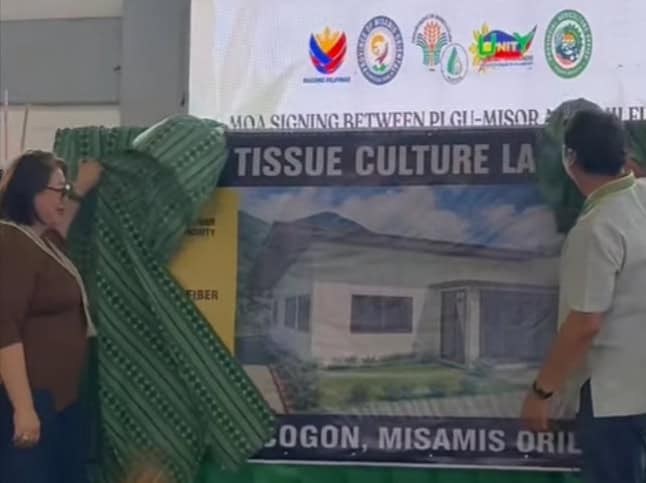
THE provincial government of Misamis Oriental and the Philippine Fiber Industry Development Authority (PhilFIDA) signed a memorandum of agreement on Augist 18, 2026 in Sugbongcogon town to strengthen cooperation in developing the province’s natural fiber industry.
The activity also featured the ceremonial turnover of the repaired abaca tissue culture laboratory funded by PhilFIDA at a project cost of P3.1 million.
The P3.1-million repair of the abaca tissue culture laboratory is funded by PhilFIDA as part of efforts to support abaca propagation and the development of the natural fiber industry in Misamis Oriental.
The facility turnover was held during the August 18 MOA signing and farmers forum at the Poblacion Gymnasium in Sugbongcogon.
The activity highlighted the potential of tissue culture technology in strengthening the province’s abaca industry alongside presentations on natural fiber development and PhilFIDA programs.
The event also included the oath-taking of the newly elected officers of the Provincial Agriculture and Fishery Council of Misamis Oriental.
Misamis Oriental Gov. Juliette T. Uy joined PhilFIDA Undersecretary Arnold Atienza and other agriculture officials in the MOA signing and turnover ceremony held August 18 in Sugbongcogon.
The activity brought together provincial officials, farmers, fisherfolk and partner agencies to discuss initiatives supporting agriculture and natural fiber development.
Sugbongcogon Mayor Cheeze Salvador Z. Lagbas said the establishment of the repaired abaca tissue culture laboratory provides a significant opportunity for local farmers to improve their productivity and livelihood.
He expressed gratitude to the partner agencies and assured that the municipal government will support the program within its capacity, emphasizing the importance of cooperation in creating more opportunities for farmers and their families.
Lagbas underscored the importance of bringing agricultural innovations closer to farmers particularly in small municipalities like Sugbongcogon.
He said the initiative can help strengthen farmers’ livelihoods and called on stakeholders to work together to maximize the opportunities it offers to local communities.
The provincial government will work to secure machinery and investments that can add value to abaca products and expand their market potential, Uy said.
She said the province is exploring opportunities to develop products such as plywood from abaca, noting that value-adding can help protect farmers from lower prices when production increases.
Efforts to develop higher-value abaca products could encourage more farmers to plant the crop while creating additional livelihood opportunities, Uy said.
She said the provincial government is willing to explore financing and investment options for processing facilities and machinery needed to support product development.
The abaca development program should primarily benefit farmers and their cooperatives, rather than government officials, Uy said.
She urged cooperatives to strengthen their organization and prepare members for training and production while the provincial government works with national agencies and other partners to bring appropriate technologies and processing opportunities to Misamis Oriental.
The Philippines earns only a fraction of the global abaca industry despite being its leading supplier and exporter, Atienza said during the MOA signing.
He said about 87 percent of the global abaca supply comes from the Philippines but the country captures only about ten percent of the estimated $1-billion industry with farmers receiving only a portion of that income.
Strong local and international demand for abaca products presents an opportunity for farmers and their families to expand their livelihood, Atienza said.
He said the agency can provide training on bag-making and help connect local producers to markets with demand estimates reaching at least 100,000 bags annually and potentially up to one million bags. PIA