From the Sidelines
By: Ray G. Talimio Jr.
“Raising the income tax exemption from P250,000 to P350,000 is more than a change in a tax table. It puts part of a worker’s hard-earned income back where it belongs: in the family budget.”
At a time when Filipino families are struggling with the rising cost of food, electricity, transportation, housing and education, government does not always have to give ayuda to provide relief. Sometimes, it simply has to take less.
That is why the proposal to increase the annual personal income tax exemption threshold from P250,000 to P350,000 deserves strong support.
President Ferdinand Marcos Jr. called for the measure in his 2026 State of the Nation Address. The Department of Finance (DOF) estimates that at least 3.13 million workers would benefit from the proposed adjustment, including about 1.2 million additional workers who would completely fall out of the personal income tax net. The total number of tax-exempt workers could consequently increase from about 5.1 million to 6.3 million.
Under the present tax structure established under the Tax Reform for Acceleration and Inclusion (TRAIN) Law, taxable annual income of P250,000 or below is subject to 0% income tax. The P250,000 threshold has remained unchanged despite the substantial increase in prices and wages since TRAIN took effect in 2018.
A P250,000 income today simply does not buy what P250,000 could buy eight years ago. Keeping the exemption threshold frozen while prices and nominal wages rise gradually pulls more workers into the income tax system even when their actual purchasing power has not necessarily improved.
In taxation, this phenomenon is often called “bracket creep.” A worker may receive a salary increase intended merely to compensate for inflation, only to find that part of the increase is absorbed by income tax.
Increasing the threshold to P350,000 partially corrects that distortion.
According to the DOF, workers earning between P250,000 and P350,000 annually could gain as much as P15,000 in additional annual take-home pay. Those earning P350,000 and above could receive income tax relief of up to P17,500 annually, depending on how the revised brackets are ultimately structured.
More importantly, this is not an ayuda. It is income earned by the taxpayer.
The proposal is no longer merely an announcement from the President’s SONA. It is now moving through Congress, although an interesting debate is emerging over just how much tax relief Filipino workers should receive.
In the House of Representatives, House Bill No. 10345 was filed by Speaker Faustino “Bojie” Dy III and Majority Leader Ferdinand Alexander “Sandro” Marcos. The measure would raise the exemption to P350,000. The House Committee on Ways and Means has already approved the proposal in principle.
In the Senate, Senate Bill No. 2338, or the proposed Expanded Income Tax Exemption Act of 2026, was filed by Senate President Pro Tempore Vicente “Tito” Sotto III and similarly proposes a P350,000 threshold. Senator JV Ejercito, however, filed Senate Bill No. 2341 proposing a substantially higher P600,000 exemption.
But a proposal that may offer a more lasting solution deserves serious consideration. Bukidnon 1st District Rep. Jose Manuel “Joeman” Alba has filed House Bill No. 10275, aptly called the “Tax-Free First Million Act,” which proposes a phased and indexed tax relief schedule eventually raising the annual income tax exemption threshold to P1M. Alba’s approach recognizes a group too often overlooked in government policy: the middle class, which frequently earns too much to qualify for government assistance but not enough to comfortably absorb the rising cost of food, housing, education, healthcare and other necessities.
More importantly, his bill provides for periodic adjustment of income tax thresholds to reflect inflation, addressing bracket creep rather than merely replacing one fixed threshold with another. For the record, Cavite Rep. Ramon Jolo Revilla III has also filed House Bill No. 7952 proposing a P400,000 exemption and an increase in the tax-free ceiling for 13th month pay and other benefits from P90,000 to P150,000. With proposals ranging from P350,000 to P400,000, P600,000 and eventually P1M, Congress now has an opportunity to establish a system in which income tax thresholds keep pace with inflation and the changing cost of living.
There is also an economic argument for tax relief. Lower and middle-income households generally spend a substantial portion of additional disposable income. Money returned through lower taxes can circulate through groceries, restaurants, transportation, neighborhood stores and other businesses.
Government must nevertheless confront the fiscal cost. The DOF estimates that raising the personal income tax exemption to P350,000 could reduce revenues by around P60B annually. But that should not automatically become an excuse for imposing taxes elsewhere on ordinary consumers.
Before creating new burdens, government should first ask how much additional revenue can be generated through better tax administration, digitalization, collection from tax evaders, reduction of smuggling and plugging revenue leakages. Equally important is the spending side: every peso saved from corruption, ghost projects, overpriced procurement and wasteful expenditures is effectively a peso government does not have to collect from taxpayers.
Congress should therefore move decisively on tax relief, but it should go beyond simply choosing a new number. Indexing tax thresholds to inflation deserves serious consideration. Without indexation, we will simply repeat the same debate several years from now as inflation again erodes the value of whatever new exemption Congress approves.
Tax policy should recognize a simple economic reality: a salary increase does not necessarily mean a worker has become richer.
Sometimes, it only means everything else has become more expensive.
Let workers keep more of what they earn. Then make government prove that every peso it still collects is spent well.
Sources: The Manila Times, “Proposed tax exemption to benefit 3.13M,” August 17, 2026.
Philippine News Agency, reports on proposed income tax relief measures.
House of Representatives, House Bills Nos. 10345, 10275 and 7952.
Senate of the Philippines, Senate Bills Nos. 2338 and 2341.
Bureau of Internal Revenue, Income Tax schedules and TRAIN Law implementing materials.
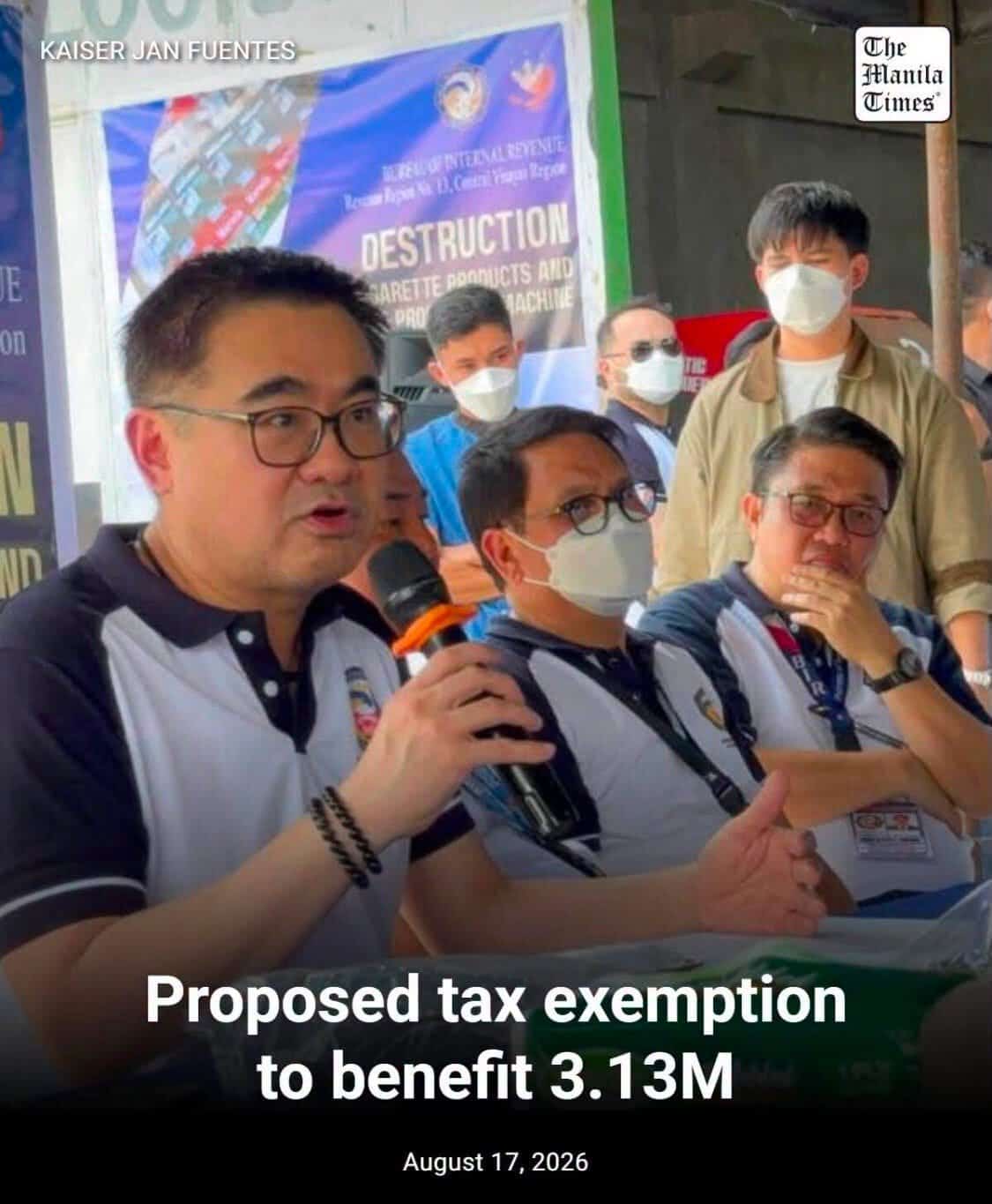
Photo Credit: The Manila Times / Kaiser Jan Fuentes
Disclaimer: The views and opinions expressed in this article are those of the author and do not necessarily reflect those of the organizations with which he is affiliated.
About the Author: Ray G. Talimio Jr. is a Certified Public Accountant (CPA), economist, tax advisor, columnist and business consultant. He is a Past President and Past Chairman of the Oro Chamber, former Co-Chairman of the Regional Development Council-X Economic Development Committee, former Chairman of the MSME Development Council of Misamis Oriental and Cagayan de Oro, former Chairman of BIMP-EAGA Northern Mindanao, a National Officer of the Philippine Institute of Certified Public Accountants (PICPA), and a member of the Association of Certified Public Accountants in Public Practice (ACPAPP). He writes on economics, taxation, governance, public accountability and national development.