
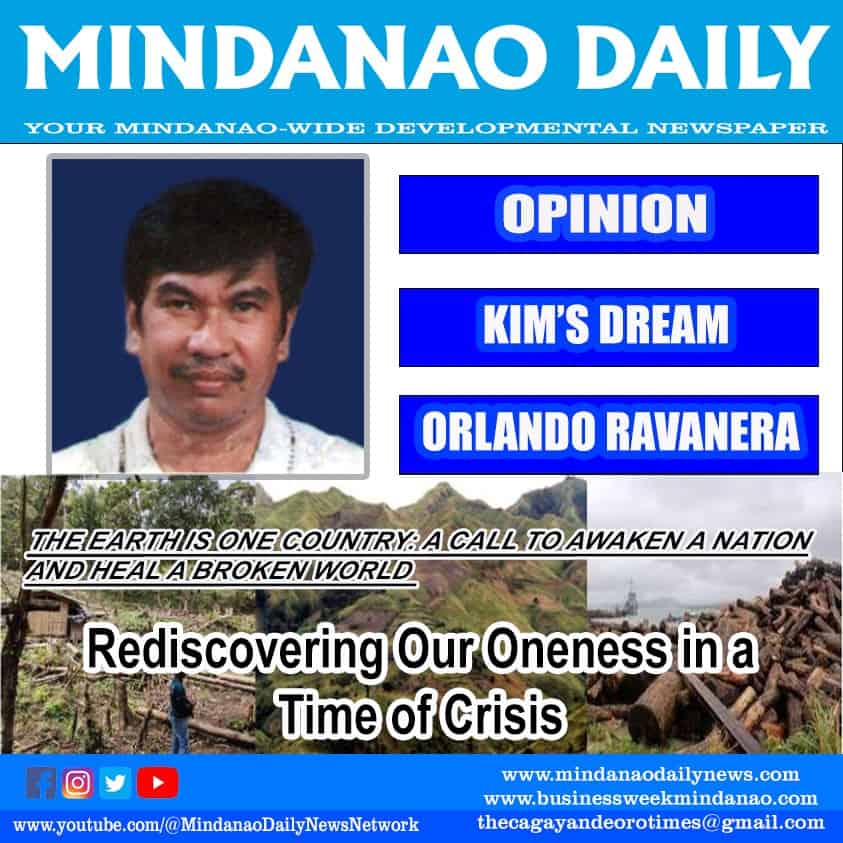
THE EARTH IS ONE COUNTRY: A CALL TO AWAKEN A NATION AND HEAL A BROKEN WORLD
Kim’s Dream Orlan Ravanera
The statement that the Earth is one country and mankind its citizens, first articulated by Bahá’u’lláh, is not merely a poetic expression; it is a profound truth that humanity has long ignored. Today, as the world faces deepening ecological collapse, widening inequality, and moral disorientation, this truth has become an urgent call to awaken. We now live in a time when nearly eight billion human beings must learn not only to coexist, but to recognize that our survival depends on unity, shared responsibility, and a renewed relationship with nature.
Yet, we find ourselves in a broken world, a world where the majority suffer while a small elite prospers excessively. This imbalance is not accidental; it is the result of centuries of a distorted worldview rooted in domination, exploitation, and unchecked greed. The climate crisis, poverty, and social unrest we experience today are not isolated problems; they are symptoms of a deeper illness: a collective insanity driven by materialism and disconnection from our true human essence. When astronauts first captured images of Earth from space, humanity saw, for the first time, a borderless planet, a single, fragile blue sphere suspended in the vastness of the universe. There were no lines dividing nations, no markers of ownership, only one interconnected home. This visual truth confirmed what ancient wisdom had always known: that life is fundamentally interconnected.
However, over the past 500 years, the rise of imperial powers has violently contradicted this principle of oneness. Through colonization, conquest, and economic domination, powerful nations imposed a system that prioritized control and profit over harmony and sustainability. The ideology of survival of the fittest replaced the sacred understanding of mutual coexistence. In this system, weaker nations, including the Philippines, were subjugated, their resources extracted, and their cultures diminished.
This historical injustice continues today in more subtle but equally destructive forms, which we now call modern imperialism. Multinational corporations, oligarchs, and the so-called “one percent” dominate global systems of finance, politics, and media. Their influence shapes policies that prioritize profit over people and the planet, perpetuating cycles of poverty and environmental degradation. Before colonization, Indigenous communities lived in harmony with nature. In the Philippines, Indigenous Peoples understood land not as property but as a sacred trust. Their worldview was grounded in the principle of Res Communis that no one owns the land, but everyone shares in its use and responsibility.
This wisdom is evident in the engineering marvel of the Ifugao Rice Terraces, often called the “Eighth Wonder of the World.” These terraces were not built through exploitation but through cooperation with nature. The Ifugaos observed the stars, such as the Big Dipper, to guide agricultural practices. They respected natural cycles, ensuring sustainability for generations. Contrast this with today’s reality: forests are cleared for profit, rivers are polluted by mining, and ancestral lands are taken for corporate expansion. Indigenous communities are displaced, their rights violated, and their voices silenced. What was once a relationship of stewardship has been replaced by a system of extraction.
The Philippines today reflects the broader global crisis. Despite its rich natural resources, millions of Filipinos struggle with poverty, rising costs of living, and environmental disasters. Typhoons grow stronger, floods become more frequent, and communities, especially the poor, bear the brunt of these impacts. Why does this happen? Economic systems prioritize short-term profit over long-term sustainability. Coal plants continue to operate, fossil fuels dominate energy production, and development projects often disregard environmental and social consequences. Meanwhile, wealth remains concentrated in the hands of a few powerful families and corporations.
This is not merely a political or economic issue; it is a moral crisis. It reflects a society that has lost its sense of balance, where greed is normalized, and compassion is sidelined. At the core of this crisis is a distorted consciousness, a fixation on material wealth, status, and consumption. Humanity has become trapped in what many spiritual thinkers describe as ego-based consciousness, where identity is tied to possessions and power rather than values and purpose. This unconscious way of living drives endless consumption, environmental destruction, and social inequality. It convinces us that happiness comes from accumulation, even as it leads to emptiness and conflict. Spiritual leaders, including the Dalai Lama, have long warned about this imbalance. He emphasizes that our exploitation of nature stems from ignorance, greed, and a lack of respect for life. According to him, saving the world requires a revolution of compassion, a shift from self-centeredness to collective care.
To heal our broken world, humanity must undergo a profound transformation not just in systems, but in consciousness. We must move from a focus on “having” to a focus on “being.” This means rediscovering our true nature not just as physical beings, but as conscious, interconnected parts of a greater whole. Ancient wisdom traditions remind us of this truth. The Chinese philosopher Zhang Zai wrote that Heaven is our father and Earth is our mother, and that all people are our brothers and sisters. This perspective dissolves divisions and fosters a deep sense of responsibility toward others and the natural world.
When we embrace this formless consciousness, we begin to value compassion over competition, cooperation over domination, and sustainability over exploitation. We shift from maximizing profit to maximizing meaning, from consuming endlessly to living mindfully. The path forward requires a collective awakening, a revolution not of violence, but of values. Governments, institutions, and individuals must work together to create systems that prioritize human dignity and ecological balance.
In the Philippine context, this means: First, protecting ancestral lands and respecting Indigenous rights. Second, transitioning to renewable energy and reducing dependence on fossil fuels. Third, supporting local communities and sustainable livelihoods. Fourth, promoting education that fosters environmental awareness and social responsibility, and fifth, challenging systems of corruption and inequality. But beyond policies, it requires a change of heart, a commitment to unity, empathy, and shared responsibility. The crises we face today, climate change, inequality, and social fragmentation, are deeply interconnected. They cannot be solved in isolation. They require a unified response rooted in the recognition that we are one human family, sharing one planet.
The words of Bahá’u’lláh resonate more strongly than ever: the Earth is indeed one country, and mankind its citizens. If we continue to live as divided nations driven by selfish interests, we risk destroying the very foundation of life. But if we embrace our shared humanity and act with compassion and wisdom, we can create a future that is just, sustainable, and harmonious. The choice is ours. The time to awaken is now. All for God’s greater glory.
###