
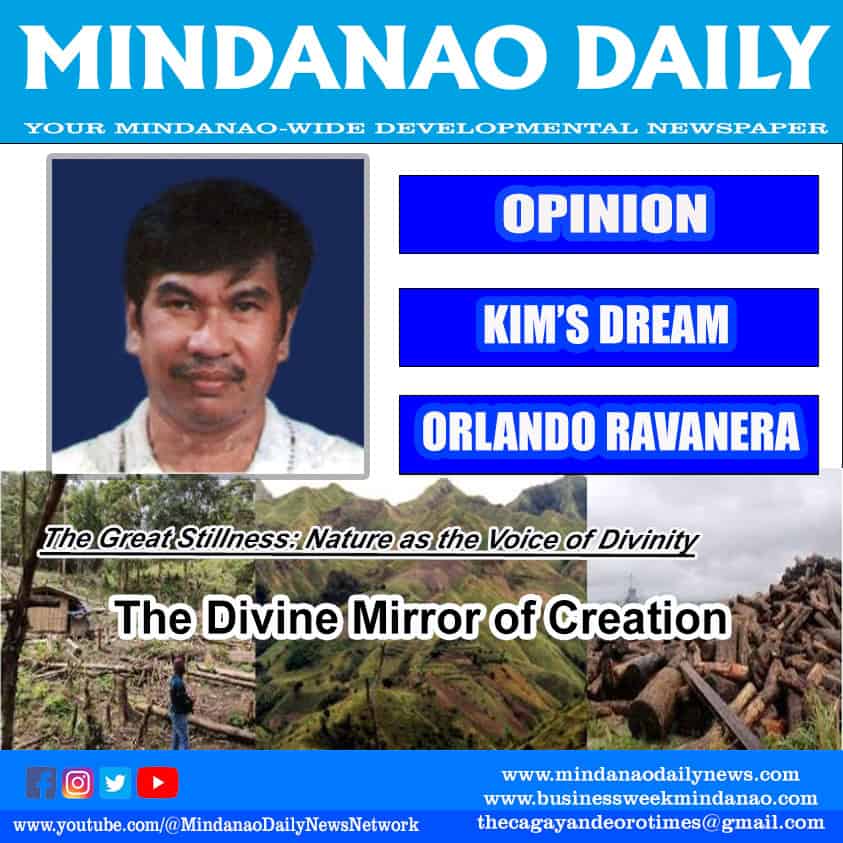
The Great Stillness: Nature as the Voice of Divinity
It is res Ipsa loquitor, the thing speaks for itself. Indeed, nature’s beauty speaks of a higher presence, a sacred intelligence that no language can fully define. Every ray of sunlight piercing the morning mist, every river winding through the valleys, every leaf unfolding in silence proclaims the glory of the Creator. Nature is not apart from God; it is the living reflection of the Divine Mind. In the stillness of creation, we encounter the invisible made visible, the unseen revealed through form, color, and movement. The mountains rise as ancient cathedrals, the oceans chant their hymns, and the forests breathe in rhythm with the Spirit that animates all life.
This is the Creator’s living masterpiece, the first and oldest scripture, written long before human language was born. Yet humanity has forgotten this truth. Inside our churches, we kneel before painted images of the Divine, while outside, the true image of God, the living world, is being destroyed. Leonardo da Vinci’s works may reveal the genius of man, but they remain mere imagination. The real face of God shines in the eyes of every living creature, glimmers in the rivers, and pulses in every heartbeat of creation.
Indigenous Peoples have long understood that the highest form of worship is not ritual but reverence for the care of the land, the protection of rivers, and the honoring of life. They see the mountains, forests, and seas as living temples of the Divine. To destroy creation is blasphemy; to protect it is a sacred duty. In the lush heart of Mindanao, when the forests were threatened by corporate greed, Indigenous communities rose to defend the sacred. They formed human barricades, lying across logging roads, willing to die so that the trees might live. Their courage was not just defiance; it was faith, an act of love for God’s living creation.
The same devotion was seen in India’s Chipco Movement when women rushed to the forests, hugging the trees and crying, “Before the axe touches these trees, it must pass through our bodies!” This was not rebellion; it was reverence. In their embrace of nature, they embraced the Divine. For what greater act of love exists than to give one’s life for creation, for in doing so, one gives one’s life for God Himself. In their sacrifice, we see the truest form of spirituality: the realization that all life is one under the sacred breath of God.
And yet, even as courage blooms among the humble, the powerful have desecrated the Earth. In the once-sacred forests of Mt. Kalatungan and Mt. Kitanglad, sawmills roar where birds once sang. Hundreds of thousands of hectares of forest home to eagles, orchids, and tarsiers have been destroyed by greed. The mountains that once gathered the rains and nourished rivers now stand wounded and barren. Humanity, in its blindness, has exchanged reverence for exploitation and worship for domination.
Why have we allowed this? Because of a sickness in human consciousness, the illusion that we exist apart from nature, that we are its masters instead of its caretakers. This illusion has birth arrogance, greed, and blindness. The Earth, once a sanctuary of abundance, has become a battlefield of extinction. Homo sapiens, the self-proclaimed “intelligent species,” has become the executioner of life itself. We pray in comfort while forests burn. We sing hymns while rivers turn black with poison. We offer gold and wealth while the soil that feeds the poor turns to dust.
God’s creatures vanish in silence. Their extinction is the echo of our moral decay. We have convinced ourselves that their pain is not our concern, but nature’s first law is interconnection: what harms one, harms all. The floods that drown our cities, the droughts that starve our children, the storms that devastate our homes, these are not random punishments. They are the Earth’s lamentation for the crimes we have committed against her.
Our nation, the Philippines, stands among the countries most wounded by climate change. Each typhoon, each landslide, each flood cries out that the consequences of greed can no longer be ignored. Scientists warn that we are now in a planetary emergency, one minute before midnight. And yet, humanity continues to sleep. GAIA, the living Earth, is now in her sixth extinction, not caused by asteroids or ice ages, but by human hands. One-fourth of humanity faces hunger because the soil is poisoned, water is depleted, and biodiversity is erased, all in the name of profit. We continue to worship the idol of economic growth, mistaking material wealth for progress while our spiritual life withers. The reign of global corporations has turned the planet into a marketplace and life itself into a commodity. This is not progress; it is genocide against nature and the poor. The destruction of the environment is the most invisible form of violence; it kills without bullets, but with pollution, hunger, and displacement. It is the Third World War, waged in silence, where the victims are the voiceless: the poor, the defenseless, and the unborn.
Even as the Earth bleeds, many remain in denial. The web of lies spun by corporations, political powers, and media tells us that climate change is a hoax, that endless growth is possible, and that consumption equals happiness. These illusions form the spiritual fog of our time. Even global gatherings like the Conference of the Parties (COP) have become theaters of illusion where leaders speak of change, but industries continue to destroy.
The pandemic should have been our wake-up call, a reminder that humanity cannot live apart from the rhythms of nature. But we refused to awaken. We returned to our old habits of consumption and control. Humanity’s crisis, therefore, is not only ecological, it is spiritual. We have built temples of wealth but destroyed the temple of life. We have multiplied knowledge but lost wisdom. Religion, which should awaken compassion, has too often remained silent while creation dies.
The time has come to rediscover the consciousness of oneness that we are part of the sacred web of life. To destroy creation is to destroy ourselves. To love creation is to love God. The true image of God is not power or profit; it is love, stillness, and interconnection. The Creator does not dwell only in temples built by hands but in every grain of soil, every drop of rain, and every breath we take.
There is a stillness in nature that speaks the language of the Divine. The wind in the trees, the rhythm of the waves, the silence of the stars all whisper the same eternal truth: We are one. When we quiet the mind and listen deeply, we hear the pulse of the universe within our own heartbeat. This is the Great Stillness, the sacred presence that unites all things.
Let us return, then, to the rhythm of life. Let us walk gently upon the Earth as children of the same Creator, caretakers of the same home. Let us replace greed with gratitude, domination with harmony, and indifference with compassion. When humanity rediscovers stillness and listens once more to the voice of creation, we will find God not in the distance, but here, in the whisper of the forest, in the breath of the wind, in the beating heart of the Earth.
Only through this awakening shall we heal both the planet and the soul. For in the Great Stillness, we remember: Nature is not apart from God, it is God’s reflection, His living word made visible.
###