From the Sidelines
By: Ray G. Talimio Jr.
“If barangay and SK officials are given two more years in office, will gratitude someday matter when a Constituent Assembly sends constitutional amendments to a national plebiscite?”
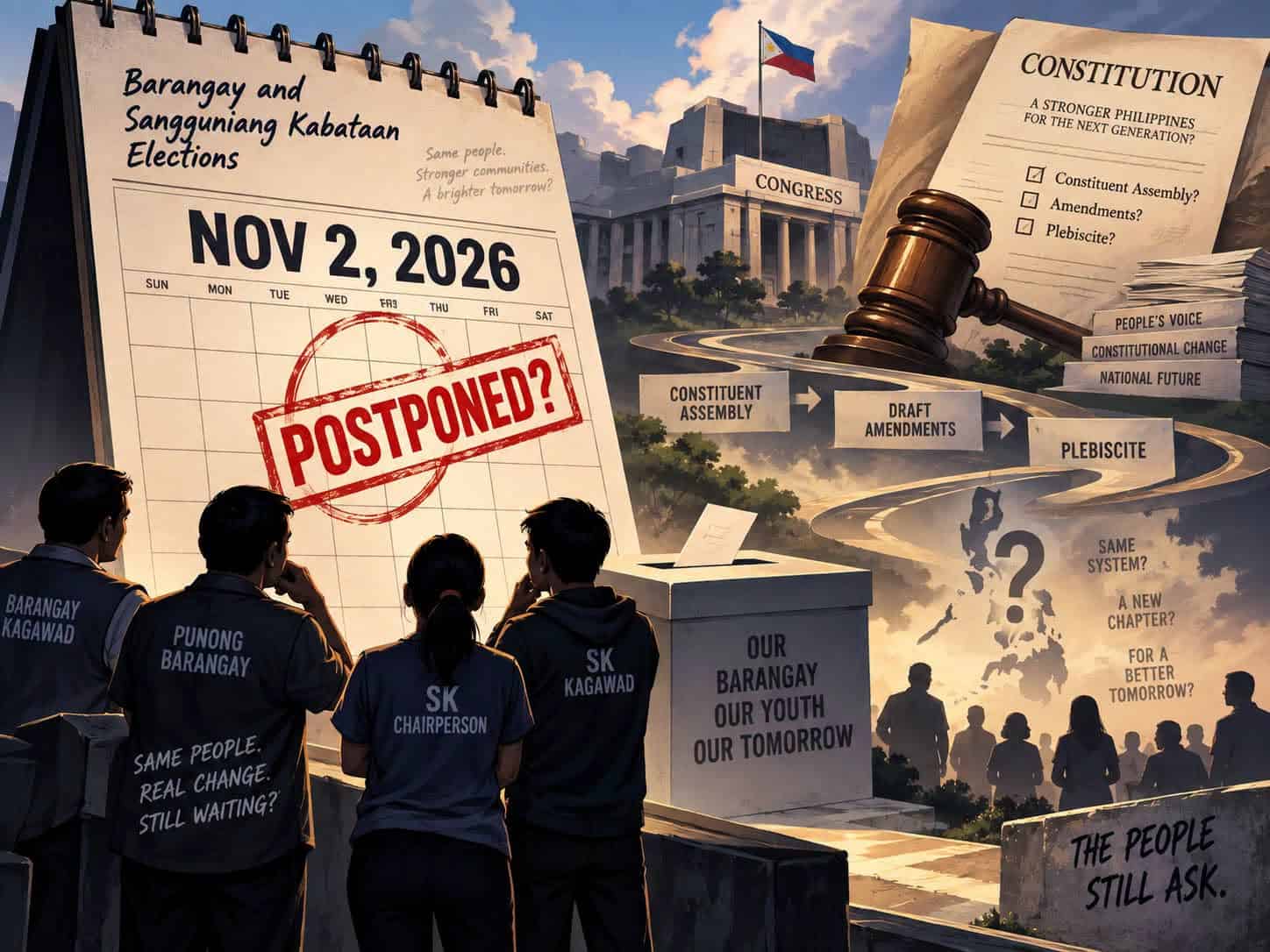
The Barangay and Sangguniang Kabataan Elections (BSKE) remain scheduled for November 2, 2026 under Republic Act No. 12232. Yet with election day approaching, the country deserves clarity: Will the elections proceed or not? Republic Act No. 12232 fixes the next regular BSKE on the first Monday of November 2026.
Congress has practically completed its work.
The Senate approved Senate Bill No. 2387 on September 14 by a vote of 13-5. The measure fixes the term of barangay and Sangguniang Kabataan (SK) officials at five years and moves the next elections to the second Monday of November 2028. The House subsequently adopted the Senate bill on September 16 as an amendment to its own measure.
Because the House accepted the Senate version, there is no conflicting version requiring reconciliation through a bicameral conference committee. The measure therefore proceeds to enrollment and presentation to the President.
What the public needs to know now is the exact date Malacañang received the enrolled bill. Article VI, Section 27 of the Constitution provides that the President must communicate a veto within thirty days from receipt. Otherwise, the measure becomes law as if he had signed it.
Meanwhile, the Commission on Elections must operate under the existing law unless and until it is changed. Government cannot expect election officials, barangays, SK officers, prospective candidates and voters to remain indefinitely uncertain as November 2 approaches.
The situation becomes more intriguing when viewed alongside continuing efforts in Congress to amend the Constitution. The House Committee on Constitutional Amendments has considered several proposals, including one expressly calling upon Congress to convene to consider constitutional amendments, as well as proposals involving a constitutional convention and specific amendments to the 1987 Constitution.
That raises an unavoidable political question.
If Congress eventually chooses the Constituent Assembly route and constitutional amendments are submitted to the people in a plebiscite, could an extension benefiting incumbent barangay and SK officials acquire political significance beyond simply saving election expenses?
Barangay and SK officials cannot determine a plebiscite themselves. The electorate does. But grassroots officials have organizations, local networks and daily access to communities that can matter greatly in any nationwide political campaign.
There is no verified evidence of an agreement linking the BSKE extension to constitutional change. It should not be presented as one. But when an administration-backed or congressional action directly benefits thousands of incumbent local officials, and constitutional amendments remain under discussion, public scrutiny is inevitable.
Deputy Speaker Janette Garin has argued that extending terms could save government approximately P30 billion in direct election costs. Saving public money is a legitimate consideration.
But uncertainty also has a cost.
The Palace should make its position clear. Whatever the outcome, barangays, SK officials, candidates, COMELEC and voters deserve sufficient time to prepare.
And should a Constituent Assembly and plebiscite eventually follow, the public will inevitably examine whether today’s extension and tomorrow’s constitutional campaign ever intersected.
Sources:
House of Representatives; Senate of the Philippines; 1987 Constitution; Republic Act No. 12232; Commission on Elections.
Photo Credits:
AI-generated editorial image created with OpenAI image generation tools for this article.
Disclaimer:
The Constituent Assembly and plebiscite discussion raises questions of governance, political dynamics and public accountability. It does not assert that an agreement exists between the administration and incumbent barangay or SK officials.
About the Author:
Ray G. Talimio Jr. is a Certified Public Accountant (CPA) and an economist, business leader, consultant and columnist. He is a Past President and Past Chairman of the Cagayan de Oro Chamber of Commerce and Industry, former Co-Chair of the Regional Development Council-X Economic Development Committee (RDC-X EDC), and former Chair of the Micro, Small and Medium Enterprise Development (MSMED) Council of Misamis Oriental and Cagayan de Oro City. He has served as a national officer of the Philippine Institute of Certified Public Accountants (PICPA) and is a member of the Association of Certified Public Accountants in Public Practice (ACPAPP). He writes on economics, taxation, governance, public accountability and national development.
###