

By Chris V. Panganiban
SAN FRANCISCO, Agusan del Sur — With the Taguibo watershed struggling to meet the Butuan City’s water requirements, a local forestry and mapping specialist has proposed studying the Agusan River as a supplementary source—an idea that highlights the growing pressure to reduce Butuan’s dependence on a single water system.
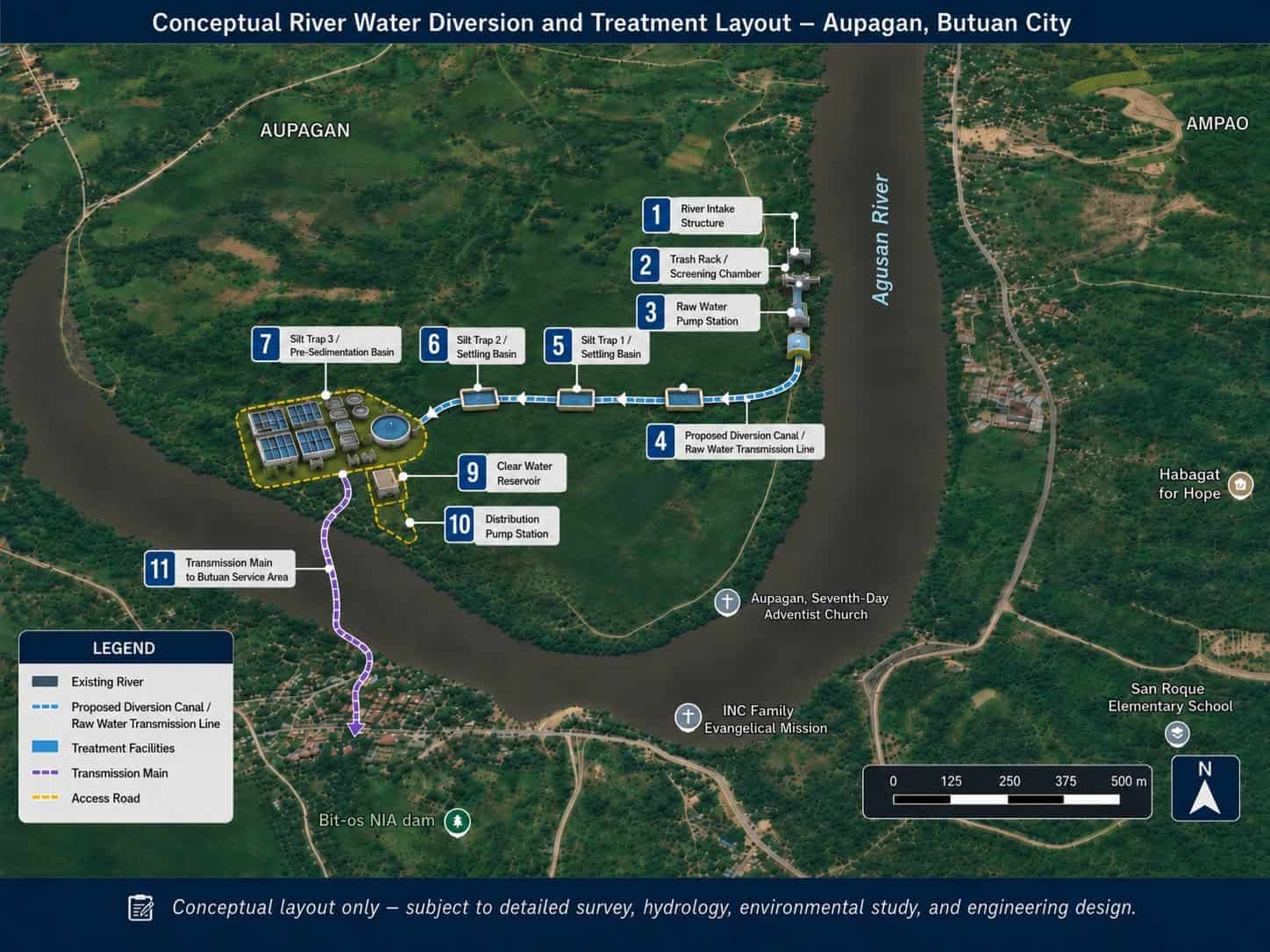
Reymar Ballescas presented an AI-generated map showing his proposed location for a surface-water treatment facility in the plains of Aupagan, near a bend in the Agusan River. He said water could potentially be diverted from the river, treated and distributed to nearby communities.
Ballescas, however, emphasized that the map represented only his “spatial imagination” and was not an engineering proposal. Although he identified himself as a forester, geographic information system specialist and independent consultant, he acknowledged having no technical expertise in designing water-treatment facilities.
Alternative source
The concept calls for treating Agusan River water primarily for bathing, washing, cleaning and other household purposes. If proven safe and practical, a separate supply for such uses could lessen demand on the higher-quality water drawn from Taguibo.
Ballescas suggested that even a facility capable of supplying half of Taguibo’s output could serve densely populated communities near the proposed site, including San Vicente, Villa Kananga, Maon and Golden Ribbon.
His proposal comes as prolonged dry conditions continue to reduce water availability in Butuan. The Butuan City Water District earlier reported that production had fallen to about 41.89 million liters per day from the normal 55 million liters per day.
An estimated 91,425 residents were experiencing low-pressure or no-water service, prompting the city government to declare a state of calamity on Sept. 5 and expand emergency rationing and other supply measures.
Treatment concerns
Drawing water from the Agusan River would require extensive technical and environmental studies. Issues to examine include the river’s water quality, seasonal changes in flow, potential contamination, treatment requirements, and the cost of pumping water to the distribution network.
Ballescas noted public concerns over possible mercury and other contaminants associated with mining activities in upstream portions of the Agusan River Basin, including areas in Davao de Oro. He argued that these concerns underscore the need for an appropriate treatment system rather than automatically excluding the river as a possible source.
Any plan to use the river for drinking or household purposes would need to comply with government water-quality standards. Authorities would also have to determine whether treated water intended only for non-drinking uses could be distributed through the existing network or would require a separate system.
Study gap
Publicly accessible records show that BCWD previously undertook a broader feasibility study for a water-supply development and treatment project, but available information does not identify the Agusan River as its proposed source.
The Environmental Management Bureau of the Department of Environment and Natural Resources Caraga regional office have also monitored the river’s environmental condition and water quality, but no published document reviewed confirms a government feasibility study specifically on treating Agusan River water for Butuan’s distribution system.
A separate DOST-supported study by Caraga State University researchers identified Kolambugan, Padiay, Pianing, Simbalan and Guinabsan as possible supplementary watersheds. The research ranked Kolambugan and Simbalan among the most suitable, but it assessed nearby watersheds rather than the direct extraction and treatment of water from the Agusan River.
The proposal also raises questions over construction and operating costs, electricity requirements, land availability and the possible effect on consumer rates. Because the suggested site is relatively low-lying, engineers would have to determine the pumping, storage and transmission facilities needed to serve communities at different elevations.
No confirmation has been made that the city government or BCWD is formally evaluating Ballescas’ proposed location. His estimate that a facility could provide half of Taguibo’s output has likewise not been supported by hydrological, engineering or financial analysis.
###