From the Sideline
By: Ray G. Talimio Jr.
“The impressive Waste-to-Energy plant circulating on social media may be artificial intelligence, but the project behind it is very real. The more useful question is whether Davao can finally turn a decade-old plan into a financially and environmentally sustainable solution to its garbage problem.”
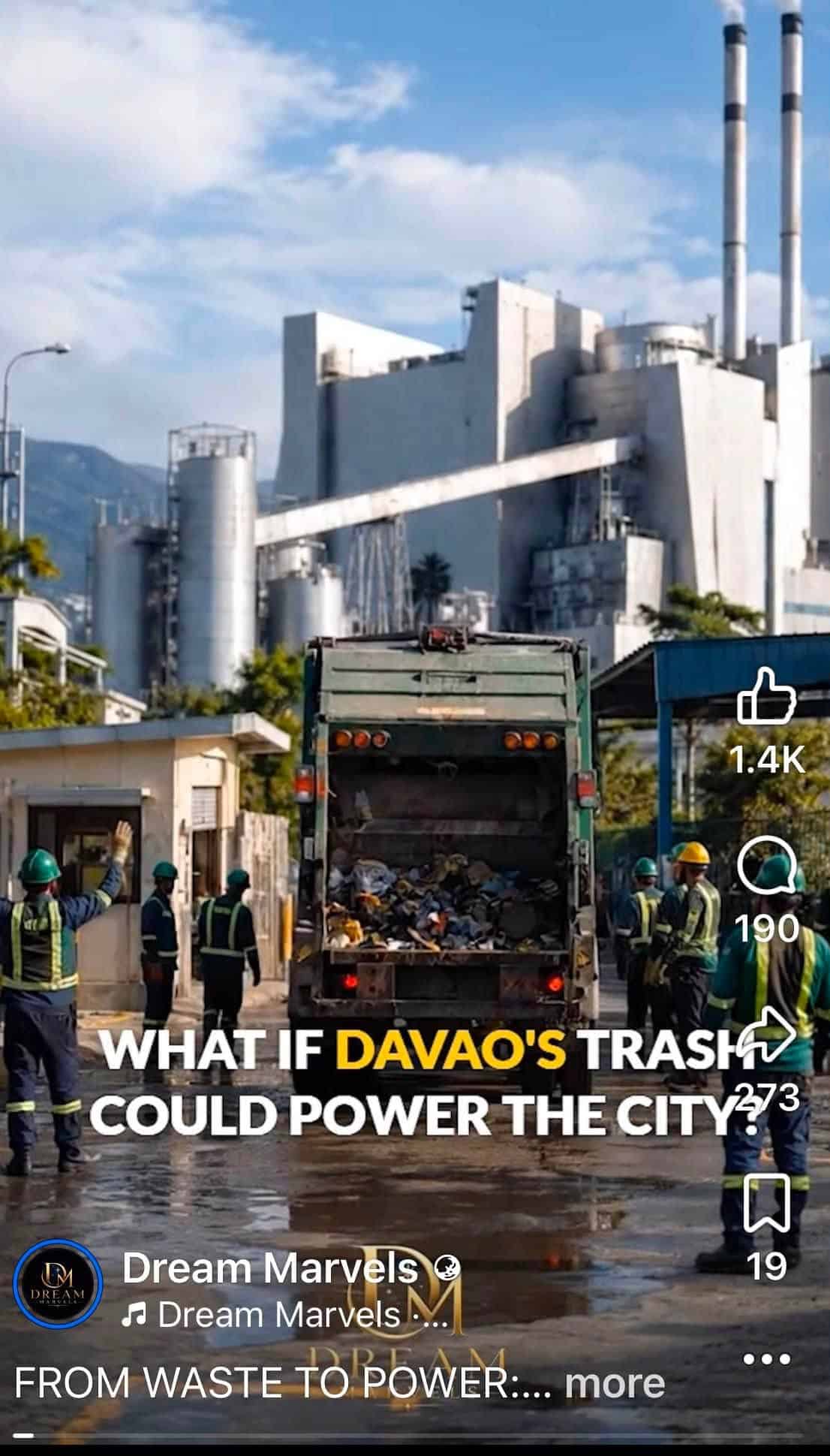
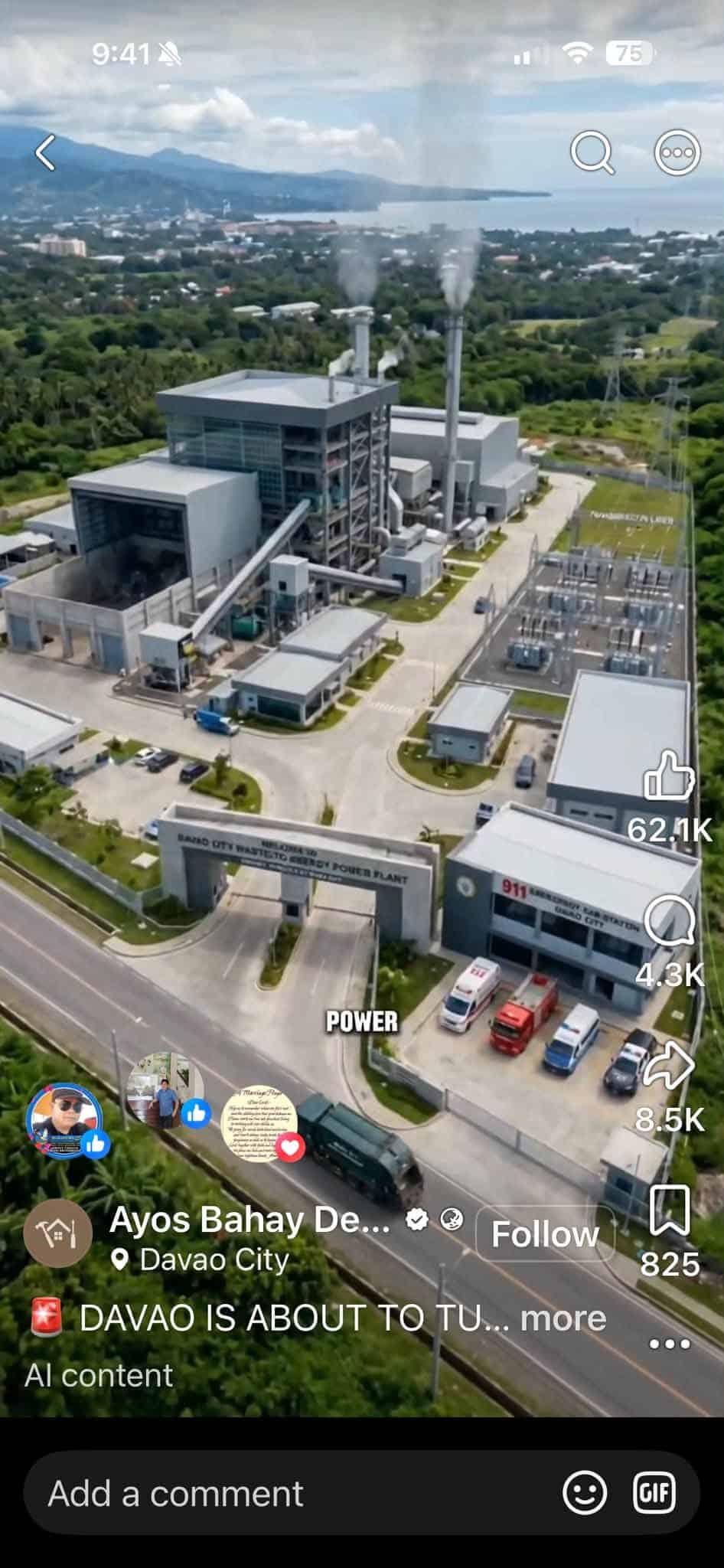
The video is impressive. A modern Waste-to-Energy (WTE) complex stands amid lush greenery, complete with smokestacks, electrical facilities and even an emergency response station. The entrance boldly identifies it as the Davao City Waste-to-Energy Power Plant.
There is only one problem. It does not exist yet.
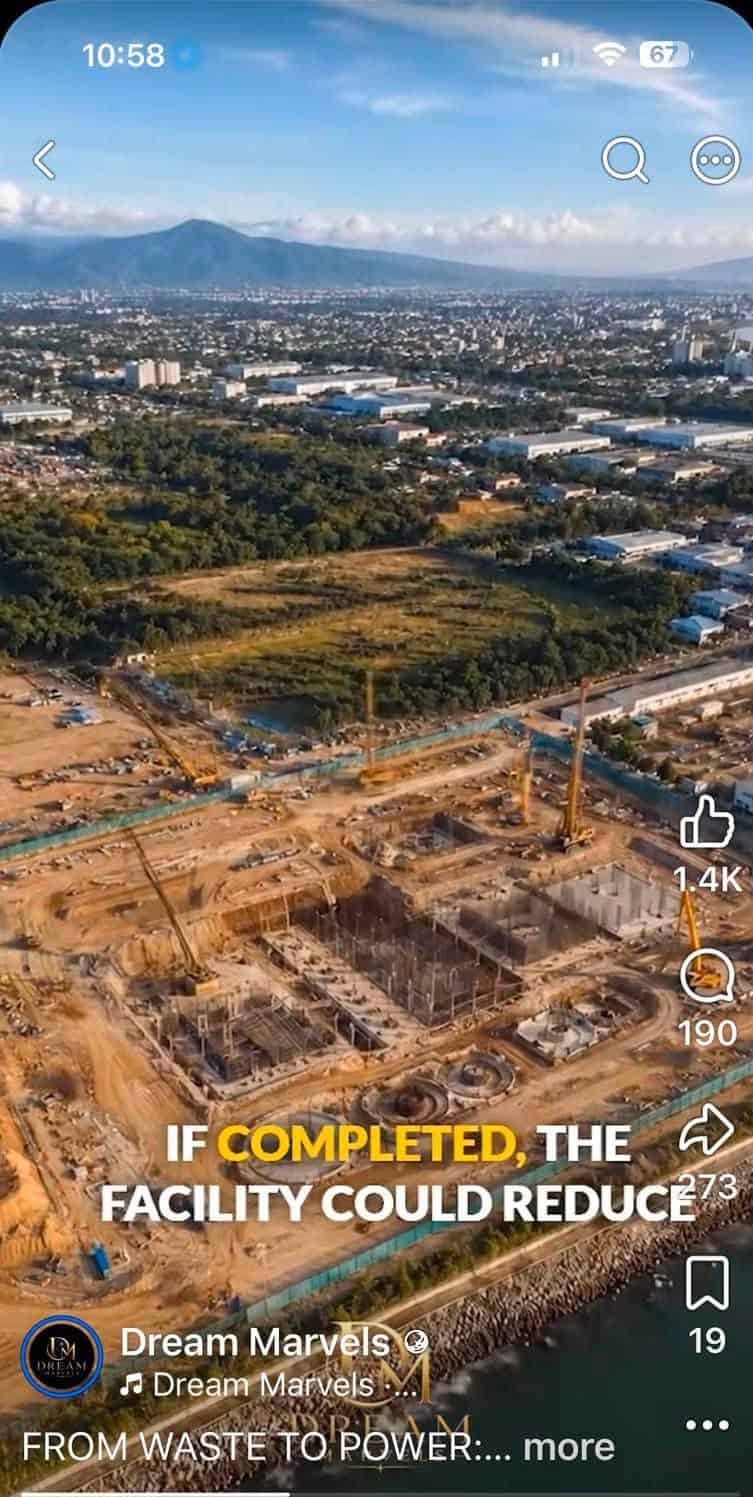
And another social media reel goes even further, showing what appears to be a WTE facility under construction and asking, “What if Davao’s trash could power the city?” The imagery is compelling, but it should not be confused with documentary footage. Official records show that Davao’s proposed WTE facility was still undergoing the environmental approval process in 2026. The project is real. The impressive plants and construction scenes circulating online are not proof that it has already been built or is being built.
The Department of Environment and Natural Resources, Environmental Management Bureau Region XI (DENR-EMB XI) scheduled public scoping for the project only last April 15, 2026. The proposed site is in Sitio Pungot, Barangay Biao Escuela, Tugbok District.
But dismissing the videos as merely artificial intelligence would miss the bigger story.
Davao has been pursuing WTE for years. Japan and the Philippines signed an Exchange of Notes on March 20, 2018 for grant assistance worth ¥5.013B, or roughly P2B to P2.5B depending on the exchange rate used. Japan’s records identify the undertaking as the Project for the Development and Construction of Waste-to-Energy Facilities in Davao City.
The proposed facility is designed to process around 600 tons of municipal solid waste daily. Earlier Japan International Cooperation Agency (JICA) planning documents projected approximately 9.7 megawatts (MW) of electricity available for sale, while other project presentations placed gross generation at around 11 MW.
This distinction is important. WTE should not primarily be viewed as another power generation project. It is first a waste-management solution that recovers energy from garbage that would otherwise require disposal.
And that brings us to economics.
Japan’s grant does not automatically mean Davao gets an entire WTE facility for free. Earlier project financing discussions contemplated billions of pesos in additional Philippine government support to complement Japanese assistance and fully finance the facility.
That means Filipino taxpayers potentially have substantial exposure to the project as well.
Earlier project studies also contemplated a tipping fee, the amount the city pays for every ton of garbage delivered for treatment. One project scheme cited P600 per ton, while other financial scenarios indicated substantially higher amounts depending on capital support, operating costs and electricity revenues.
These are historical planning figures, not necessarily the final fee Davao will eventually pay.
That distinction must be emphasized because the tipping fee could determine whether WTE becomes an economic solution or an expensive long-term obligation.
There is also an inherent policy challenge. WTE facilities need a reasonably predictable volume and calorific quality of waste to operate efficiently. Yet Republic Act No. 9003, or the Ecological Solid Waste Management Act, encourages segregation, recycling, composting and waste reduction.
The objective, therefore, should never become “produce enough garbage to feed the plant.” WTE should handle appropriate residual waste after economically recoverable and recyclable materials have been removed.
This is where Cagayan de Oro and Misamis Oriental should watch Davao carefully.
Rather than immediately asking whether we should build our own WTE plant, we should study whether a regional approach makes greater economic sense.
A facility serving Cagayan de Oro together with participating Misamis Oriental local government units could potentially achieve the scale necessary to justify the huge capital investment. But that requires actual numbers: daily residual waste volume, hauling distances, tipping fees, electricity revenues, financing costs, environmental safeguards and the cost of alternatives.
Five safeguards should be non-negotiable: transparent competitive procurement, independent emissions monitoring, mandatory waste segregation before combustion, full disclosure of tipping-fee and waste-volume commitments, and an independent lifecycle comparison with sanitary landfills, recycling, composting and other technologies.
Davao therefore offers Northern Mindanao something potentially more valuable than a blueprint.
It offers a case study.
Its experience can show us what works, what causes delays, what government must subsidize and what taxpayers eventually have to pay.
The AI-generated plants circulating online may be fiction today. But Davao’s WTE project is not.
For Cagayan de Oro and Misamis Oriental, the challenge is not to copy the picture.
It is to learn from the project before building our own.
Sources: Department of Environment and Natural Resources, Environmental Management Bureau Region XI, Notice of Public Scoping, Construction of Waste-to-Energy Facilities in Davao City Project, March 27, 2026.
DENR-EMB XI, Project Description for Scoping, The Project for the Construction of Waste-to-Energy Facilities in Davao City, March 2026.
Ministry of Foreign Affairs of Japan, Official Development Assistance, Exchange of Notes, March 20, 2018.
Japan International Cooperation Agency, Davao City Infrastructure Development Plan and Capacity Building Project, Solid Waste Management Plan.
City Government of Davao, official materials on the proposed Waste-to-Energy project.
Photo Credits: Screenshots from Facebook reels posted by Ayos Bahay De… and Dream Marvels. The images depicting completed or under-construction WTE facilities are illustrative or generated visuals and should not be construed as photographs documenting the present construction status of the proposed Davao City WTE facility.
Disclaimer: The views and opinions expressed in this article are those of the author and do not necessarily reflect those of any organization or institution with which he is affiliated.
About the Author: Ray G. Talimio Jr. is a Certified Public Accountant (CPA), economist, tax advisor, columnist and business consultant. He is a Past President and Past Chairman of the Oro Chamber, former Co-Chairman of the Regional Development Council-X Economic Development Committee, former Chairman of the MSME Development Council of Misamis Oriental and Cagayan de Oro, former Chairman of BIMP-EAGA Northern Mindanao, a National Officer of the Philippine Institute of Certified Public Accountants (PICPA), and a member of the Association of Certified Public Accountants in Public Practice (ACPAPP). He writes on economics, taxation, governance, public accountability and national development.