

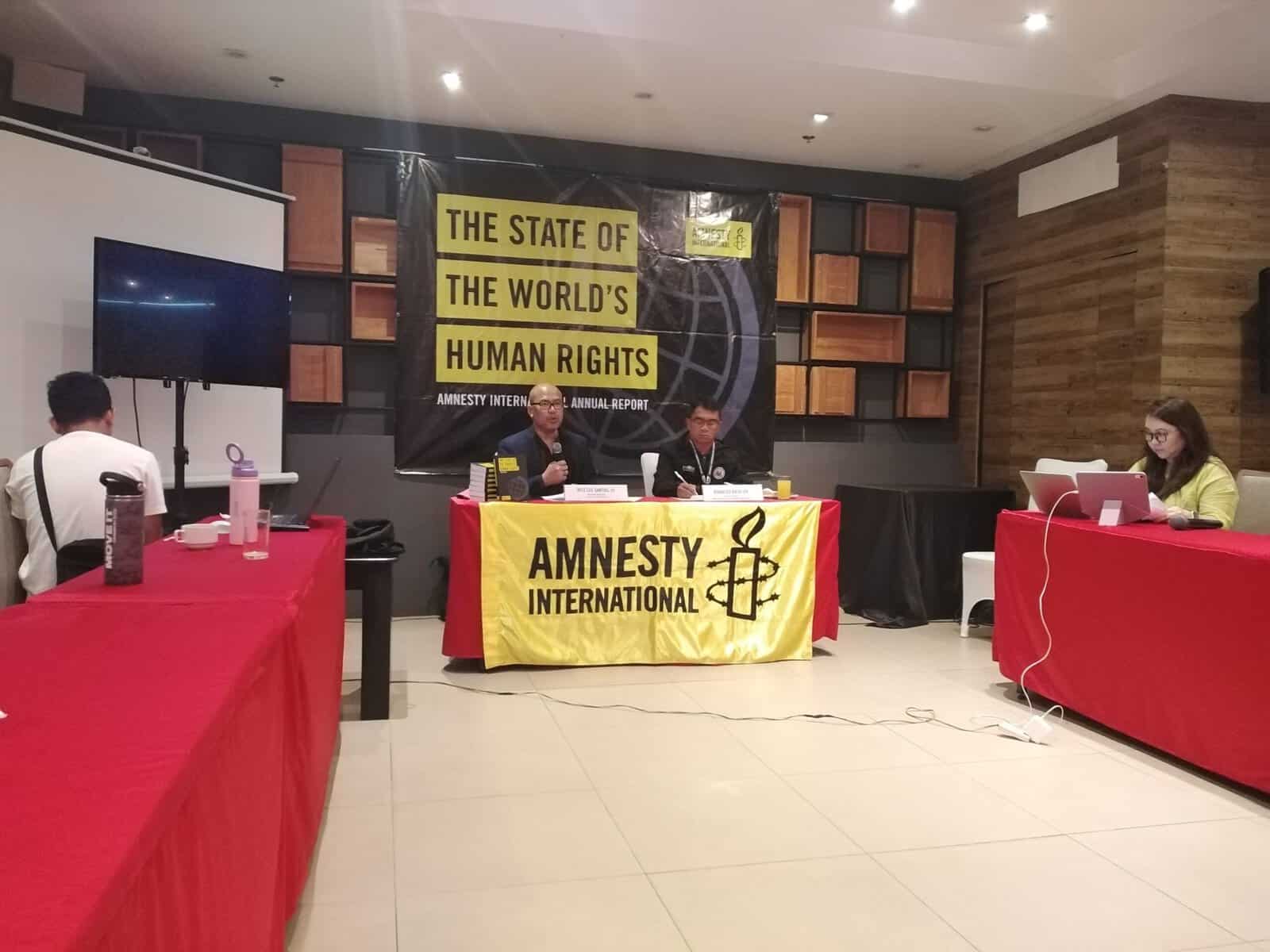
CAGAYAN DE ORO CITY – Amnesty International Philippines reiterated today that the dire hurnan rights situation in Mindanao is the consequence of decades of impunity and the failure in holding the government to account for leaving communities vulnerable to precarious living and uncertain futures.
On the last leg of the rolling launch of Amnesty International’s annual report on the state of the
world’s human rights, two days after the devastating earthquake struck the region, Amnesty stressed that the conversation can no longer be limited to merely disaster preparedness or quick emergency response.
“Mindanao is paying the price of accountability failures, this is not sinply a result of natural hazards, but unnatural disasters made possible by the lack of commitment of local government units to make certain that communities can thrive despite disasters. The question is no longer whether government agencies can mobilize rescue operations after a disaster, this is the time for reckoning and looking into what the government owes the people of Mindanao after years of warnings, repeated tragedies, and missed opportunities to center human rights in governance and service,” said Ritz Lee Santos,
III, section director of Amnesty International Philippines.
During the press conference, Amnesty International Philippines highlighted the aftermath of the magnitude 7.8 earthquake that hit Mindanao two days prior, which news reports indicate has left more than 30 people dead, a hundred or more people injured and affected 700,000 individuals due to displacement and damages.
“Just seven months after the Davao Oriental earthquake, another major one left devastating
consequences. The quick response operations that saved lves and the tireless efforts of emergency responders are laudable but rescue operations alone become futile when prior failures are not addressed by local government units and when the national government lacks prevention efforts. This type of governance puts everyone in danger, including the rescuers and frontliners. When buildings collapse and essential services become inoperable, communities are exposed to more risks that go beyond acts of nature. Unaddressed accountability issues are more consequential than the disaster itself,” Santos lamented.
Amnesty International Philippines emphasized that the right to life and adequate housing impose obligations on the state to protect people from foreseeable disasters through effective regulations and risk reduction measures.
Additionally, Amnesty said that the right to health requires governments to ensure that medical facities remain functional or alternatives are prepared during emergencies.
“The government owes the Filipinos infrastructures that withstand climate hazards. Yet Mindanao has repeatedly borne the worst impacts of climate emergencies because the government lacks the basic will to protect communities. We have already seen Filipinos in protests calling for accountatbilty over dubious public works contracts and irregular procurement practices, andther rebuilding process after the recent earthquake, another opportunity tor corruption. Without prosecution of those already charged, the cycle continues for Mindanao and the rest of the country.” added Santos.
Amnesty called far stricter safeguards over reconstruction efforts, warning that post-disaster funding has historically been vuinerable to iregularities.
The organization also expressed its support to the enactment of the lndependent People’s Commission Act to establish independent civil society oversight over public funds.
The proposal aligns with Amnesty’s legislative human rights agenda for the 20th Congress where the recommendations for the review of laws governing business operations, disaster risk management and environmental protection to ensure that human rights take precedence over commercial interests is highlighted for their work on climate justice.
Amnesty further warned that the earthquake’s impact extends beyond immediate humanitarian needs.
It has also disrupted ongoing efforts to strengthen marine ecosystems and protect the livelıhoods or coastal communities in Mindanao.
“Fisherfolk in General Santos, Sarangani, Davao del Sur and Zamboanga now face the combined
pressures of environmental degradation, economic insecurity, business encroachment and disaster recovery. All of these are converging threats where on one hand, climate change is making disasters more destructive and less predictable, and on the other, food insecurity and economic vulnerability are deeply entrenched. Together, these push the communities closer to the brink of desperation. Climate change is producing new forms of harm that disproportionately affect marginalized populations,” Santos said.
Amnesty lnternational Philippines also raised concerns over the continuing attacks on Lumad
communities and indigenous peoples human rights defenders across Mindanao, noting that
indigenous leaders protecting ancestral lands, forests, water sources and ecosystems remain among the most vulnerable to red tagging.
“Indigenous communities are not obstacles to development, they are among the most important defenders of our environment and among the strongest allies in confronting climate change. Yet they continue to face threats simply for protecting the ancestral lands to sustain their communities,” Santos explained.
Amnesty cited the case of Lumad leader Michelle Campos, reflecting a broader pattern of military operations targeting Lumad communities.
They also mentioned the case of the Talaingod 13 as emblematic of the criminalization of solidarity work with indigenous communities.
“For years, indigenous human rights defenders have faced intimidation, attacks, arbitrary arrests, and even killings. Red-tagging has become a dangerous tool that places indigenous leaders at heightened risk simply for asserting their rights. Communities seeking recognition of their ancestral domains should not have to spend decades navigating bureaucracy while also defending themselves from harassment, intimidation, and politically motivated accusations. When indigenous peoples are forced to fight corporations, local authorities, and government institutions all at once, the promise of justice becomes impossible to reach,” Santos said.
Corruption, bureaucracy and the domineering presence of corporations, including the extractive industry spurred by heightened global demand for transition minerals, have made the ancestral domain claiming process even more complex, tedious and life-threatening.
“The people of Mindanao have heard promises after every disaster, every tragedy, every crisis. What they are owed now is accountability. Without accountability, disasters become recurring injustices, and the most vulnerable continue to pay the price,” concluded Santos.