
By CHRIS V. PANGANIBAN
PROSPERIDAD, Agusan del Sur — Lawmakers from this province are seeking the nationwide adoption of an award-winning anti-poverty initiative that they said has transformed the lives of thousands of upland farmers over the past decade.
Speaking before the House Committee on Agriculture and Food on March 3, Rep. Adolph Edward Plaza of Agusan del Sur’s 2nd District sponsored House Bill No. 1384, which seeks to institutionalize the Upland Sustainable Agriforestry Development (USAD) program in upland agricultural communities across the country.
“I respectfully manifest that the explanatory note of House Bill 1384 shall serve as my sponsorship speech,” Plaza told lawmakers, describing the proposal as “evidence-based legislation.”
“This is not a paper proposal,” he said. “This is a program that has been thoroughly debated during inception, vetted and nurtured, painstakingly implemented, calibrated, and updated for 15 years now.”
Plaza said the USAD program, first implemented in Agusan del Sur in 2013 in the aftermath of Typhoon “Pablo,” had produced measurable gains in upland communities long mired in poverty.
He cited improved incomes among farmer-beneficiaries and a steady decline in the province’s poverty incidence — from 48.1 percent in 2012 to 37.9 percent in 2018 — as among its “receipts.”
Recently, the Philippine Statistics Authority noted that the poverty rate in Agusan del Sur dropped from 33.4% in 2021 to 23.4% in 2023, surpassing the 2025 target of 27.4% ahead of schedule.
Plaza said the bill provides a legal framework for replicating what he described as a “tested and validated prototype” of community development. Joining him during the committee hearing were Gov. Santiago Cane Jr. and two of the program’s architects, Ranulpo Paler and Efren Isorena, who were present to answer queries from lawmakers.
Rep. Alfelito Bascug of Agusan del Sur’s 1st District co-authored the bill, along with Leyte Rep. Richard Gomez and at least 11 other lawmakers.
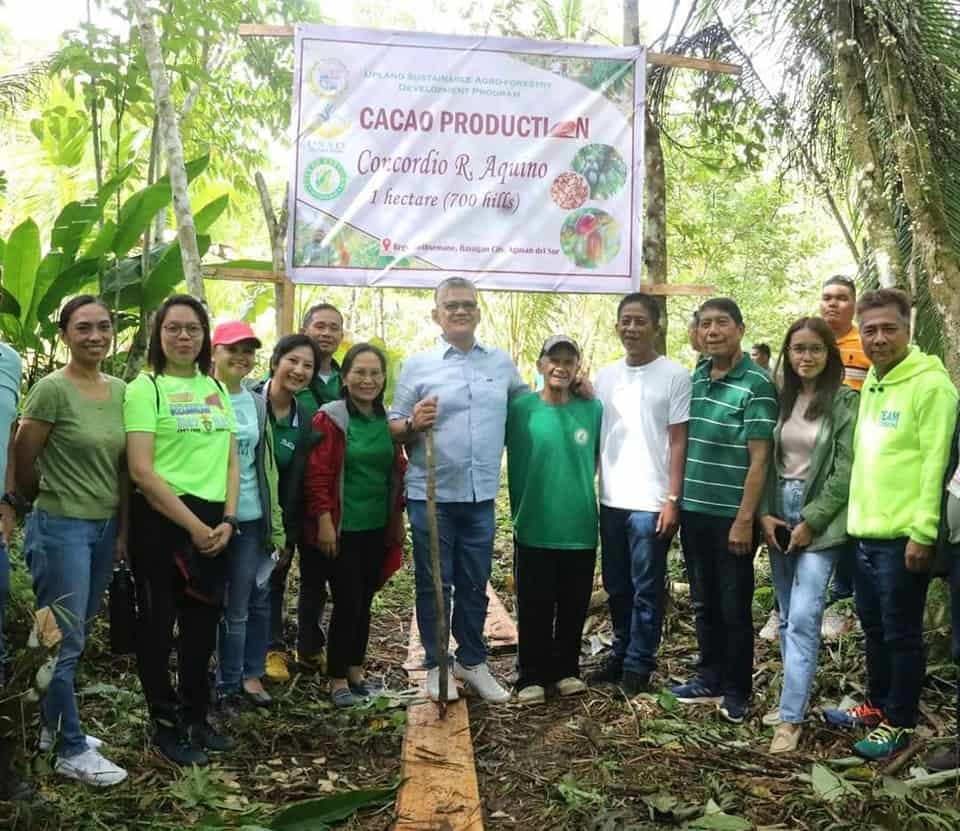
Under the USAD model, farmer-enrollees identify crops suited to their land and market conditions. The provincial government provides free seedlings and technical assistance, including guidance on planting design and spacing for high-value trees such as falcata.
Falcata, favored for its fast maturity and straight trunk suitable for lumber and pulp, can fetch up to P12,000 per mature tree, according to program data. While waiting seven to nine years for the trees to mature, farmers are encouraged to intercrop vegetables and other short-term crops to sustain household income.
An initial survey of 944 farmer-beneficiaries showed that 56 percent, or 549 families, had moved above the poverty threshold, earning at least P22,000 a month. Program data also indicated improvements in food security, school retention and a decline in teenage pregnancies and early marriages in participating communities.
In an online interview, Atty. JD Quinonez, chief of staff of Plaza, said the measure remains pending at the committee level but is gaining traction.
“It is still at the committee level, but it’s looking good. There is still plenty of time,” Quinonez said.
He added that once the measure reaches second reading and secures House approval, Sen. Kiko Pangilinan, chair of the Senate Committee on Agriculture, is expected to file a counterpart measure in the Senate.
According to Quinonez, Pangilinan plans to adopt the House version to speed up the legislative process and avoid the need for a bicameral conference committee.
Supporters of the bill said institutionalizing USAD would help rural communities recover more quickly from calamities, protect watersheds and forestlands, and reduce poverty in geographically isolated and disadvantaged areas.
About half of the country’s more than 100 million people live in rural areas, many of them dependent on agriculture for livelihood. Lawmakers backing the measure said replicating the Agusan del Sur model could provide a sustainable pathway out of poverty for upland communities nationwide.
###