
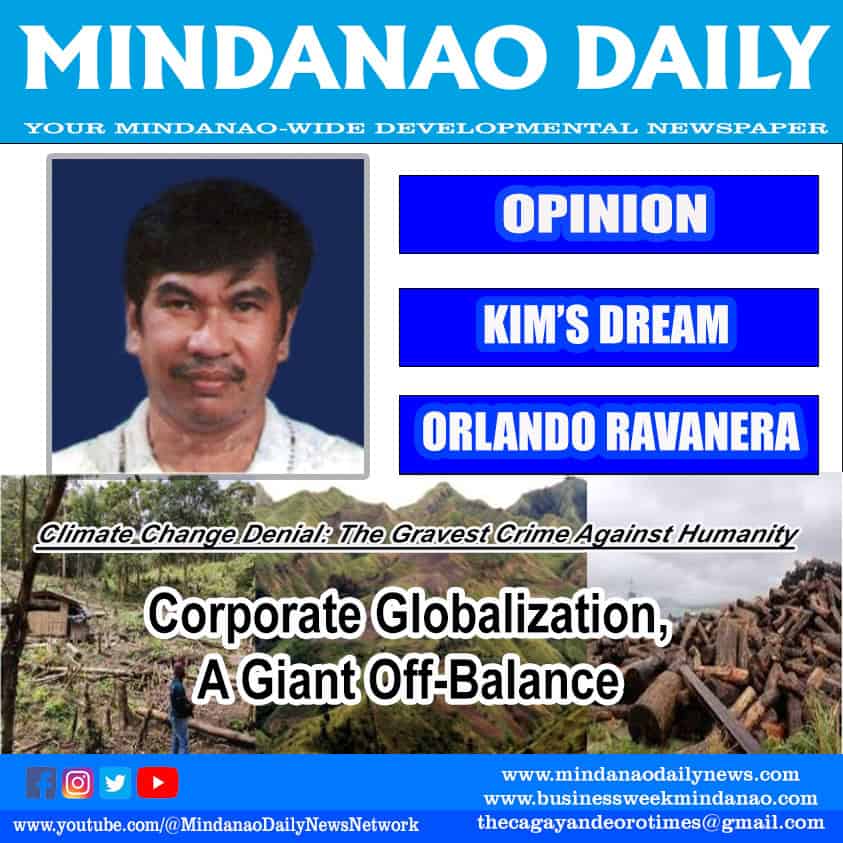
Climate Change Denial: The Gravest Crime Against Humanity
Kim’s Dream Orlan Ravanera
We are living at a decisive moment in human history. The crises we face today, climate collapse, mass extinction, widening inequality, forced displacement, and moral confusion, are not isolated tragedies. They are deeply interconnected consequences of a dominant economic model often called neo-liberal capitalism or corporate globalization. This model claims to promote growth, prosperity, and the common good. Yet when we examine its actual impact, we see something profoundly troubling: ecological devastation, extreme concentration of wealth, and a political culture increasingly shaped by denial and corruption. At its core, corporate globalization is built on the ideology of growth at all costs. It assumes that economies must constantly expand, that profit must perpetually increase, and that markets must be liberated from social and ecological limits. The system is driven by what many critics describe as the money-must-grow principle. In such a framework, forests become timber inventories, rivers become drainage systems for industrial waste, oceans become extraction zones, and communities become labor pools or consumer markets. Nature is reduced to a commodity. Human beings are reduced to economic units.
This paradigm has produced staggering inequality. Today, a tiny fraction of humanity controls a disproportionate share of global wealth, while billions struggle for food, water, housing, and security. The promise that wealth would trickle down to the poor has proven largely illusory. Instead, what we see is the consolidation of corporate power and the weakening of democratic institutions. Economic decisions that shape the lives of millions are increasingly made in corporate boardrooms rather than through genuine democratic participation.
Corporate globalization can be described as a giant off-balance. Like a runaway machine that cannot slow down without collapsing, it must continue expanding to survive. To maintain high returns, it must constantly extract more resources, exploit more labor, and stimulate more consumption. But in doing so, it destabilizes the very ecological systems that sustain life. Forests, the lungs of the planet, are cleared at alarming rates for logging, mining, and industrial agriculture. Rivers and bays are polluted by toxic runoff and plastic waste. Agricultural lands are degraded by chemical-intensive farming. Indigenous cultures are displaced in the name of development. The planet’s atmosphere is overloaded with greenhouse gases from fossil fuels that power industrial economies. Such an economy not only exploits the Earth; it also fuels militarization. Vast resources are devoted to military arsenals capable of destroying humanity many times over. Instead of investing in renewable energy, ecological restoration, and social protection, enormous wealth is funneled into systems of war and control. It is a tragic paradox: we claim to pursue development and security, yet we undermine the very foundations of life and peace.
The consumer culture promoted by this system deepens the crisis. Advertising industries continually manufacture desire, encouraging a throw-away mentality in which products are quickly discarded and replaced. Waste piles up in landfills and oceans. Meanwhile, the extraction of raw materials accelerates. This pattern is not sustainable. It survives only by stimulating endless consumption on a finite planet. One of the most alarming manifestations of this paradigm is climate change denial. Scientific consensus has long established that human activities, especially the burning of fossil fuels, are driving global warming. Yet powerful corporate interests, particularly in the fossil fuel industry, have funded campaigns to sow doubt, distort science, and delay climate action.
The consequences of delay are catastrophic. Climate change is no longer a distant threat; it is a lived reality. Intensified typhoons, prolonged droughts, heat waves, wildfires, and floods devastate communities around the world. Food security is threatened as crops fail. Water sources become contaminated. Diseases such as malaria and dengue spread more easily in warmer climates. The most vulnerable, especially in developing nations, bear the heaviest burden, even though they contributed least to the problem. Estimates from independent studies have linked hundreds of thousands of deaths each year to climate-related impacts, with projections rising if urgent action is not taken. When the health consequences of fossil fuel pollution, such as respiratory diseases and cardiovascular conditions, are included, the annual death toll climbs into the millions. These are not abstract statistics; they represent real human lives.
Philosopher Lawrence Torcello has argued that the systematic destruction of conditions necessary for human life constitutes a crime against humanity. If a government intentionally enacted policies designed to destroy cultural lands and displace entire populations, it would provoke international outrage and accusations of genocide. Climate inaction, when pursued despite clear scientific warnings, raises profound moral and legal questions. When leaders knowingly obstruct climate solutions to protect corporate interests, they endanger present and future generations.
The issue is not merely environmental; it is ethical. To deny climate science in the face of overwhelming evidence is not an innocent mistake. It becomes culpable ignorance when done to protect profits. It becomes corruption when political campaigns are financed by industries whose business models depend on continued fossil fuel extraction. It becomes a betrayal of public trust when media institutions amplify misinformation rather than the truth. Climate denial does not operate in isolation. It is sustained by what many observers call a “web of denial,” a network of think tanks, lobbying groups, public relations firms, and sympathetic political actors. Together, they construct narratives that minimize risk, attack scientists, and frame environmental regulation as an assault on economic freedom. Some strands of religious fundamentalism have also contributed to apathy, suggesting that environmental destruction is either divinely ordained or irrelevant in light of apocalyptic expectations. Such interpretations ignore the moral responsibility to care for creation and protect the vulnerable. They reduce faith to fatalism, discouraging meaningful action in the face of preventable suffering. This convergence of corporate interests, political power, and ideological distortion has profound consequences. It delays the transition to renewable energy. It weakens environmental regulations. It divides societies through fear and misinformation. And it erodes democracy itself.
Environmental thinker Vandana Shiva warns that corporate globalization undermines economic democracy. When corporations gain disproportionate influence over public policy, democratic institutions become hollow. Elections remain, but real power shifts to those who control capital. This concentration of economic power can foster authoritarian tendencies, religious extremism, and right-wing populism, as political leaders exploit fear and resentment to maintain control.
In such a context, democracy risks degenerating into what some describe as a democracy of death, a system in which exclusion, hate, and division are used to mobilize votes. At the same time, ecological collapse accelerates in the background. Economic dictatorship coexists with formal political structures, creating the illusion of freedom while narrowing genuine choices. We stand, metaphorically, close to midnight on the doomsday clock. The scientific warnings are clear. The moral stakes are immense. The question is whether humanity will continue defending an economic model that devours its own ecological foundation, or whether we will courageously transform it.
To awaken is to recognize that the climate crisis is not simply an environmental issue; it is a civilizational crisis. It challenges our assumptions about progress, wealth, and success. It calls us to redefine development not as endless consumption, but as the flourishing of life within planetary limits. True progress must prioritize ecological balance, social equity, and democratic participation. It must invest in renewable energy, regenerative agriculture, public health, and community resilience. It must protect Indigenous lands and honor traditional ecological knowledge. It must strengthen, not weaken, democratic institutions.
Above all, it must be grounded in moral clarity. The deliberate obstruction of climate action, when lives and ecosystems are at stake, is a grave injustice. Persisting in denial endangers humanity’s shared future. To confront the crisis with honesty and courage is to affirm life. The time for complacency has passed. The time for awakening has come. All for God’s greater glory.
###